CTX-UXO: In the field with EOD specialists to “teach” AI how to detect UneXploded Ordnance
Published in Computational Sciences

From the field to the lab
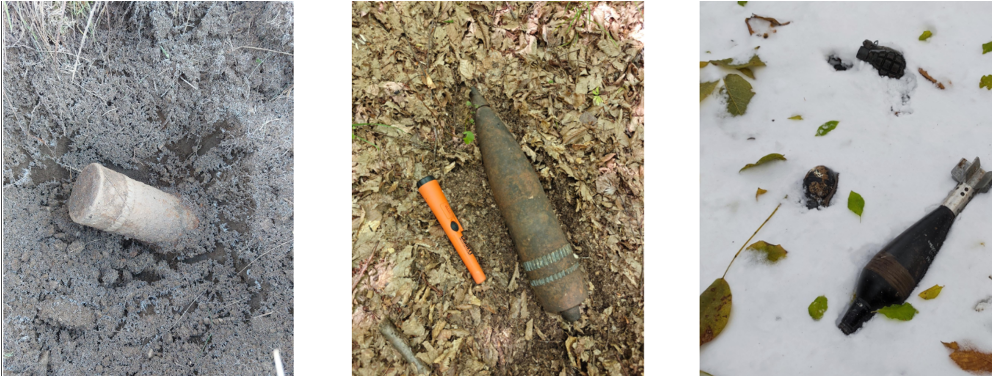
We knew that Eastern Europe had been heavily affected by unexploded ordnance (UXO) left behind by both World Wars, and by 2021, when we began this work, the global context had made the problem painfully timely. Our first attempts relied on symbolic logic to identify UXO types. Then we hit a wall at our very first real-world scenario: a World War II aviation bomb discovered in Romania. Two things made that bomb special. First, an agricultural tractor had struck it in the nose, right where we assumed the fuse to be. Second, it was a very rare bomb model. Some of our team had been trained in UXO handling, with formal courses behind them, yet had never encountered one (aviation bomb) in the field. In a moment like that, emotion can overwhelm you. We understood right then that we needed a new kind of support system, one that is impartial and can confirm UXO identification, even for rare types. We set out to use neural networks to support the detection and identification of these devices. But we quickly hit a fundamental roadblock: AI is only as good as the data it receives. Public repositories existed, but they contained mock-ups, weapons in perfect condition on white backgrounds, or technical drawings from training manuals. In reality, a bomb is often covered in mud, hidden in snow, or partially buried. That is how the need for Contextual Vision for Unexploded Ordnances (CTX-UXO) was born.
From the lab, straight to the trenches
To solve the lack of representative data, we had to leave the comfort of the laboratory. The CTX-UXO dataset was not downloaded from the internet; it was created through approximately four years of data collection on the ground. This was only possible through a close collaboration with pyrotechnical personnel from the National Romanian Inspectorate for Emergency Situations. We photographed grenades, projectiles, and mortar bombs exactly as they were found in the field: in camouflaged environments, in forests, or semi-buried in the soil. For obvious safety reasons, when explosive charges were present, operators only approached to capture detailed views when conditions permitted. The data acquisition process was lengthy, spanning four years. We intend to expand the dataset over time, both in terms of the associated descriptors and its overall size.
Research challenges and successes
One of the most unexpected challenges was the responsibility of protecting human lives not just through AI, but through data security. We realized that publishing a dataset of real field images comes with a risk: GPS metadata. To comply with a zero-risk policy regarding the disclosure of intervention site locations (preventing civilians from seeking out these dangerous areas), we implemented a rigorous sanitization process, completely removing EXIF metadata (including temporal acquisition timestamps and geographic coordinates) from every single image.
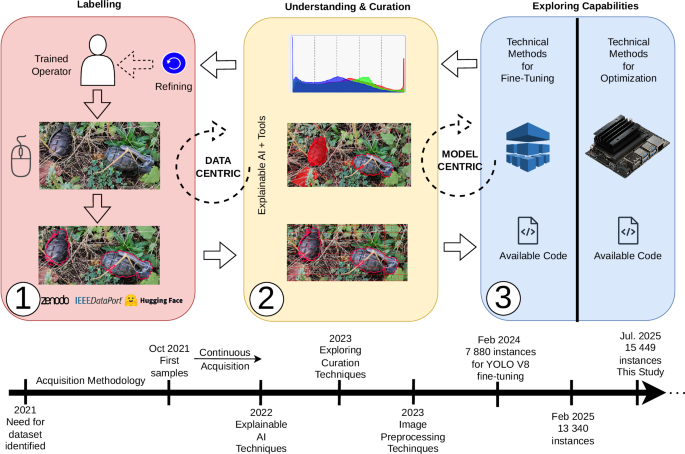
On the technical side, we had an "AHA!" moment when we observed how our AI models were making mistakes. Because munitions are often very well camouflaged (either intentionally for military purposes or due to the passage of time) small neural networks tended to learn background features instead of identifying the actual weapon. By using Explainable AI techniques we could see exactly why the classification task failed in specific cases. The most common solution was to apply a "copy-paste on new backgrounds" augmentation technique, effectively forcing the model to focus strictly on the features of the bomb.
Implications for future research
Our work does not stop with publishing this dataset. We see CTX-UXO as a strong baseline upon which the global scientific community can build. The implications are direct: we envision a near future where these real-time detection models are widely deployed on unmanned ground vehicles (UGVs) and aerial vehicles (UAVs). By delegating visual recognition to robots equipped with these AI models, we hope to drastically reduce the risks faced daily by pyrotechnists, and local communities in post-conflict regions.
We hope our work demonstrates that AI has a profoundly humanitarian calling when backed by correct, hard-earned, and responsibly managed data.
When we think of artificial intelligence, we usually picture virtual assistants, agentic AI, or the classic textbook question: "Is there a dog or a cat in this image?". For a significant part of the world's population, this technology can do something far more literal: it can preserve a sense of normality and everyday safety.

Follow the Topic
-
Scientific Data
A peer-reviewed, open-access journal for descriptions of datasets, and research that advances the sharing and reuse of scientific data.

Related Collections
With Collections, you can get published faster and increase your visibility.
10 years of the FAIR principles
Publishing Model: Open Access
Deadline: Nov 14, 2026
Data to support cancer treatment, diagnosis, and disease understanding
Publishing Model: Open Access
Deadline: Jan 02, 2027