Cultural Intelligence in Action: Strengthening Psychological Capital in Multicultural Hospitality Service
Published in Behavioural Sciences & Psychology




“Knowing is not enough; we must apply. Willing is not enough; we must do.”
— Johann Wolfgang von Goethe
Multicultural interactions are now an everyday reality in the global hospitality industry, where frontline employees engage with guests from diverse cultural backgrounds, each bringing different expectations, communication styles, and service norms that shape the service encounter (Earley & Ang, 2003; Jiony et al., 2021). Our recent study examines how cultural intelligence (CQ) contributes to psychological capital (PsyCap) among hotel frontline employees in Kota Kinabalu, Sabah, Malaysia. The findings suggest modest yet meaningful effects, highlighting the importance of motivational and behavioral cultural intelligence in strengthening psychological capital—confidence, hope, resilience, and optimism—in multicultural hospitality interactions.
This study builds on the broader journey of my PhD research examining the interplay between cultural intelligence, psychological capital and service quality in multicultural service environments. Data collection took place while hotels were still recovering from the COVID-19 pandemic, and managers were understandably cautious about allowing external research activities. In many ways, the pandemic context made the research even more relevant, as frontline staff increasingly need to engage with guests while remaining cautious and adaptable, drawing on psychological resources such as confidence, resilience, optimism, and hope. Much of my research, including work developed during my PhD, sits at the intersection of intercultural communication, management, organizational culture and behavior, and positive organizational psychology. It examines how individuals draw on their personal capacities to navigate interactions and shape work practices in multicultural environments—often unfolding in fleeting moments of intercultural interaction. In this context, working alongside fellow researchers who share similar interests and values, we continue to explore how capabilities such as cultural intelligence and psychological capital shape the ways frontline employees interpret and manage diverse service encounters.
Why Cultural Intelligence Matters in Hospitality Service
Cultural intelligence has emerged as a key capability in multicultural workplaces (Ang & Van Dyne, 2015). Within hospitality environments, it allows employees to interact effectively with guests from different cultural backgrounds while maintaining service quality and professionalism.
Cultural intelligence is typically understood as comprising four dimensions (Ang et al., 2007):
-
Metacognitive CQ – awareness and reflection during cultural interactions
-
Cognitive CQ – knowledge about cultural norms and practices
-
Motivational CQ – the willingness to engage with cultural diversity
-
Behavioral CQ – the ability to adapt communication and actions during interactions
Together, these dimensions shape how individuals interpret and respond to cultural differences. However, frontline hospitality environments are dynamic and time-pressured, where employees must often respond to culturally diverse guests quickly and intuitively.
This raises an important question:
Which aspects of cultural intelligence actually strengthen the psychological resources that employees rely on in multicultural service encounters?
Observations from the Frontline
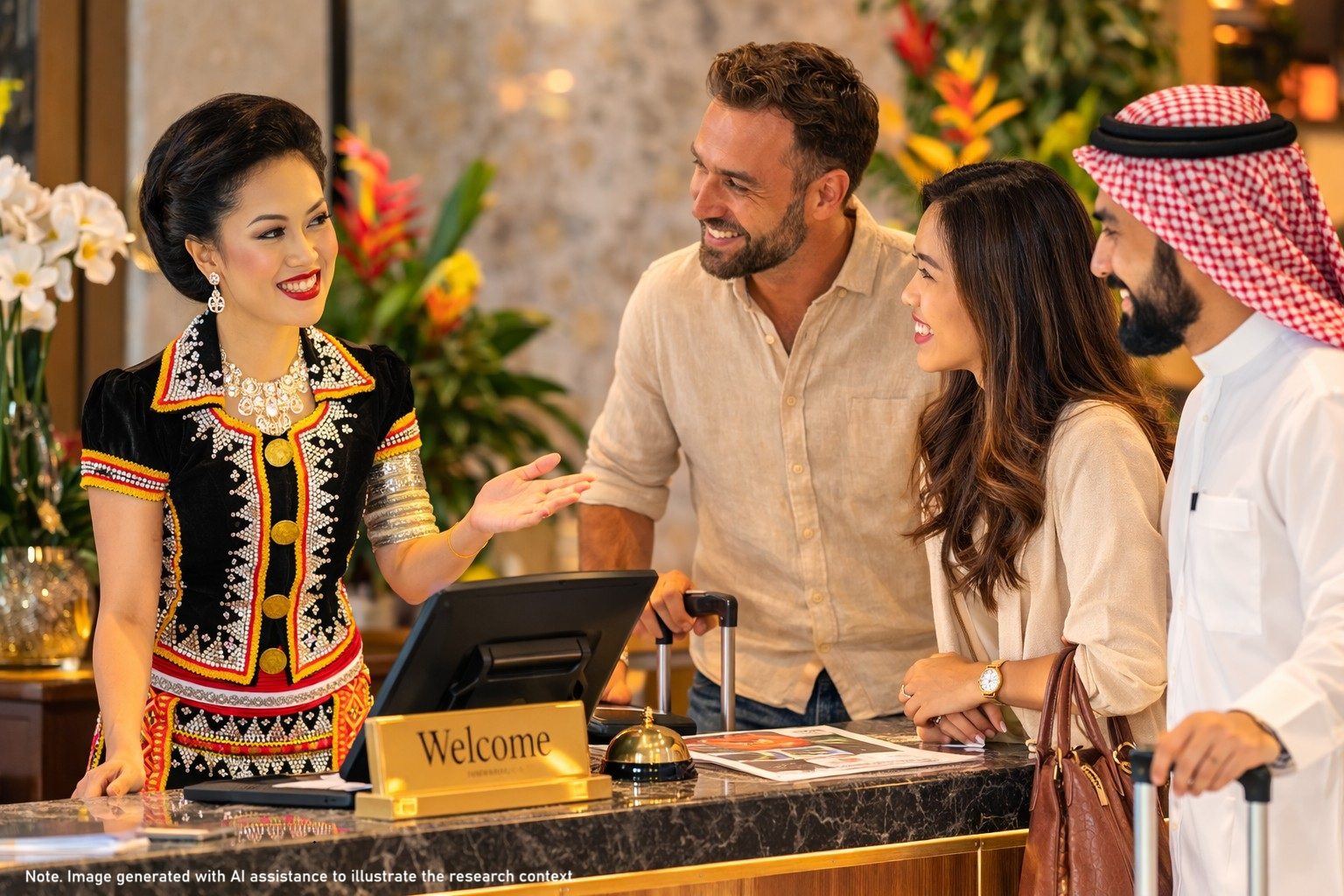
The motivation for this research emerged from observations in hospitality environments where employees regularly interact with culturally diverse guests. Based on interviews and interactions with frontline employees, we found that despite receiving training in service standards and cross-cultural communication, employees sometimes experience uncertainty or stress when navigating culturally sensitive interactions. Conventional explanations often attribute these challenges to insufficient training or limited cultural knowledge; however, our observations suggested that the issue extends beyond knowledge alone. Even when employees understand cultural norms, they may still face uncertainty in real-time service encounters. This led to an important insight: what matters most may not simply be what employees know about cultures, but how they engage with and respond to cultural differences in real time.
How Does the Action-Oriented Cultural Intelligence Perspective Explain These Challenges?
Our study therefore advances what we describe as an Action-Oriented Cultural Intelligence perspective, which emphasizes the role of motivational and behavioral cultural intelligence in strengthening psychological capital.
Drawing on survey data from frontline hotel employees in Kota Kinabalu, Malaysia, this study provides a context-specific examination of multicultural hospitality service encounters. The results reveal a clear pattern: while metacognitive and cognitive cultural intelligence contribute to intercultural awareness and knowledge, motivational and behavioral cultural intelligence play a more practical role in frontline service interactions. In practice, employees who actively engage with culturally diverse guests and adapt their communication and behavior during service encounters tend to demonstrate stronger psychological resources.
Through What Mechanism Does Cultural Intelligence Strengthen Psychological Capital?
From our analysis, a simple but meaningful mechanism emerged. When frontline employees actively engage with culturally unfamiliar situations and adapt their responses during service interactions, they strengthen their psychological capital—strengthening psychological resources such as confidence, resilience, optimism, and hope (Luthans, Youssef-Morgan, & Avolio, 2015). In turn, these psychological resources support more effective service encounters, better guest experiences, and stronger organizational outcomes. In this sense, cultural intelligence is not merely a cognitive capability but a practical behavioral resource that unfolds in the everyday, often fleeting moments of multicultural service interactions.
What This Means for Hospitality Organizations?
The Action-Oriented Cultural Intelligence perspective emerging from this study offers several practical implications for hospitality organizations. The findings suggest that cross-cultural training programs should move beyond an emphasis on knowledge acquisition toward stronger behavioral engagement. While understanding cultural norms remains important, it is equally critical to develop employees’ motivation to interact across cultures and their ability to adapt their behavior during real service encounters—often unfolding in fleeting yet consequential moments of interaction with guests.
Experiential learning approaches—such as role-playing exercises, service simulations, and coaching—can help employees develop culturally adaptive behaviors in realistic service scenarios. Equally important is recognizing and reinforcing frontline staff who demonstrate culturally responsive service behaviors, as such practices can further strengthen psychological capital within service teams.
This research also highlights the value of embedding cultural intelligence and psychological capital into broader human resource practices, including recruitment, onboarding, and employee development programs. Integrating these capabilities across the employee lifecycle can help organizations cultivate a workforce that is better prepared to navigate multicultural service environments with confidence and adaptability.
Why Does Psychological Capital Matter in Multicultural Hospitality Service?
As global travel continues to expand, hospitality organizations increasingly operate in culturally diverse service environments. Hospitality remains an inherently sensitive industry, where frontline employees must navigate interactions carefully, as even brief—often fleeting—service encounters can significantly influence guest perceptions, satisfaction, and overall service experiences. From both our observations in the industry and our research findings, it is clear that managing these environments requires more than operational efficiency; it requires employees who are psychologically equipped to handle complex interpersonal interactions. Strengthening psychological capital through action-oriented cultural intelligence may therefore contribute to more resilient employees, more adaptive service interactions, and more sustainable hospitality operations.
In multicultural hospitality settings, the ability of frontline employees to engage confidently and adaptively in brief service encounters may be just as important as operational efficiency.
Where Should Research and Practice Go Next?
There are no easy answers to the complexities of multicultural hospitality service. This research, however, invites us to ask and reflect on more meaningful questions. Instead of focusing solely on whether employees have received cross-cultural training, we might ask whether such training truly prepares frontline staff for the brief yet impactful encounters that define hospitality work.
In destinations such as Kota Kinabalu—a melting pot of local cultures and international visitors, important questions naturally arise:
- How can hospitality establishments better support frontline employees psychologically as they navigate multicultural service encounters?
- How can training help cultivate motivation, adaptability, and resilience among frontline staff?
- How might leadership practices and organizational culture reinforce these capabilities in everyday service interactions?
Future research could explore:
- How cultural intelligence and psychological capital develop over time within hospitality organizations.
- How leadership, workplace culture, and training design shape employees’ intercultural capabilities.
- How experiential learning, digital tools, or simulation-based training may strengthen intercultural adaptability and frontline service performance.
By asking these deeper questions, we move closer to understanding how cultural intelligence can become a practical strength in the many fleeting moments of intercultural interaction—moments in which frontline employees draw on psychological capital—confidence, resilience, optimism, and hope—to create meaningful hospitality experiences for guests.
Selected references are provided below for readers interested in exploring the topic further.
References
Ang, S., & Van Dyne, L. (2015). Handbook of cultural intelligence. Routledge. https://doi.org/10.4324/9781315703855
Ang, S., Van Dyne, L., Koh, C., Ng, K. Y., Templer, K., Tay, C., & Chandrasekar, N. (2007). Cultural intelligence: Its measurement and effects on cultural judgment and decision making, cultural adaptation and task performance. Management and Organization Review, 3(3), 335–371. https://doi.org/10.1111/j.1740-8784.2007.00082.x
Earley, P. C., & Ang, S. (2003). Cultural intelligence: Individual interactions across cultures. Stanford University Press.
Jiony, M. M., Lew, T. Y., Gom, D., Tanakinjal, G. H., & Sondoh, S., Jr. (2021). Influence of cultural intelligence and psychological capital on service quality: A study of the hotel industry in Sabah, Malaysia. Sustainability, 13(19), 10809. https://doi.org/10.3390/su131910809
Luthans, F., Youssef-Morgan, C. M., & Avolio, B. J. (2015). Psychological capital and beyond. Oxford University Press.
Original Article
The full research article can be accessed at:
https://doi.org/10.1007/s12144-026-09081-x
Related Studies in This Research Stream
https://doi.org/10.3390/su131910809
https://doi.org/10.3390/su131910799

Follow the Topic
-
Current Psychology

This is a journal for dissemination of peer-reviewed research on diverse psychological issues.
Related Collections
With Collections, you can get published faster and increase your visibility.
High Sensitivity Through the Lens of Context - Challenges and Potential
Collection Title: “High Sensitivity Through the Lens of Context - Challenges and Potential”
Guest Editor: Dr. Alon Goldberg, Tel-Hai College, Department of Education, Upper Galilee 12210 Israel. https://orcid.org/0000-0002-3267-1947
Contact: alongol@telhai.ac.il
And
Dr. Mona Vintila, West University of Timişoara, mona.vintila@e-uvt.ro
Overview and Rationale
Highly sensitive personality (HSP) is a temperamental trait characterized by deep cognitive processing of sensory and emotional information, heightened emotional reactivity, and increased sensitivity to environmental subtleties. While high sensitivity has long been framed predominantly through a vulnerability lens, recent research suggests it may also confer adaptive advantages in certain contexts.
This collection would seek to broaden the scientific exploration of HSP by encouraging research that addresses both its challenges and adaptive potential across diverse contexts and by inviting empirical, theoretical, and conceptual contributions that reflect the full range of HSP-related outcomes. This includes studies that examine environmental mismatches resulting in distress or dysfunction, as well as investigations into creative adaptation, resilience, growth, and flourishing in supportive settings.
Aim of the Collections
The aim of the Collections would be to expand the focus on high sensitivity in psychology by exploring the dynamic interplay between the trait and environmental, social, cultural, and psychological contexts. We would particularly welcome contributions that adopt a contextualized lens, whether the outcomes are positive, negative, or complex. Our objective would be not to exclude studies that emphasize vulnerability but to broaden the scientific discourse to include variability in experiences and outcomes.
Scope and Topics
We would encourage a wide range of submissions from different psychological subfields, including but not limited to:
•Developmental psychology
•Individual differences and personality research
•Clinical and counseling psychology
•Educational psychology (e.g., how highly sensitive students respond to classroom demands, teacher-student dynamics or sensory stimulation in learning environments)
•Occupational and organizational psychology (e.g., how highly sensitive individuals experience workplace demands, leadership styles, sensory overstimulation, or derive meaning and satisfaction in various occupational contexts)
•Cognitive psychology - deep processing, attentional sensitivity, and adaptive decision-making in contextually supportive conditions
•Socioemotional psychology - emotion regulation, positive emotionality, and prosocial behavior of those with HSP
•Health psychology (e.g., association between HSP and health issues and onset of disease)
•Neuroscience and genetics
•Evolutionary psychology (e.g., theoretical frameworks examining HSP as an adaptive survival strategy)
•Cultural psychology - cultural perceptions and expressions of high sensitivity, sensitivity in diverse sociocultural contexts and settings
Key Themes May Include:
•The interaction of HSP with supportive vs. non-supportive environments
•Adaptive and maladaptive responses to context among highly sensitive individuals
•The role of creativity, imagination, or environmental shaping as coping mechanisms
•Longitudinal trajectories and developmental factors influencing HSP
•Context-sensitive interventions and clinical applications
•Sociocultural or policy implications for educational, occupational, or therapeutic environments
Clarification on Inclusion Criteria
This collection would welcome studies that report on both strengths and vulnerabilities associated with high sensitivity. Manuscripts that address adverse outcomes, particularly when contexts are not aligned with the needs of highly sensitive individuals, would be, not only welcome, but considered essential to the goal of understanding variability. We also would like to invite theoretical or empirical work on mechanisms, including stress reactivity, differential susceptibility, biological sensitivity to context, and gene-environment interactions.
Article Types and Methodologies
We would be open to a variety of article types, including empirical research (quantitative, qualitative, or mixed methods), meta-analyses, systematic reviews, theoretical papers, and innovative methodological approaches. We also would encourage cross-disciplinary collaborations and perspectives that integrate multiple levels of analysis (e.g., biological, psychological, contextual). Submission deadline for full manuscripts Sep. 1, 2026
Publishing Model: Hybrid
Deadline: Sep 01, 2026

Please sign in or register for FREE
If you are a registered user on Research Communities by Springer Nature, please sign in