Decoding Hydrogen‑Bond Network of Electrolyte for Cryogenic Durable Aqueous Zinc‑Ion Batteries
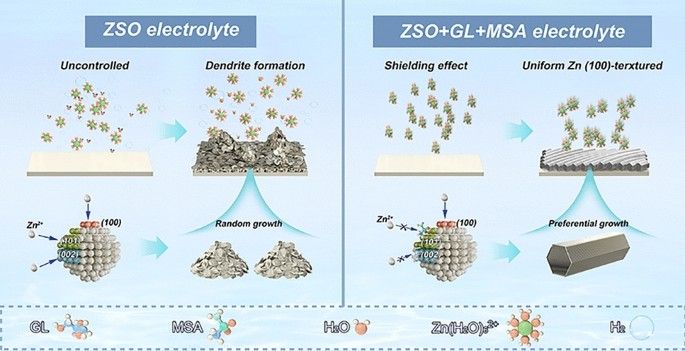

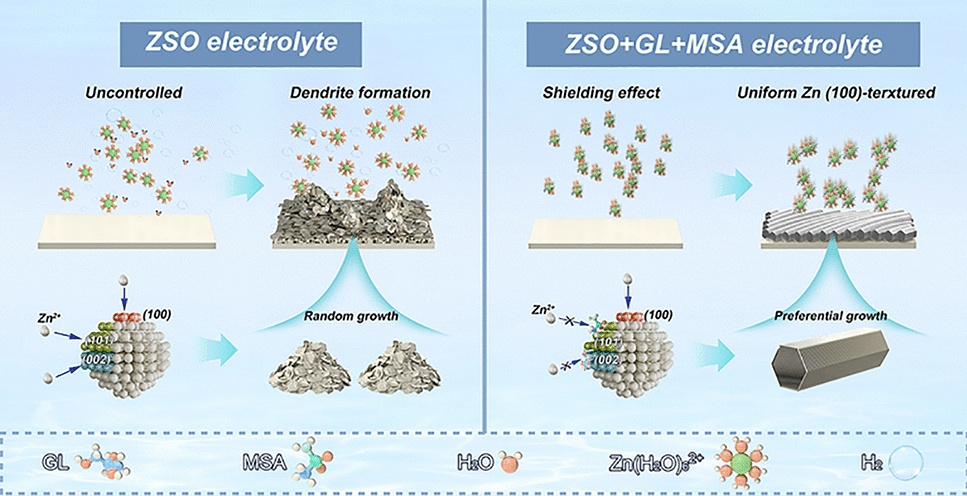

As renewable energy storage expands into polar and high-altitude regions, conventional aqueous zinc-ion batteries (AZIBs) face a triple threat: dendrite growth, hydrogen-evolution corrosion, and electrolyte freezing below –20 °C. Now researchers from Southern University of Science and Technology, Soochow University and Guilin University of Technology—led by Prof. Lin Zeng, Prof. Yongbiao Mu and Prof. Jingyu Sun—report a dual-additive electrolyte that re-wires the hydrogen-bond network, guides (100)-oriented zinc deposition, and delivers record lifespan from room temperature down to –40 °C. The work provides a universal recipe for cryogenic-tolerant, high-rate AZIBs deployable in extreme climates.
Why Hydrogen-Bond Reconstruction Matters
- Anti-Freeze & Anti-Dendrite: Glycerol (GL) and methylsulfonamide (MSA) raise configurational entropy, suppress ice nucleation and lower freezing point to –45 °C while blocking water access to the Zn surface.
- (100)-Textured Anode: Cooperative adsorption of GL on Zn(101) and MSA on Zn(002) channels growth along the highly active Zn(100) plane, cutting activation energy for stripping by 50 %.
- Entropy-Driven Kinetics: Elevated disorder offsets viscosity penalty, enabling 40 mA cm-2 reversible plating and 5 A g-1 cathode rates without concentration polarization.
Innovative Design & Features
- Dual-Additive Synergy: 50 vol % GL disrupts the H-bond lattice; 1 M MSA tunes solvation shell from 5.7 to 4.2 coordinated H2O per Zn2+, suppressing HER and forming a 7–10 nm SEI rich in ZnCO3 and ZnS.
- In-Situ Spectroscopy & MD: ATR-FTIR, Raman and NMR capture blue-shifted O–H modes; MD simulations reveal Cl- enrichment near GL and Li+ clustering along PEI chains, validating lane-separated ion transport.
- Cryo-Electrochemistry: Symmetric cells run 5400 h at –20 °C (0.5 mA cm-2, 0.5 mAh cm-2) and 600 h at 40 mA cm-2(30 °C), while full cells retain 85 % capacity after 2 000 cycles at –20 °C.
Applications & Future Outlook
- Grid Storage in Cold Climates: pouch cells (300 μL electrolyte) deliver 78 % capacity retention after 600 cycles at 1 A g-1, proving scalability for alpine micro-grids and polar base stations.
- Fast-Charging Devices: critical current density rises to 60 mA cm-2 at 30 °C and 25 mA cm-2 at –20 °C, unlocking 10-min charge capability for portable electronics and e-bikes.
- Electrolyte Platform: the entropy-boosted, H-bond-engineered concept is compatible with existing ZnSO4supply chains; next steps include antifouling polymers for natural brine and fire-retardant variants for aerospace.
This comprehensive study demonstrates that entropy-mediated hydrogen-bond reconstruction can simultaneously defeat dendrites, hydrogen evolution and electrolyte freezing, pushing aqueous zinc batteries into the cryogenic frontier. Stay tuned for more sub-zero breakthroughs from Prof. Lin Zeng, Prof. Yongbiao Mu and Prof. Jingyu Sun and their teams!

Editor of Nano-Micro Letters, which is an Open-Access, peer-reviewed journal reported papers that have at least one dimension ranging from a few sub-nanometers to a few hundreds of micrometers. The journal is published by Springer Nature and indexed by SCI, EI, SCOPUS, Pubmed, etc. The 2025 JCR Impact Factor is 38.5. The 2025 CiteScore is 58.9.
Follow the Topic
-
Nano-Micro Letters
Nano-Micro Letters is a peer-reviewed, international, interdisciplinary and open-access journal that focus on science, experiments, engineering, technologies and applications of nano- or microscale structure and system in physics, chemistry, biology, material science, and pharmacy.