Potato starch extraction: Techniques, challenges, and future opportunities
Published in Agricultural & Food Science

Explore the Research

Potato starch extraction: Techniques, challenges, and future opportunities
Potato starch extraction: Techniques, challenges, and future opportunities
From the Field to the Flask: My Journey into Potato Starch Extraction Research
Potatoes are everywhere. They sit quietly in our kitchens, appear in comfort food across cultures, and are often taken for granted. Yet, for me as a researcher, potatoes became something far more meaningful: an entry point into understanding how simple agricultural materials can drive innovation in food, pharmaceutical, and sustainable materials research. My journey into potato starch extraction did not begin with sophisticated instruments or large-scale facilities—it started with curiosity, trial-and-error experiments, and an appreciation for how much potential lies in everyday raw materials.
Why Potato Starch?
My interest in potato starch extraction grew during my early research work, when I began exploring natural polymers and their industrial relevance. Starch, in particular, fascinated me. It is renewable, biodegradable, inexpensive, and remarkably versatile. Potato starch stood out because of its high purity, large granule size, and excellent functional properties, making it valuable for applications ranging from food thickening to tablet formulation and even bioplastics.
What struck me most was how a single extraction process could influence so many downstream applications. A slight variation in processing conditions could change the starch’s viscosity, swelling power, or suitability for pharmaceutical use. That realization pushed me to look beyond “how” starch is extracted and focus on “why” extraction methods matter.
Traditional Techniques: Learning from the Basics
My first encounters with potato starch extraction relied on traditional wet grinding and compression methods. These techniques are widely used, especially in regions where resources and advanced equipment are limited. On paper, they appear straightforward: crush the potato, wash away fibers and proteins, and collect the starch.
In practice, however, these methods taught me valuable lessons about inconsistency. Small changes in raw material quality, washing steps, or drying conditions could significantly affect starch yield and purity. I remember long days in the lab troubleshooting why two batches processed the same way produced different results. Those frustrations shaped my understanding of why quality control is not an optional step but a foundation of reliable starch production.
Modern Approaches: When Technology Meets Sustainability
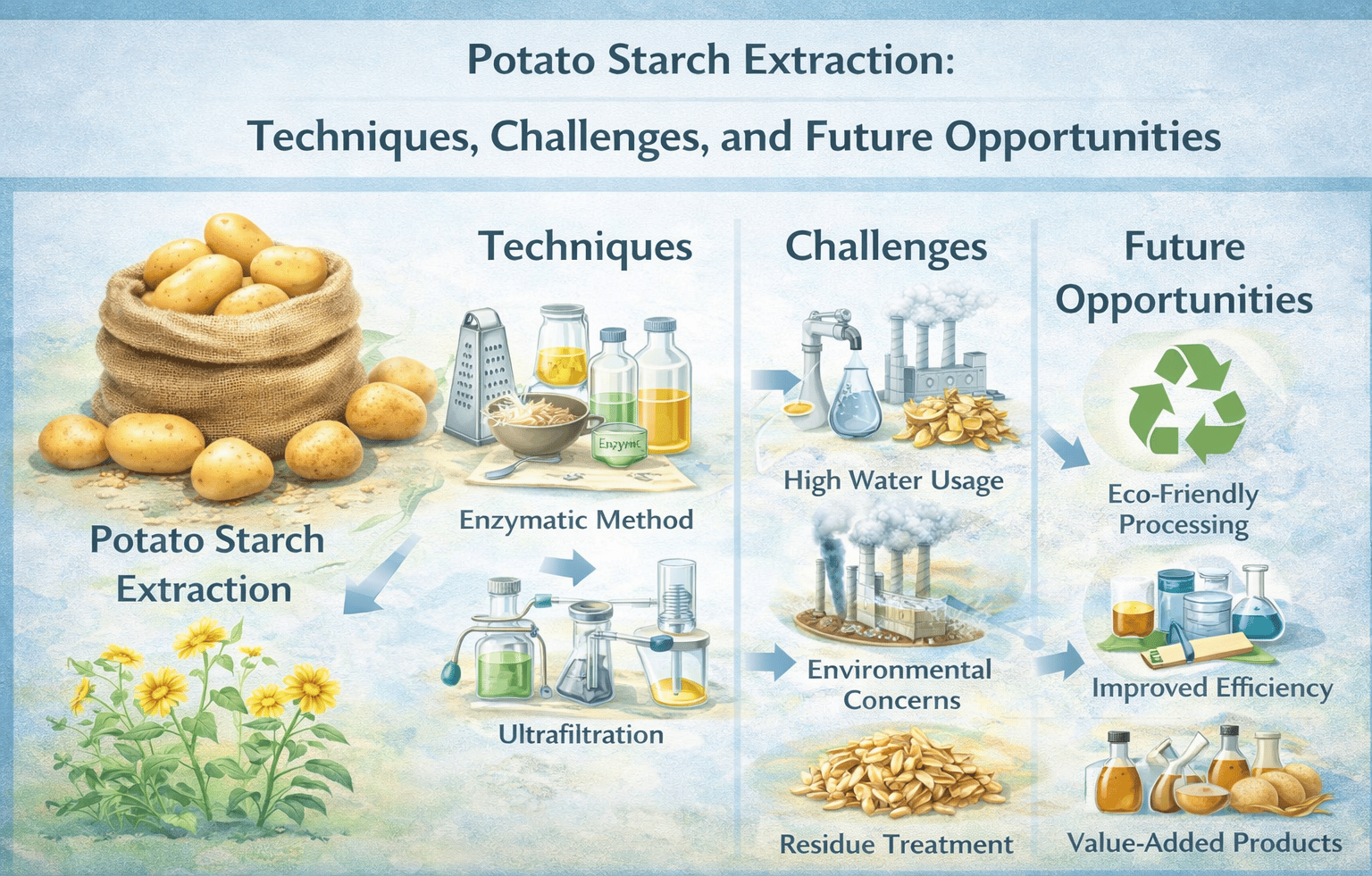
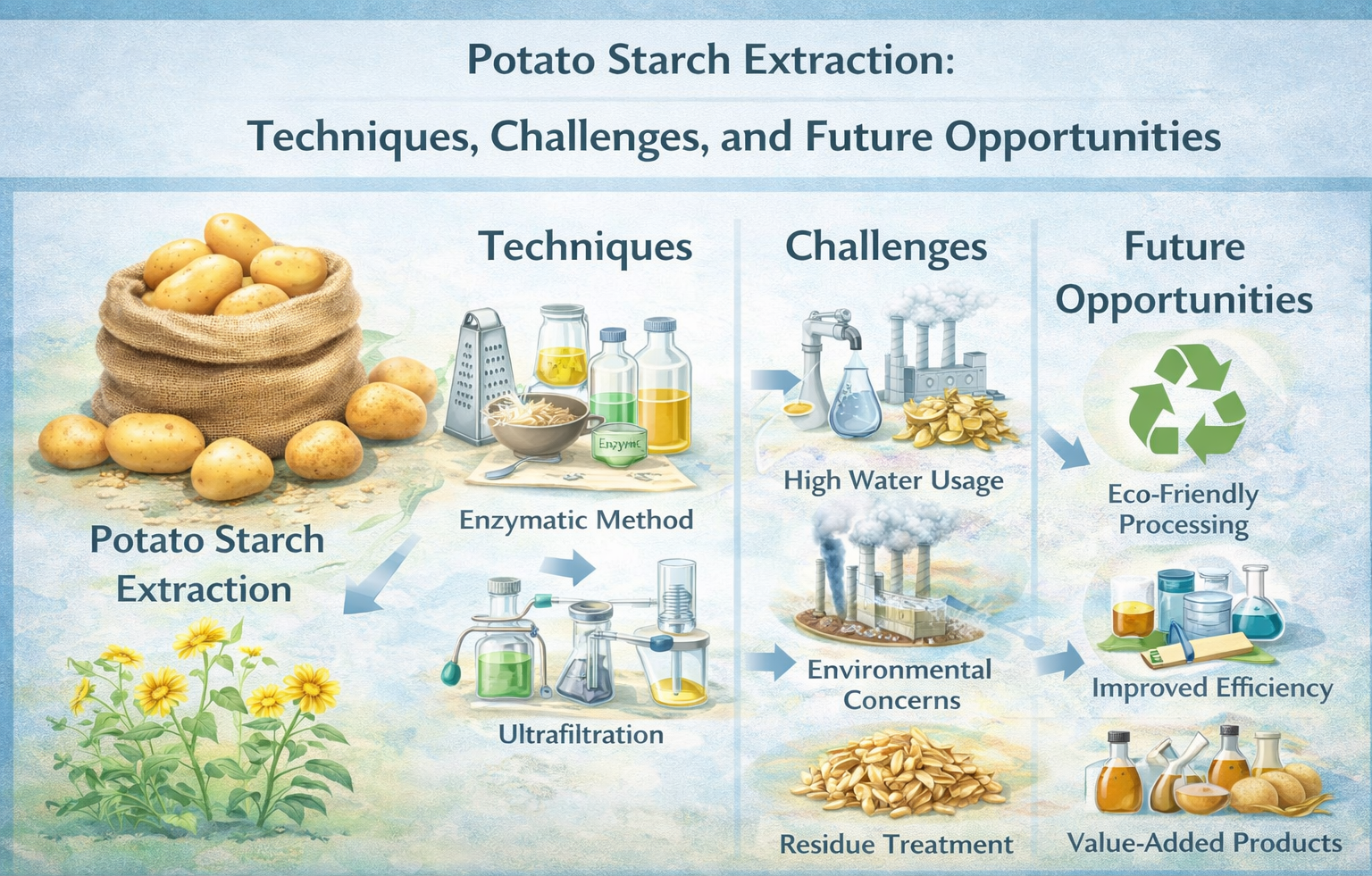
As my research progressed, I became increasingly interested in modern extraction techniques. Enzymatic methods, ultrasonic treatment, and microwave-assisted extraction opened new possibilities for improving yield while reducing processing time and energy use. These methods also aligned with a broader shift in research toward sustainability.
One of the most exciting aspects of this phase was seeing how “green” approaches—such as enzyme-assisted extraction or reduced chemical usage—could maintain starch quality while lowering environmental impact. It was a powerful reminder that innovation does not always mean complexity; sometimes it means refining processes to be cleaner, safer, and more efficient.
The Hidden Importance of Quality Control
One of the most overlooked aspects of starch extraction, especially outside industrial settings, is quality control. Through my work, I learned that starch purity is not just a technical concern—it directly affects safety, functionality, and regulatory acceptance.
Monitoring raw material quality, controlling processing parameters, and testing starch composition became central to my research mindset. Whether the starch was intended for food, pharmaceutical, or biodegradable material use, consistency was key. These experiences reinforced my belief that rigorous quality control bridges the gap between laboratory research and real-world application.
Challenges That Shaped My Perspective
No research journey is complete without challenges. For potato starch extraction, issues such as microbial contamination, water consumption, waste generation, and variability in potato cultivars consistently surfaced. At times, these challenges felt discouraging, especially when experiments failed despite careful planning.
However, they also pushed me to think more critically. Could waste streams be reused? Could extraction residues be valorized? Could processing be optimized to reduce water use? These questions gradually shifted my thinking from extraction alone to a broader “waste-to-value” and sustainability framework—an approach that now shapes much of my research philosophy.
Looking Ahead: Future Opportunities
What excites me most today is the future of potato starch extraction. Emerging trends such as clean-label ingredients, biotechnological modifications, and nano-scale starch applications are redefining how we view this natural polymer. Consumers increasingly want minimally processed, transparent ingredients, and starch producers must adapt accordingly.
From a research perspective, this means integrating advanced technologies with practical, scalable solutions. I believe that interdisciplinary collaboration—between food scientists, pharmacologists, biotechnologists, and environmental scientists—will be essential to unlocking the full potential of potato starch.
Reflections from a Researcher’s Life
Working on potato starch extraction has taught me more than technical skills. It has taught me patience, adaptability, and the value of persistence. It reminded me that impactful research often begins with ordinary materials and simple questions. Most importantly, it reinforced why I chose a research career: to transform familiar resources into meaningful solutions for industry and society.
I hope that by sharing my journey, fellow researchers—especially early-career scientists—can see that even modest topics can lead to significant scientific and personal growth. Sometimes, the most valuable discoveries are hidden in plain sight, waiting for us to look a little closer.

Salman Ahmed (ORCID: 0000-0003-2033-0181) holds a B.Pharm. degree from the University of Karachi, Pakistan, and a PhD and M.Phil. in Pharmacognosy from the same institution. He has gained valuable experience in the pharmaceutical industry, having worked at Helix Pharma, Pharm Evo (Pvt.) Ltd., and Searle Pakistan Ltd. Currently, he holds the position of Assistant Professor in the Department of Pharmacognosy at the Faculty of Pharmacy, University of Karachi, Pakistan.
Salman Ahmed has made significant contributions to the field with a decade-long career dedicated to teaching Pharmacognosy, also known as Natural Products Sciences. He has authored 125 research papers with an impact factor of 100 with 2297 citations, a h-index of 24, and an i10-index of 59. He has secured multiple research grants in Pharmacognosy (2021, 2018, 2016, and 2014) to study plants traditionally used for analgesic, anti-inflammatory, diuretic, and antidiarrheal purposes and their effects on digestive enzymes. Additionally, he has authored seven books and presented 16 posters at national and international conferences. Salman Ahmed's expertise is acknowledged by various esteemed journals published by Elsevier, Springer Nature, Wiley, MDPI, Hindawi, and Dove Medical Press Limited, as he serves as an invited reviewer for these publishers.
Scientific Achievements (2011–2015): He pioneered a cost-effective copper sulfate-induced chick emesis model for evaluating natural antiemetics. His research explores antiemetic, analgesic, and anti-inflammatory properties in Pakistani plants, herbs, and spices, reporting fixed oil's analgesic effects and discovering Bergenin as an antiemetic. He authored two state-of-the-art reviews on natural antiemetics, "Antiemetic effects of bioactive natural products" and "Natural antiemetics- an overview". He was awarded Nishan-e-Zafar by the University of Karachi in 2014.
Scientific Achievements (2016–2024): Dr Salman Ahmed pioneered glass slide models to grow Whewellite, Brushite, and Urate crystals for the evaluation of antiurolithiatic and anti-gout drugs, presenting key findings at international conferences such as MMDR-7, STEP-5, ISNPC-14, and ISNPF-2. His book “How to Grow Urinary Stone and Gouty Crystals on Glass Slide” provides detailed methodologies for replicating crystal growth in vitro and discusses the implications for understanding crystal morphologies, disease mechanisms and developing herbal treatment strategies.
Dr Ahmed's research highlights the antiurolithiatic potential of pentacyclic triterpenes and polyphenols. These compounds inhibit calcium oxalate crystallization, reduce oxidative stress, and modulate inflammation. They also promote nephroprotection, diuresis, and ACE inhibition, advancing natural therapeutics for kidney stone prevention.
His contributions include “Glossary of Globally Used Herbs and Animals for Urolithiasis” (2024), a comprehensive book exploring medicinal plants covering botanical families from A to Z and animal-based remedies covering their historical use, mechanism of action, and therapeutic spectrum against Whewellite, Brushite, and Urate crystals separately. His research on antiurolithiatic formulations compiles mono- and polyherbal remedies from diverse regions, including Appalachia, Canada, India, and the Middle East. His work provides critical data for future phytochemical, pharmacological, and toxicological studies, aiding in the discovery of safer, more effective treatments for kidney stones.
Additionally, he explores the anticancer potential of marine peptides against breast, ovarian, cervical, malignant melanoma, prostate, neuroblastoma, glioblastoma, leukemia and lymphoma, advancing natural therapeutics for cancer treatment.