What everyday home cooking taught us about household food waste
Published in Healthcare & Nursing, Social Sciences, and Sustainability
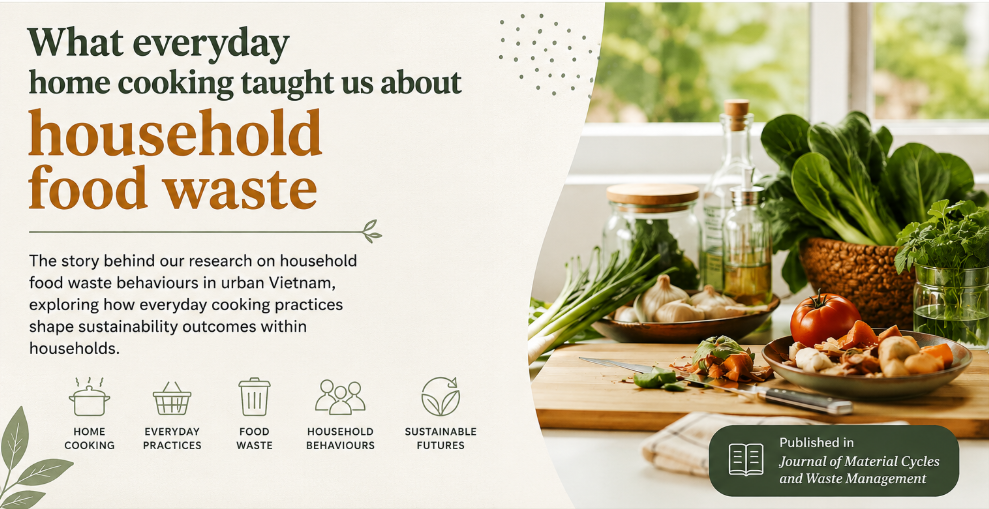



Discussions about food waste often focus on disposal, recycling, or waste management systems. However, during my PhD journey, I became increasingly interested in what happens much earlier in the home cooking process planning meals, purchasing ingredients, storing food, cooking, managing leftovers, and navigating everyday household routines.
As someone who began my PhD while also being a full-time homemaker with two young children, I became interested in how sustainability is lived within ordinary household kitchens. Over time, this curiosity evolved into a broader research question: how do everyday home cooking practices shape household food waste behaviours?
This interest eventually led to our recently published paper in the :
Phan, T. X. D., Zeng, D., & Zuo, A. (2026).
Towards sustainable food consumption: understanding household food waste drivers for improved waste management in urban Vietnam.
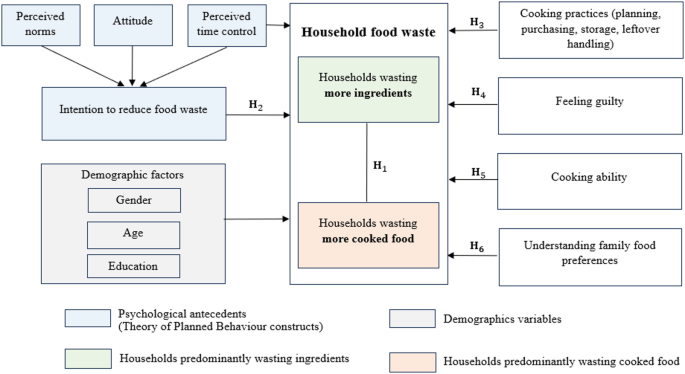
Rather than treating household food waste as a single behaviour, this study distinguished between households that primarily waste raw ingredients and those that primarily waste cooked food. We wanted to understand whether these different waste patterns were shaped by different household dynamics and behavioural drivers.
The research was based on extensive face-to-face household interviews conducted across Ho Chi Minh City, Vietnam, involving 642 households and a team of 25 enumerators. The fieldwork was self-funded through my supplementary scholarship during my PhD candidature, and the survey process itself became an important learning experience about the realities of everyday household sustainability practices.
Using Covariance-Based Structural Equation Modelling (CB-SEM), we examined how psychological and behavioural factors influenced food waste during the home cooking process.
Several findings stood out to us.
First, sustainability intention alone did not significantly translate into lower food waste behaviours, highlighting an important intention–behaviour gap within households.
Second, cooking ability and understanding family food preferences consistently helped reduce food waste across different household types.
Interestingly, planning and storage behaviours — which are often emphasised in food waste discussions — showed more limited effects within the urban Vietnamese context, where households frequently purchase fresh food in smaller quantities.
We also found that feelings of guilt were associated with higher waste among cooked-food-wasting households, suggesting possible post-rationalisation behaviours rather than actual waste reduction.
Beyond the statistical findings, one of the most important lessons from this research was that household food waste is deeply embedded within everyday life. Sustainability is shaped not only by policies and technologies, but also by ordinary routines, family dynamics, cooking practices, time pressures, and the realities of urban living.
For me personally, this research also reinforced the value of practice-grounded inquiry — where everyday experiences can become meaningful starting points for broader sustainability research.
You can read the paper here:
https://doi.org/10.1007/s10163-026-02516-4

I am the Founder and Independent Researcher of LifeNest Research, a practice-based research platform that transforms everyday life into meaningful research insight. My work focuses on sustainable consumption behaviours, food waste reduction, and wellbeing across households and food systems. Drawing on practice-based and process-oriented approaches, I connect daily routines -- particularly food-related practices -- with broader sustainability transitions, policy relevance, and social innovation.
Follow the Topic
-
Journal of Material Cycles and Waste Management
This journal specializes in the interdisciplinary science of material cycles and waste management.