Talking to older adults: between help and ageism
Published in Neuroscience, Behavioural Sciences & Psychology, and Arts & Humanities



Explore the Research
 Nature Publishing Group UK
The two faces of elderspeak - npj Dementia
npj Dementia - The two faces of elderspeak
Language, aging, and elderspeak
Language changes with age, though not always in intuitive ways. Healthy older adults typically have larger vocabularies than younger people, reflecting decades of accumulated knowledge. At the same time, many experience slower processing speed and greater difficulty following rapid or noisy speech. In Alzheimer’s disease, the scenario shifts further. Word retrieval slows and semantic knowledge itself may begin to erode. Faced with these changes, and often guided by age-related stereotypes, conversational partners naturally adjust their speech. Elderspeak often emerges at this intersection of real communicative need and well-meaning but sometimes misguided intuition.
Elderspeak is a recognizable bundle of adjustments. Speech rate decreases and pauses are prolonged. Pitch often rises and intonation becomes more exaggerated. Vocabulary shifts toward shorter, more frequent words, and sentences are shortened and simplified. Repetition becomes more common, as do terms of endearment such as ‘dear’ or ‘sweetheart’. Many speakers also adopt collective framing, replacing ‘you’ with ‘we’ (“we’re going to take our pill now”).
In real interactions, these features usually travel together. A caregiver helping someone dress might say, “Okay sweetheart, we’re going to put our sweater on, aren’t we?” During medication rounds, one might hear, “Here comes our pill, nice and easy.” The communicative intent is typically kind: to reassure, guide, and maintain cooperation. But good intentions do not always translate into good outcomes.
Two sides of the elderspeak coin
Many older adults report that elderspeak feels patronizing or subtly disrespectful. The resemblance to infant-directed speech is difficult to ignore, and cognitively intact seniors in particular may experience it as a status downgrade. In dementia care, the consequences can be more than perceptual. Certain elderspeak patterns (like exaggerated sing-song prosody combined with infantilizing address terms) have been linked to increased physiological stress and behavioral resistance. In some studies, exposure to elderspeak doubled the likelihood of resistiveness to care.
Yet, not all elderspeak features are harmful, and some are clearly beneficial. Simplifying sentence structure can make instructions easier to follow. Strategic repetition can reinforce comprehension. A modestly slower speech rate can give listeners the extra processing time they need without sounding unnatural.
Psycholinguistic research helps explain these mixed effects. Listeners do not evaluate speech features one by one. Instead, they integrate multiple cues to infer both meaning and speaker intent. Syntactic simplification mainly reduces cognitive load, whereas prosodic exaggeration strongly shapes social interpretation.

Consider the difference between two ways of delivering the same clinical instruction. A neutral request such as “Please lift your arm so I can check your blood pressure” typically signals task-focused support. By contrast, when the message is rendered as “Okay sweetie, let’s lift our arm now, nice and easy,” the added pitch exaggeration, endearment, and collective framing can shift the social meaning of the exchange. Structurally, the sentences are similarly simple, but pragmatically they communicate very different assumptions about the listener’s competence.
This pattern suggests that problems arise less from any single feature than from over-accommodation bundles that signal global incapacity. Blanket advice such as “never simplify” or “always slow down”, therefore, misses the real issue.
One size will never fit all
The most important takeaway is variability. Older adults are extraordinarily heterogeneous. Cognitive status, hearing ability, personality, cultural expectations, and disease stage all shape how speech adjustments are received.
A healthy older adult with strong vocabulary but slower processing speed may benefit primarily from reduced speech rate. A person with moderate Alzheimer’s disease may require both slower delivery and simpler lexical choices. Meanwhile, exaggerated warmth that feels patronizing in early dementia may become functionally helpful in later stages when attentional and emotional scaffolding is needed.
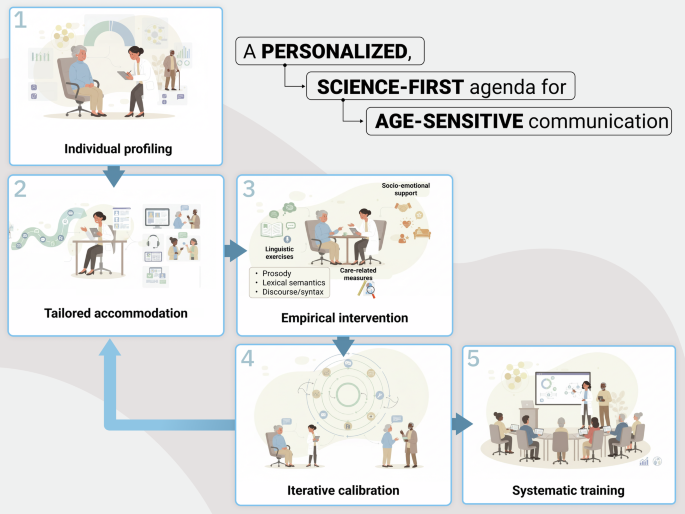
Rather than abandoning elderspeak altogether, a more productive path is strategic refinement. A science-first approach begins with careful profiling of the older adult’s sensory, cognitive, and linguistic capacities. These profiles can guide tailored adjustments, leading to specific changes in rate, vocabulary, or syntax that match documented needs.
Communication strategies should then be tested in real interactions, refined through feedback, and ultimately translated into scalable training for caregivers. Encouragingly, intervention studies already show that when staff replace patronizing elderspeak with respectful, needs-based adjustments, resistiveness to care decreases and interactions become smoother.
The bottom line
Elderspeak is often (and, sometimes, rightly) criticized, but treating it as uniformly harmful is too simplistic. Some of its features genuinely support comprehension and care. Others undermine dignity and cooperation. Most effects depend on how, when, and with whom the speech is used.
As populations age worldwide, the stakes for getting this right will only grow. What we need is not less accommodation but smarter accommodation, with adjustments that are personalized, evidence-based, and responsive to change over time.
In the end, the goal is simple: support without stereotyping. Getting there depends on matching our words to real needs, not assumptions.

Adolfo García is Director of the Cognitive Neuroscience Center (UdeSA, Argentina), Senior Fellow at the Global Brain Health Institute (UCSF, USA), Associate Researcher at USACH (Chile) co-founder of Include (a global network for crosslinguistic research on brain health), and CSO of TELL (a speech testing app). He has obtained funds from multiple international agencies (NIH, SNSF, DAC, Alzheimer’s Association), authored over 200 publications, and led multiple science dissemination projects (including two TED talks). His accolades include two Paper of the Year Awards from the Alzheimer’s Association, Harvard’s Ig Nobel Prize, the Early Career Award from the Society for the Neurobiology of Language; and the UpLink Top Innovator Award from the World Economic Forum.