How Do Our Cellular Gates Survive a Constant Evolutionary Arms Race?

How do our cellular gates survive an endless, evolutionary arms race? In our latest study, we reveal how Junctional Adhesion Molecules adapt to extreme pH environments and evade viruses.
How Do Our Cellular Gates Survive a Constant Evolutionary Arms Race?
Like

Share this post

Choose a social network to share with, or copy the URL to share elsewhere

This is a representation of how your post may appear on social media. The actual post will vary between social networks

Explore the Research

Springer Berlin Heidelberg
Springer Berlin Heidelberg Springer Berlin Heidelberg

Microenvironmental pH and host-pathogen co-evolution potentially influence the structural architecture of junctional adhesion molecules - Molecular Genetics and Genomics

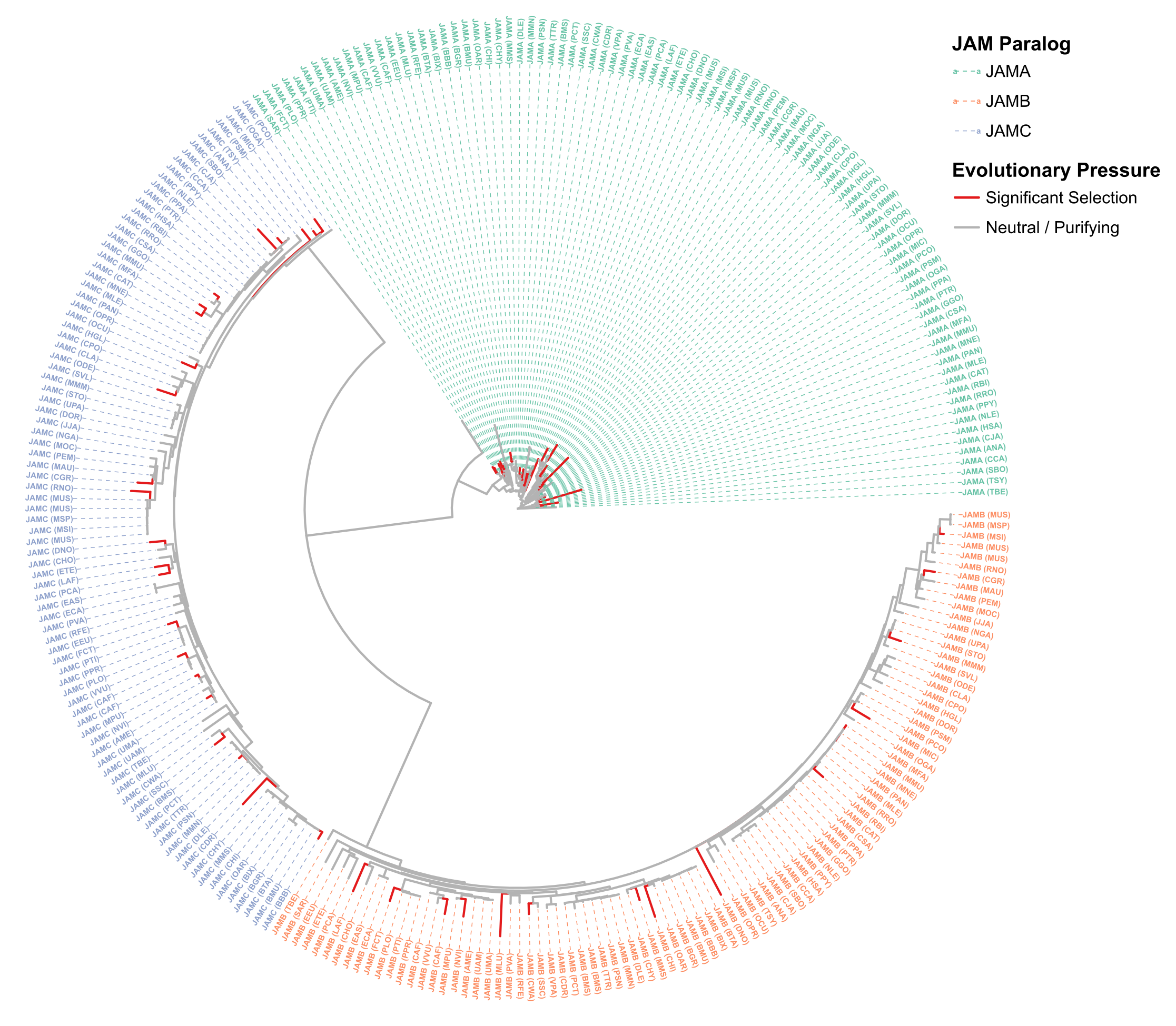
Understanding how proteins dynamically adapt to diverse and changing physiological microenvironments is a fundamental challenge in modern biological sciences. Junctional adhesion molecules (JAMs) are a family of conserved proteins critically involved in immune regulation and cell adhesion. In this study, we investigate the evolutionary and structural dynamics of three paralogs across 274 mammalian taxa, which share similar tertiary structures but differ in isoelectric points (pI). By integrating phylogenetic modeling, partial correlation, network topology, and evolutionary molecular dynamics in physiological pH (6.5–10.5) gradient, we explored potential explanations driving this diversification. Our analysis identified JAM-B as a likely central node in the conservation network, with Lys and Cys residues as central evolutionary residues. Evolutionary mapping revealed recent episodic selection bursts across 17% to 26% of mammalian lineages, could indicate that specific functional interfaces are undergoing rapid, lineage-specific innovation. Notably, we identified episodic hotspots in JAM-A at the distal D1 viral entry interface, consistent with an ongoing host-pathogen arms race, and parallel adaptive clusters at the C-terminal motifs across all paralogs. AlphaMissense profiling revealed that acidic-> basic mutations exhibit significantly lower pathogenicity scores. In preliminary early-onset dynamics simulations, root-mean-square-deviation profiles could suggest a pI-stability relationship, JAM-A and JAM-C displayed biphasic pH-dependent deviations (at pH 8.0 and pH 8.5). Dynamics-aware evolutionary profiling identified key dynamic-conserved residues: JAM-A at Gln66, JAM-B at Gln36 and Val57, and JAM-C at several basic residues. Together, these results suggest that isoelectric divergence correlates with residue evolution and microenvironment-specific structural dynamics. Ultimately, our integrated computational framework provides genomic insights into paralog diversification, offering a testable architectural blueprint for targeted mutagenesis or therapeutic modulation of pH-sensitive adhesion processes.

Every day, our cells must communicate, stick together, and defend themselves against microscopic invaders. At the forefront of this microscopic world are Junctional Adhesion Molecules. These barrier proteins sit right at the cell surface, regulating tissue integrity and immune responses. But this exposed location also makes them a prime target. Viruses continuously try to hijack these exact receptors to gain entry into our cells.

This raised a fascinating question for us. How do these structural proteins adapt to evade viruses while still performing their essential daily jobs in changing chemical environments?

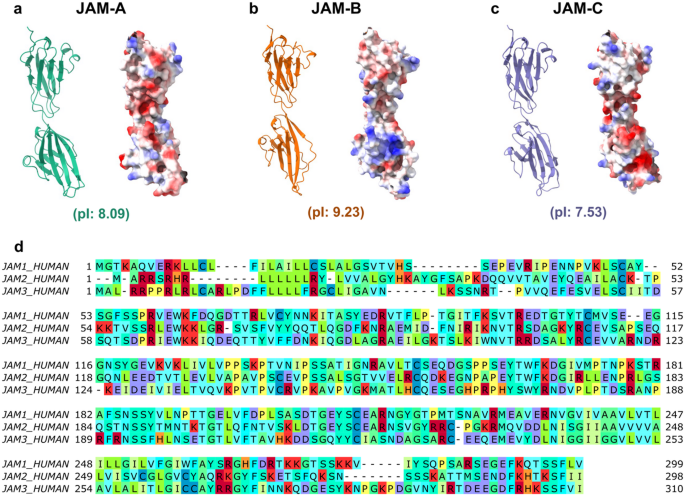
In our recent study published in Molecular Genetics and Genomics, We wanted to explore the unseen forces shaping these critical barrier proteins. We looked at three human paralogs: JAM-A, JAM-B, and JAM-C. When you look at their three dimensional shapes, they appear nearly identical. Yet, they possess entirely different chemical personalities. They have remarkably distinct isoelectric points, which dictate their electrical charge. JAM-B is highly basic with a pI of 9.23, JAM-A sits in the middle at 8.09, and JAM-C is more acidic at 7.53. We wondered why nature would preserve the exact same structural blueprint but alter the chemical charge so drastically.

To find the answer, we combined evolutionary phylogenetic modeling of 274 mammalian species with molecular dynamics simulations testing a physiological pH gradient from 6.5 to 10.5. The results painted a beautiful picture of environmental adaptation.

We discovered that JAM-B acts as a highly constrained evolutionary connector. Despite its high positive charge, it remains structurally rigid and stable across a broad range of pH levels. Conversely, JAM-C is the most evolutionarily volatile member of the family. Because JAM-C is heavily involved in guiding immune cells into inflamed, highly acidic microenvironments, its lower pI allows it to remain flexible and continuously adapt to these challenging conditions. JAM-A and JAM-C even exhibited unique V-shaped stability profiles, showing that their flexibility is directly dictated by the surrounding acidity.

The exciting revelation came when we mapped the evolutionary history of these proteins. We observed rapid, recent genetic adaptations concentrated precisely at the structural interfaces hijacked by pathogens like mammalian orthoreoviruses and feline calicivirus. Mammalian lineages are actively modifying the localized flexibility of these binding pockets. They are essentially changing the locks on the cellular doors.

We also pinpointed specific dynamic conserved residues, such as Glutamine 66 in JAM-A. These specific amino acids are strictly preserved by evolution but retain the ability to flex and shift in response to pH changes. They act as microscopic hinges that allow the protein to function perfectly under electrostatic pressure.

Understanding this delicate balance between structural rigidity and chemical flexibility gives us a new way to look at human biology.

By learning how these adhesion proteins naturally adapt to acidic environments and viral threats, we can begin to design better targeted therapies for diseases characterized by severe chemical imbalances, such as heart failure or cancer. It reminds us that even at the atomic level, life is constantly learning, shifting, and surviving.

Please sign in or register for FREE

If you are a registered user on Research Communities by Springer Nature, please sign in

Follow the Topic

Infectious Diseases
Life Sciences > Health Sciences > Biomedical Research > Medical Microbiology > Infectious Diseases
Molecular Evolution
Life Sciences > Biological Sciences > Evolutionary Biology > Molecular Evolution
Protein Biochemistry
Life Sciences > Biological Sciences > Molecular Biology > Protein Biochemistry
Virology
Life Sciences > Biological Sciences > Microbiology > Virology
Cell Adhesion
Life Sciences > Biological Sciences > Cell Biology > Cell Adhesion
Genetics and Genomics
Life Sciences > Biological Sciences > Genetics and Genomics

Related Collections

With Collections, you can get published faster and increase your visibility.

Genomics and Microbiome Signature of Physiological Adaptations in Terrestrial and Aquatic Animals

This collection of articles in the journal is directed to studies that intend to bring together genomics and microbiomics and cell, organ and whole animal physiology in terrestrial and aquatic species, including those of commercial interest. Together, these articles aim to link fundamental genomics discoveries with the study of biodiversity, the understanding of environmental adaptations, and the development of new advances in farm animal production.

Publishing Model: Hybrid

Deadline: Ongoing

Molecular Mechanisms Linking Genetic Variation to Human Disease

This collection focuses on how molecular genetics uncovers mechanisms of disease across diverse biological systems. The selected papers span regulatory pathways of mitochondrial biogenesis, oncogenic and tumor suppressor mutations in breast cancer, cardiovascular signaling via c-Src and ROS, immune gene contributions to intervertebral disc degeneration, and actionable insights from genetic testing in pediatric nephrolithiasis. Together, these studies bridge fundamental genetic discoveries with clinically relevant phenotypes, emphasizing how mechanistic insights advance translational medicine.

Publishing Model: Hybrid

Deadline: Ongoing