Do More Conscious Leaders Perform Better?
Published in Neuroscience and Behavioural Sciences & Psychology





It is evident that the world is drastically changing, as tools like artificial intelligence (AI) flood into our occupational systems. Are general mental ability tests, i.e., I.Q., really going to be a meaningful differentiator among people while still relying heavily on verbal and numerical reasoning, and now, increasingly, the same knowledge is universally accessible through a supercomputer? If I.Q. and emotional intelligence have been touted as key abilities in the past, will they hold up against the current-day transformation into the 4th industrial revolution (Ross & Maynard, 2021)?
AI’s rise has also increased questions and salience around consciousness. The key separator between us and the machines. So, if consciousness is what currently separates us from AI, why don't we evaluate leaders based on their conscious intelligence?
To answer this question, we would first want to know if consciousness is an advantage. While it's easy to assume, in true scientific form, we would want to test this assumption.
However, because the world of work is undergoing transformation, I needed a context-neutral indicator that had already been linked to current-day performance and could remain relevant on an ongoing basis, and the mental faculty of executive function presented itself as a natural solution. Executive function is an umbrella term for many vital sub-variables key to self-determined positive behavioural control.
And so, the study's research question was formed: How is a leader’s level of consciousness related to their executive function?
But what is consciousness?
This erupted a plethora of sub-questions:
- How would we measure it?
- What theory of consciousness would be relevant, and which would not?
- How is consciousness different or similar to attention, awareness and indeed executive function itself?
Refer to the paper to see how I tackled the second and third questions, but regarding the dilemma of measurement, I first deduced a specific distinction between different theories of consciousness, awareness, and attention.
Once complete, the tool criteria became:
- Self-reported to capture the subjectivity of consciousness.
- Previously demonstrated adequate psychometric properties.
- Tested for construct differentiation with self-awareness and mindfulness.
- Measure local states of consciousness, including first and higher-order thoughts.
This made the Troyer Level of Consciousness Inventory (Troyer, 2012) an ideal solution.
To investigate whether leaders who were more conscious had better executive function, this study used a passive correlational design involving the two questionnaires.
We used Qualtrics to create the survey, including both questionnaires, and Prolific to sample leaders based on predetermined inclusion and exclusion criteria.
The data was then audited and put into SPSS for analysis.
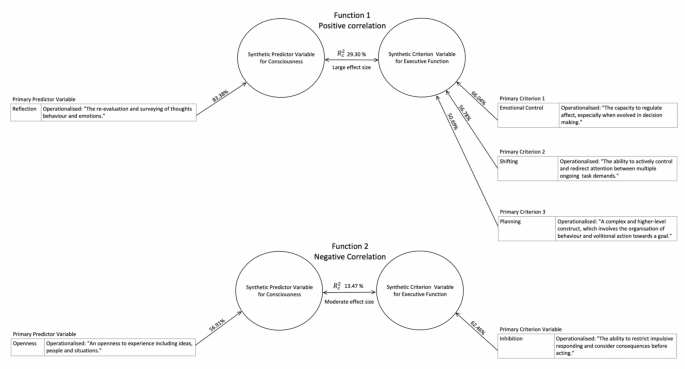
Apart from investigating the correlation between the total scores for consciousness and executive function, we also wanted to examine how the sub-domains of each variable relate to one another. Performing multiple correlations would be problematic, as consciousness has 4 sub-domains and executive function has 5, resulting in 20 separate correlations, which would increase the experiment-wise error rate.
Also, since the sub-domains are from questionnaires, they will have multicollinearity with others in the same set, thereby disqualifying multiple regression as an option. Whereas canonical correlation analysis (CCA) can handle multicollinearity between variable sets and permit multiple comparisons to be initiated simultaneously, thereby eliminating the need to perform multiple comparisons sequentially.
The finding that higher levels of consciousness are correlated with higher levels of executive function meant we could at least rest assured that we had found evidence supporting the initial assumption that greater consciousness may indeed be an advantage, specifically in relation to better executive function.
But what about the relationships of the subdomains? The CCA found that conscious reflection was correlated with better cognitive flexibility, planning and emotional control, and, interestingly, that being open-minded was associated with worse impulse control. While meta-self-awareness showed little relevance in the CCA analysis.
The CEO and C-Suite executives had the most extreme scores, with the lowest scores for total level of consciousness and meta-self-awareness, while possessing the highest scores for helping others, planning, and inhibition. However, further investigation was hindered due to the group’s sample size.
While this study does not establish a causal relationship, it is interesting to examine the results.
Firstly, this sample of leaders scored highest for inhibition (impulse control) compared with any other subdomain. The only two subdomains they scored lower on than a non-leadership sample were meta-self-awareness and openness. This raises a question: are people with low openness and meta-self-awareness and high impulse control more likely to be placed in leadership positions? Would attempting to increase their meta-self-awareness have a positive or detrimental effect? Might it help combat unethical pro-organisational behaviour? Since Executive coaching is offered as an intervention, the assumption is that greater meta-self-awareness would positively affect performance.
But this study raises deeper questions about the utility of different levels of consciousness. It might be tempting to take the initial finding from the total scores of the two questionnaires and simply state that the more consciousness one has, the better, but better for what?
Rosenthal (2008) postulated that higher-order thoughts, such as meta-self-awareness, could be unnecessary for executive function; ergo, you might not need to inspect the nature of your mind (introspection) to maintain a good level of performance day to day.
So, is consciousness an advantage? Taking the results from this study, in some ways, yes, first-order thoughts appear to have a positive relationship with some executive function outputs, while others seem to have a negative one, and meta-states (higher-order thoughts) seem unnecessary for executive function performance.
Future researchers may want to investigate whether greater meta-self-awareness leads to worse executive function, namely, whether higher levels of introspection lead to a decrease in self-directed behaviour output, hinting at the notion that overthinking can lead to negative behavioural performance. Since this has the potential to drastically challenge or affirm many assumptions held by psychological helping professions, clarification is needed.
References
Rosenthal, D. M. (2008). Consciousness and its function. Neuropsychologia, 46(3), 829-840.
Ross, P., & Maynard, K. (2021). Towards a 4th industrial revolution. Intelligent Buildings International, 13(3), 159-161.
Troyer, J. A. (2012). How do we measure the invisible? Creation and validation of the Troyer Level of Consciousness Inventory.
Follow the Topic
-
Discover Psychology
This is an international, open access journal that publishes research in behavioral sciences and related fields, including health, environment, neuroscience, business, economics, ergonomics, linguistics, and education.

Related Collections
With Collections, you can get published faster and increase your visibility.
Psychological Capacities for Mental Health and Wellbeing in the Era of Climate Change and Covid-19 Aftermath
The COVID-19 pandemic has greatly altered the way we live, work and socialise and continues to impact global mental health and wellbeing. Post the COVID 19 pandemic, and in the context of increasing environmental disasters due to climate change, there is a growing importance to be prepared and effectively deal with future adversities and threats. In this respect, understanding aspects of positive psychological capacities that can access and develop individual and community strengths are gaining importance. There is a growing body of evidence from positive psychology on a broader set of positive attributes/ resources such as self-efficacy, resilience, hope, optimism, sense of coherence, autonomy, resourcefulness, identity, hope, religiosity/spirituality and life valuation as critical indicators of mental health and wellbeing.
Positive psychology has inspired many fields of research including education, health, workplace and sports, to better capture strengths and capacities that can be measured and developed to improve, health, wellbeing and productivity. However, a significant pitfall of this research has been in discipline silos, published in discipline specific journals with limited access to researchers from other fields, impairing cross-disciplinary learnings across fields. For example, empirical evidence from the field of positive organisation behaviour has suggested psychological capital (PsyCap) as an higher-order construct that includes hope, self-efficacy, resilience and optimism to be associated with workplace burnout, wellbeing and satisfaction.
This collection will provide a platform for researcher across the field of education, health and workplace to publish articles related to measuring and developing psychological capacities to improve mental health and wellbeing. This collection aims to promote exchange of ideas and knowledge between disciplines to better understand, measure and develop psychological capacities to successfully address mental health concerns and wellbeing in the era of climate change and the COVID-19 aftermath.
Keywords: Psychological capacities, Resilience, Positive Psychology, Mental health and Wellbeing.
Publishing Model: Open Access
Deadline: Sep 30, 2026
Mental Health and SDGs: Examining Interrelationships Between Mental Health and Agenda 2030
Mental health is integral to achieving the Sustainable Development Goals (SDGs), as it intersects with all the global targets for Agenda 2030. The inclusion of mental health within Agenda 2030 reflects its importance for achieving global well-being and equity. However, the complex relationships between mental health and the SDGs are often underexplored. For instance, poor mental health can hinder educational attainment, economic productivity, and resilience to environmental crises, while systemic inequities, climate change, and conflict exacerbate mental health challenges globally.
Despite growing global commitments, the integration of mental health into development agendas remains fragmented. Research is often siloed, focusing on either mental health outcomes or SDG targets, rather than exploring their interdependencies. Furthermore, there is limited understanding of how mental health interventions can accelerate SDG achievements or how progress on the SDGs can promote mental well-being. Addressing these gaps is essential to building inclusive, sustainable communities where mental health and development reinforce one another.
This collection aims to provide a platform for interdisciplinary research that examines the interrelationships between mental health and the SDGs. We welcome studies that investigate how mental health issues influence progress on the SDGs and how development efforts can address mental health disparities. This collection will offer critical insights for policymakers, practitioners, and researchers working to integrate mental health into global development strategies.
Key Themes Include (but are not limited to):
• Mental Health and Overall Health and Well-Being: Exploring mental health as a core component of health and well-being, including the integration of mental health services into primary healthcare.
• Educational Outcomes and Mental Health: Investigating the effects of mental health on learning, school attendance, and academic performance, and vice versa.
• Gender Equality and Mental Health: Examining the mental health implications of gender disparities, violence, and empowerment.
• Climate Change and Mental Health: Assessing the psychological impacts of climate-related events and the role of mental health in building climate resilience.
• Mental Health Inequities and SDG Progress: Exploring how disparities in access to mental health care affect progress on the SDGs, especially for marginalized groups.
• Resilience and Sustainable Development: Identifying protective factors and community-based strategies that enhance mental health and promote sustainable development.
• Digital Innovations and Mental Health in SDG Achievement: Evaluating the role of technology in addressing mental health challenges within development contexts.
• Mental Health Policy and the SDGs: Analyzing policies that integrate mental health into national and international development agendas.
• Youth Mental Health and SDGs: Investigating the intersection of youth mental health with education, employment, and civic participation.
• Intersectionality in Mental Health and SDGs: Exploring how intersecting identities (e.g., age, gender, socio-economic status, ethnicity) influence mental health outcomes and development goals.
Keywords: Mental Health and Sustainable Development Goals; Global Mental Health and SDGs; Mental Health Equity; Climate and Mental Health; Resilience and Well-being; Mental Health Policy and Advocacy; Education and Mental Health; Gender and Mental Health; Vulnerable Populations; Interdisciplinary Development and Mental Health.
This Collection supports and amplifies research related to all the SDGs.
Publishing Model: Open Access
Deadline: Sep 30, 2026