Do we really know about complex collective interactions of abnormal cardiac waves?
Published in Chemistry, Physics, and Protocols & Methods
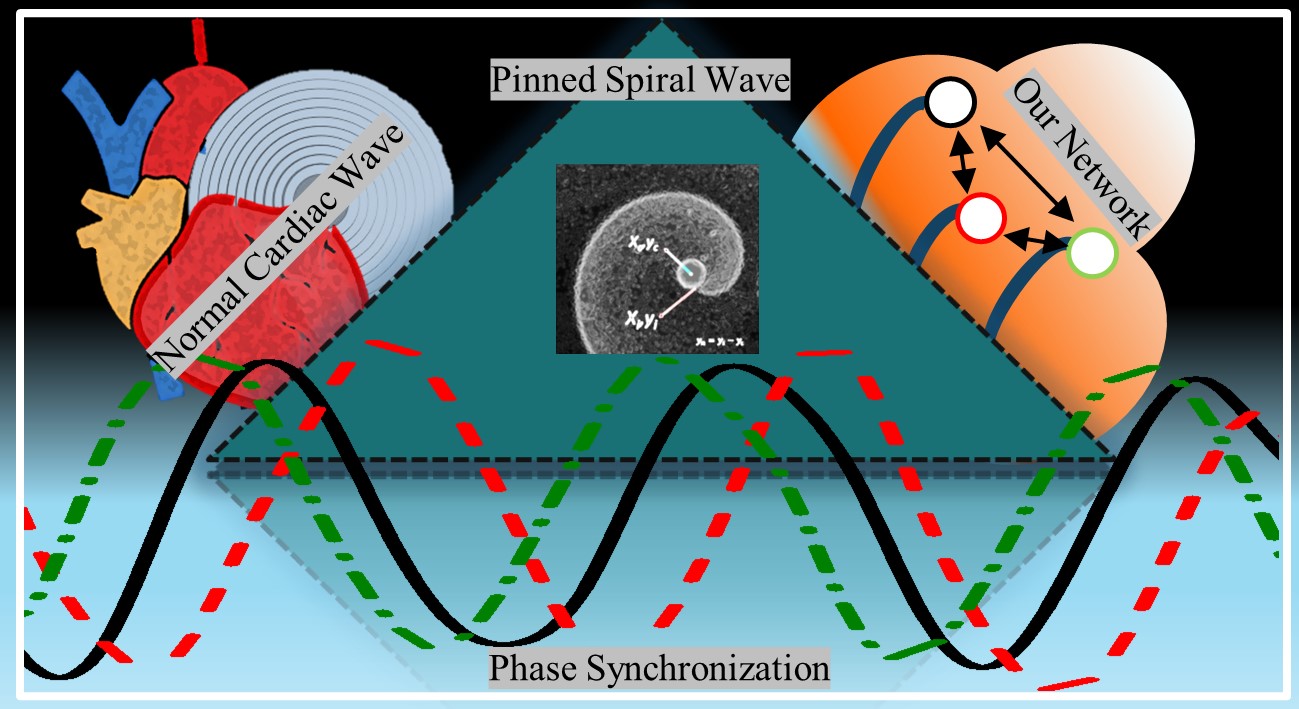


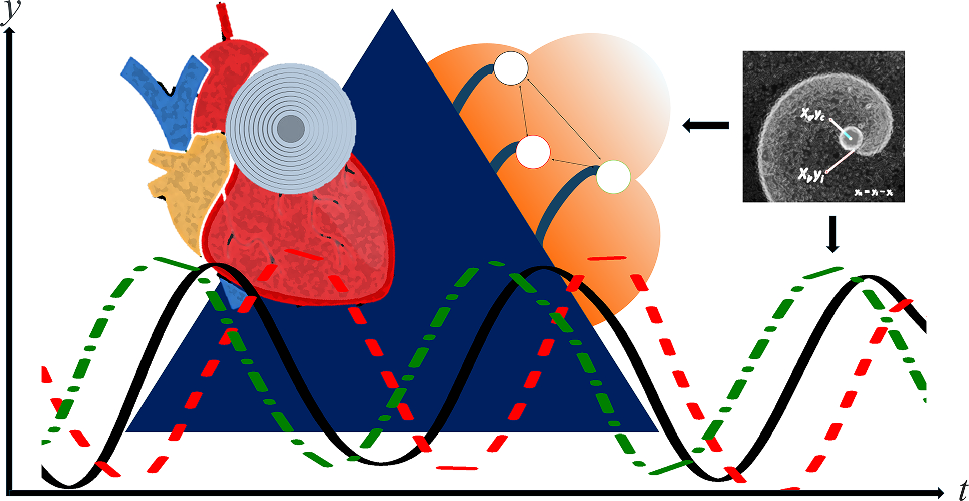

We were searching for synchronization and chimera-like collective dynamical states for spiral waves in the Belousov Zhabotinskii reaction. One may definitely ask- why? In the last two decades, scientists have been fascinated with the term 'Chimera,' though almost the same thing as 'Partial Synchronization,' was coined by many almost three decades back around 1990, around the breaking of the Soviet Union. Intentionally, I mentioned the Soviet because it is the birthplace of the Belousov-Zhabotinskii (BZ) reaction.
Let me first tell the importance of these spirals in a BZ reaction. Spirals and its three-dimensional version, 'scroll,' are excitable waves. Now, what is that? In simple language, that system is excitable if it gets excited upon some perturbation. Our cardiac system is also excitable. One more lucid definition can be given as 'damping free waves'! Imagine you have thrown a stone in the middle of a waterbody, let's say, a pond. You will notice an outwardly propagating circular wave, but for how long? Not much, right? Why? Because of the damping phenomena. If damping was absent, what would happen? You will be able to see a sustained wave. You might have seen the "ECG" report on human beings. Definitely, you have; what do we see there- wave patterns of the electrical signal? The wave will sustain till a person dies. I think now it is clear why our cardiac system is an excitable one. Spiral waves form in the cardiac system and are compared with abnormal cardiac waves (mainly in patients with tachycardia). If multiple wavelets (through a spiral breakup) are formed, that leads to more dangerous situations like ventricular fibrillation (1). Heart attack is one of the leading causes of death in developed and developing countries. We study spiral wave dynamics in the context of the human cardiac system.
If spiral waves are abnormal cardiac waves, which may lead to fatal outcomes, one researcher will obviously try- how to terminate these waves! Yes, that is one primary type of study going on in the scientific community for a few decades. There are works that suggest various gradients are capable of drifting and then terminating the spiral at the boundary. But why is there a need to study the collective dynamics of these spirals? I believe that understanding the collective behavior will lead to understanding the mechanism before reaching more fatal situations, and maybe in the future, science and technology will be able to modify the dynamics and bypass the phase reaching a dangerous outcome. It may sound like a dream! Let's leave it here. Let me go back to the story as well as history, going back to the Soviets again. Belousov was trying to mimic the Krebs cycle when he first observed the peculiar oscillation around 1950! He could not explain how this oscillation did not violate the second law of thermodynamics before the work taken seriously by Zhabotinskii and then theoretical development by Ilya Prigogine and others. Why is this reaction so important? It gives sustainable patterns in controlled conditions. And now, we can say it is one of the best laboratory models to understand cardiac excitable waves. It is well known that if scrolls are pinned to heterogeneity, lifetime increases. If heterogeneity is attached to spirals, the frequency of the spiral changes.
As said above, we were in search of synchronization and partial synchronization dynamics in our system for a better understanding of the collective dynamics of spirals formed in our hearts. We chose pinned/anchored spirals. These can also be correlated with the situation in which the cardiac waves may get attached to heterogeneities present in cardiac tissue. Heterogeneities may be scar tissue, which may be other obstacles. In our first study of this kind, we took counterrotating spirals pinned with heterogeneity of different diameters and found the counterrotating pinned spiral synchronizes(2). Then we moved for a network of a similar kind but with little intuition I, started to look at corotating one! Don't know why and also without expecting any result. My first goal was to form a corotating spiral properly, believing that if spirals form in our hearts, they will not obviously rotate counterclockwise all the time. What will be the dynamics then? Will that be the same? Now, we have the answer: No. Counterrotating pairs pinned to obstacles of the same diameter always reach complete synchronization, but there remains a lag if they are corotating. Then we also looked for a triangular geometry, but this was not intentional, rather accidental. After analyzing all the results, we tried to connect it with a higher-order network. There may remain open debate on the system. Can we call it a higher order with just three rotors? But, in a diffusive media, I think the interaction is beyond pairwise and a higher-order network. What is higher order? And why am I talking about this? In a straightforward language, a more complex network and more complex interaction are the basic properties of a higher-order network. More spirals in our hearts and their rotation may lead to complex interactions. Does their synchronization behavior lead to any fatal condition, or does the mechanism involve both synchronization and partial synchronization together? We do not know. The future will explain.
(1) 10.1016/j.hrthm.2022.06.015
(2) 10.1103/PhysRevE.106.034201

Follow the Topic

Related Collections
With Collections, you can get published faster and increase your visibility.
Challenges and Innovations in Space Dynamics, Spacecraft Control Systems and Aeroelasticity
It is well-known that the field of space dynamics and spacecraft control systems is rapidly evolving, driven by the increasing complexity of space missions and the need for enhanced performance and reliability. As we go deeper into space, the challenges associated with orbital mechanics, navigation, and attitude control become more pronounced, requiring innovative solutions to ensure mission success. Traditional methods of spacecraft control are being re-evaluated and refined to address issues such as maneuverability in varying gravitational fields, the impact of atmospheric drag on low Earth orbits, and the integration of advanced propulsion systems.
Additionally, the rise of small satellites and constellations introduces new dynamics that demand adaptive control strategies and real-time data processing capabilities. This landscape presents both challenges and opportunities, as researchers and engineers work to develop cutting-edge technologies and methodologies that can optimize spacecraft performance, enhance autonomy, and improve mission outcomes in an increasingly competitive and complex space environment. On the other hand, in modern aerospace applications, aeroelasticity has become even more crucial due to the use of composite materials and the development of high-aspect-ratio wings, unmanned aerial vehicles, and energy systems like wind turbines. These structures tend to be more flexible, increasing the likelihood of aeroelastic effects. To address these challenges, engineers are exploring innovative solutions such as active control systems and smart materials that can adapt to changing aerodynamic conditions in real time. Overall, aeroelasticity plays a fundamental role in ensuring the structural integrity, performance, and safety of advanced aerospace systems.
The SI will also be a great opportunity for disseminating recent developments of analytical and numerical techniques, and for discussing novel phenomena and behaviors on several aspects of those topics. Researchers and practitioners are invited to submit their original research work on the rapidly developing field of "Challenges and Innovations in Space Dynamics and Spacecraft Control Systems and aeroelasticity”.
The areas of interest include, but are not limited to, both theory and applications on the following topics:
1. Orbital manoeuvres of all types
2. Design of satellite constellations
3. Design of space missions in general
4. Interplanetary missions
5. Astrodynamics
6. Aerospace Engineering in general
7. Machine learning techniques to improve control accuracy and performance
8. Aeroelasticity in Aerospace
9. Space robots and multi body systems
10. Nonlinear Control, Optimal, Robust and Adaptive Control
11. Control of Chaos
12. Polynomial Chaos for sensitivity analysis.
More detailed information can be found in the Call for Papers.
Publishing Model: Hybrid
Deadline: Nov 30, 2026
Research in Physics Education and History of Physics: Focus on Teacher Training and the Teaching of Quantum Mechanics
Submissions are invited for a Special Issue of EPJ-ST dedicated to “Research in Physics Education and History of Physics: Focus on Teacher Training and the Teaching of Quantum Mechanics”.
The issue will include selected contributions presented at the national COOFIS-08 4th meeting on “Research in Physics Education and History of Physics" with a focus on teachers’ formation and on quantum mechanics education that took place from December 11th to 13th 2025 at the Università degli Studi di Milano (Italy). The conference is a forum for discussion of the Coordination of physics education research in Italy among most of the researchers working in this field.
This issue will focus on fundamental studies and applications related to research in Physics Education and the History of Physics, specifically regarding teacher training and the teaching of quantum mechanics—two distinct yet highly relevant and interconnected topics. The issue will address both theoretical and methodological aspects, as well as experimental ones, in classroom settings or more general contexts including outreach to the general public, provided they are strongly research-based and highlight problems, approaches, and proposed research-driven solutions. Particular attention will be given to contributions that integrate both themes, such as studies on teacher training in quantum mechanics or approaches that intertwine historical and educational perspectives.
The submission is open to everyone working in the field, independently on the participation to the COOFIS-08 4th meeting. We invite interested authors to contact the guest editors providing a tentative title and a short abstract of their contribution. All submitted papers will undergo standard peer-review.
We invite contributions focused on teacher training at all educational levels and/or all aspects of quantum mechanics. Topics of interest include:
• the use of Inquiry-Based Learning (IBL) as a central pedagogical tool;
• the role of history and philosophy of science in enriching teachers’ understanding and practice;
• the integration of hands-on experiments as foundational components of teacher preparation;
• promoting gender balance in physics education and the crucial role teachers play in shaping inclusive learning environments;
• approaches to teacher training that emphasize the cultural and interdisciplinary dimensions of science;
• well-being and self-efficacy in schools and university;
• contributions on historical developments relevant to teaching quantum mechanics;
• the role of mathematics in quantum physics education;
• strategies for introducing quantum mechanics at the secondary school level;
• diverse pedagogical approaches to quantum theory;
• the use of quantum applications in education;
• quantum computing and emerging quantum technologies;
• the educational value of games in teaching quantum physics;
• foundational issues in quantum mechanics and their implications for instruction.
More detailed information can be found in the Call for Papers
Publishing Model: Hybrid
Deadline: Oct 30, 2026