Behind the Paper: The Key Role of Lone-pair-electrons in Governing Gas-recognizable Flexibility of MOFs for Gas Separation and the Aqueous Scalable Synthesis





1. Designing porous materials with molecular recognition ability
Separating propylene (C3H6) from propane (C3H8) is one of the most challenging and energy-intensive processes in the petrochemical industry. Although these two molecules have very similar physical properties, their separation is essential for producing high-purity propylene, an important building block for modern chemical industries. Conventional separation methods mainly rely on cryogenic distillation, which requires significant energy consumption. Developing alternative separation technologies based on porous materials has therefore become an important research goal.
Metal–organic frameworks (MOFs) have attracted considerable attention as next-generation porous materials because their structures and chemical environments can be precisely designed. By tuning pore sizes, functional groups, and host–guest interactions, MOFs can potentially achieve highly selective molecular separation. However, designing MOFs for practical gas separation remains challenging. Many flexible MOFs exhibit excellent selectivity because their structures can dynamically respond to guest molecules. Yet, excessive flexibility may compromise structural stability. In contrast, highly stable MOFs often possess rigid frameworks that lack the ability to adapt to different molecules. Achieving both stability and intelligent flexibility has therefore been a long-standing challenge.
This inspired us to explore a fundamental question: could the flexibility of a stable MOF be precisely controlled through molecular recognition?
2. Discovering the role of lone-pair electrons
In chemistry, lone-pair electrons (LPEs) are known to play important roles in molecular interactions, coordination, and recognition processes. We wondered whether these electronic features could be used as a tool to regulate the dynamic behavior of porous materials.
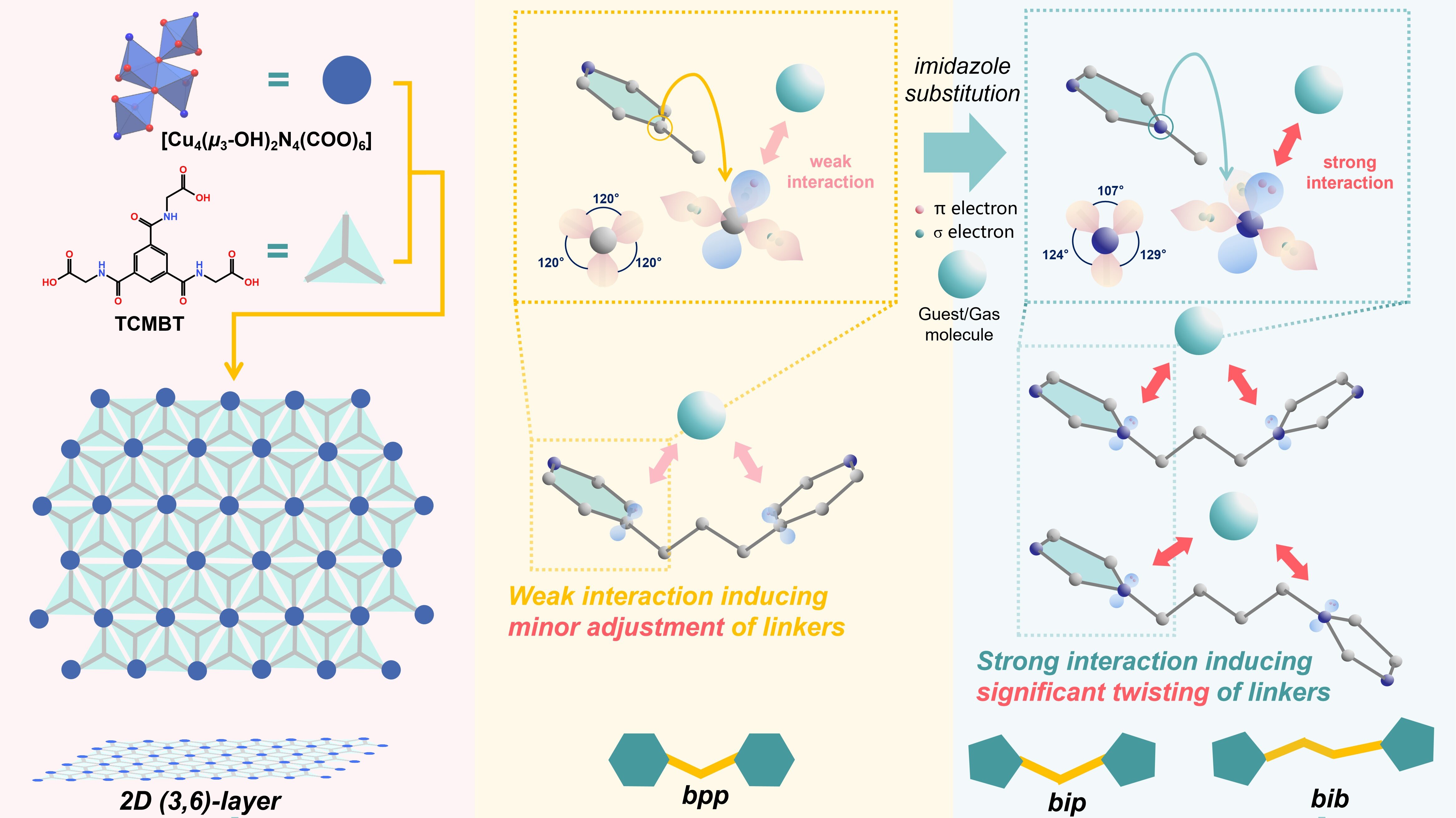
By introducing nitrogen-containing functional sites into the framework, we created a unique pore environment where LPEs could participate in interactions with guest molecules based on their quadrupole moments or hydrogen-bond acidity. Among Ar, N₂, and CO₂, only CO₂ with a pronounced quadrupole engages in strong electrostatic interactions with the LPEs to induce pore reopening, whereas nonpolar Ar and N₂ remain inactive. In the H₂O/CH₄/SF₆ group, water acts as a robust hydrogen-bond donor to trigger framework expansion, while CH₄ (weak donor) and SF₆ (inert) produce negligible uptake. For the propylene/propane pair, the slightly higher acidity of vinylic hydrogens in propylene enables preferential interaction with LPEs, initiating a cooperative gate-opening transition; propane, lacking sufficient affinity, fails to open the pore.
This behavior revealed a new type of molecular recognition mechanism: the framework could “recognize” specific gas molecules and adjust its structure accordingly. Rather than designing a completely rigid adsorption environment, we used controlled flexibility as an advantage to improve separation performance.
3. Overcoming the balance between flexibility and stability
One of the most challenging aspects of this research was maintaining structural stability while introducing dynamic behavior. Flexible frameworks are attractive because they can adapt to external stimuli, but uncontrolled structural changes may lead to instability or loss of performance. For practical applications, an ideal material should respond selectively while maintaining structural integrity during repeated operation.
Through rational structural design, we developed a stable MOF that exhibited gas-triggered flexibility without sacrificing robustness. The framework retained its structural characteristics under different conditions while preserving its ability to selectively recognize propylene.
This result demonstrates that flexibility and stability are not necessarily contradictory properties. When precisely regulated through chemical interactions, structural flexibility can become an effective strategy for achieving highly selective molecular separation.
4. Considering scalability beyond laboratory synthesis
While discovering new materials is important, translating them toward practical applications requires consideration of preparation methods. Many reported MOFs are synthesized using organic solvents or complicated procedures, which may limit their large-scale production.
Therefore, another important goal of this work was developing a more sustainable synthesis approach. We successfully prepared the material through an aqueous scalable synthesis strategy, demonstrating that the framework could be obtained using water as the reaction medium while maintaining its structural and separation properties.
This scalable preparation highlights the potential of combining advanced material design with more environmentally compatible synthesis methods, bringing MOF-based separation technologies closer to practical applications.
5. Looking beyond this study
This work provides a new perspective for designing porous materials by highlighting the importance of electronic interactions in controlling framework dynamics. Instead of treating flexibility as an intrinsic and uncontrollable feature, our study demonstrates that molecular recognition sites can be used to program responsive behavior in stable frameworks.
The concept of gas-recognizable flexibility may offer new opportunities for developing advanced materials for challenging separations, including hydrocarbon purification, carbon dioxide capture, and selective sensing. More broadly, we hope this study encourages researchers to view MOFs not only as static porous structures but also as adaptive molecular systems capable of responding intelligently to their surroundings.
Scientific discoveries often emerge from unexpected observations and continuous exploration. In this project, a simple idea—using lone-pair electrons to regulate framework behavior—eventually developed into a strategy for designing responsive porous materials. We believe that future separation technologies will benefit from materials that not only possess high adsorption capacity, but also have the ability to selectively recognize and respond to target molecules.

Research Interest: Crystalline porous materials, Metal-organic frameworks, Hydrogen-bonded-organic frameworks, Covalent-organic frameworks, Gas storage and separation, Atmospheric water harvesting, Indoor humidity control, Photocatalytic CO2 reduction, Photochromism
Follow the Topic
-
Nature Communications
An open access, multidisciplinary journal dedicated to publishing high-quality research in all areas of the biological, health, physical, chemical and Earth sciences.

Related Collections
With Collections, you can get published faster and increase your visibility.
Women's Health
Publishing Model: Hybrid
Deadline: Ongoing
Tumor Microenvironment Crosstalk and Therapeutic Implications
Publishing Model: Hybrid
Deadline: Nov 02, 2026

