Dual-strain Probiotics Improves Weight Gain in Premature Neonates: Evidence from a Randomized Clinical Trial in Afghanistan
Published in Biomedical Research and Paediatrics, Reproductive Medicine & Geriatrics


Introduction
Prematurity remains a major global health challenge and is among the leading causes of neonatal mortality worldwide. Premature neonates frequently experience slow weight gain, feeding intolerance, prolonged hospitalization, and increased risks of severe complications and death. Identifying affordable and accessible interventions that improve neonatal outcomes is especially important in low-resource settings.
Effective feeding of preterm and low-birth-weight neonates can reduce the complications and mortality associated with prematurity, and weight gain is an essential aspect of the management of preterm newborns. During the first three weeks of life, preterm neonates with a birth weight of 1000–2000 g achieve a mean daily weight gain of 5–20 g. In the second week after birth, preterm babies demonstrate the lowest mean weight increase, approximately 6.8 g/kg/day.
Probiotics are defined as “live microorganisms which, when administered in adequate amounts, confer a health benefit on the host.” The beneficial mechanisms of probiotics include modulation of intestinal permeability, enhancement of mucosal IgA responses, increased production of anti-inflammatory cytokines, promotion of intestinal maturation, and maintenance of mucosal integrity. Based on these multiple beneficial mechanisms, dual-strain probiotics may be more effective than single-strain probiotics.
A few studies have assessed the effect of probiotics on weight gain in premature neonates; however, the results remain controversial and conflicting. Single-strain probiotics containing Lactobacillus acidophilus, Bifidobacterium infantis, or Saccharomyces boulardii have been associated with increased neonatal weight gain per day. In contrast, four-strain probiotics showed no significant effect on mean weight gain in preterm neonates. Full enteral feeding was achieved earlier among neonates receiving probiotics. Oral probiotic supplementation has also been shown to significantly reduce the risk of necrotizing enterocolitis (NEC) and neonatal mortality. Furthermore, probiotics are considered safe and effective in reducing the risk of late-onset sepsis in preterm neonates. Probiotics have also been associated with shorter hospital stays, and combinations of probiotic strains may produce the greatest reduction in the development of NEC in premature infants.
Previous studies have highlighted the importance of strain-specific variations in probiotic products and their effects on host interactions in the preterm gut. Dual-strain probiotics appear to be more effective than single-strain probiotics. Bifidobacterium bifidum has been shown to accelerate the establishment of enteral feeding in preterm infants and shorten the time required to achieve adequate weight gain. In addition, Clostridium butyricum has been demonstrated to improve intestinal barrier function and positively affect growth performance. Butyrate, produced by Clostridium butyricum, is a major gut microbial metabolite beneficial for gastrointestinal health. Clostridium butyricum lacks Clostridium toxin genes, antagonizes enteric pathogens, and contributes to the prevention of infectious diseases by enhancing antimicrobial innate and cytokine-mediated immunity. Enhancing weight gain in preterm neonates may reduce complications, shorten hospital stays, decrease mortality, and improve overall neonatal care.
Before our study, limited evidence existed regarding the effects of probiotics on weight gain in preterm neonates. Therefore, there was a paucity of data concerning the effects of combined Bifidobacterium bifidum and Clostridium butyricum probiotics on weight improvement in premature infants. Moreover, among the many strategies attempted to enhance weight gain in preterm neonates, probiotic administration appears to be one of the most promising approaches. Therefore, the objective of this randomized controlled trial (RCT) was to compare the effectiveness of dual-strain probiotics comprising Bifidobacterium bifidum and Clostridium butyricum with a non-probiotic group in terms of weight gain, age to achieve full enteral feeding, and duration of hospital stay in preterm neonates with a gestational age of ≤35 weeks or a birth weight of <2000 g in Kabul hospitals. The risks of feeding intolerance and neonatal mortality were also evaluated as secondary outcomes.
Based on recent studies, we hypothesized that dual-strain probiotics are more effective than single- or multiple-strain probiotics. Furthermore, Bifidobacterium bifidum and Clostridium butyricum improve intestinal function and prevent complications in preterm neonates. Therefore, the combination of Bifidobacterium bifidum and Clostridium butyricum probiotics may improve weight gain and achievement of full enteral feeding, while reducing the duration of hospital stay and mortality in preterm neonates.
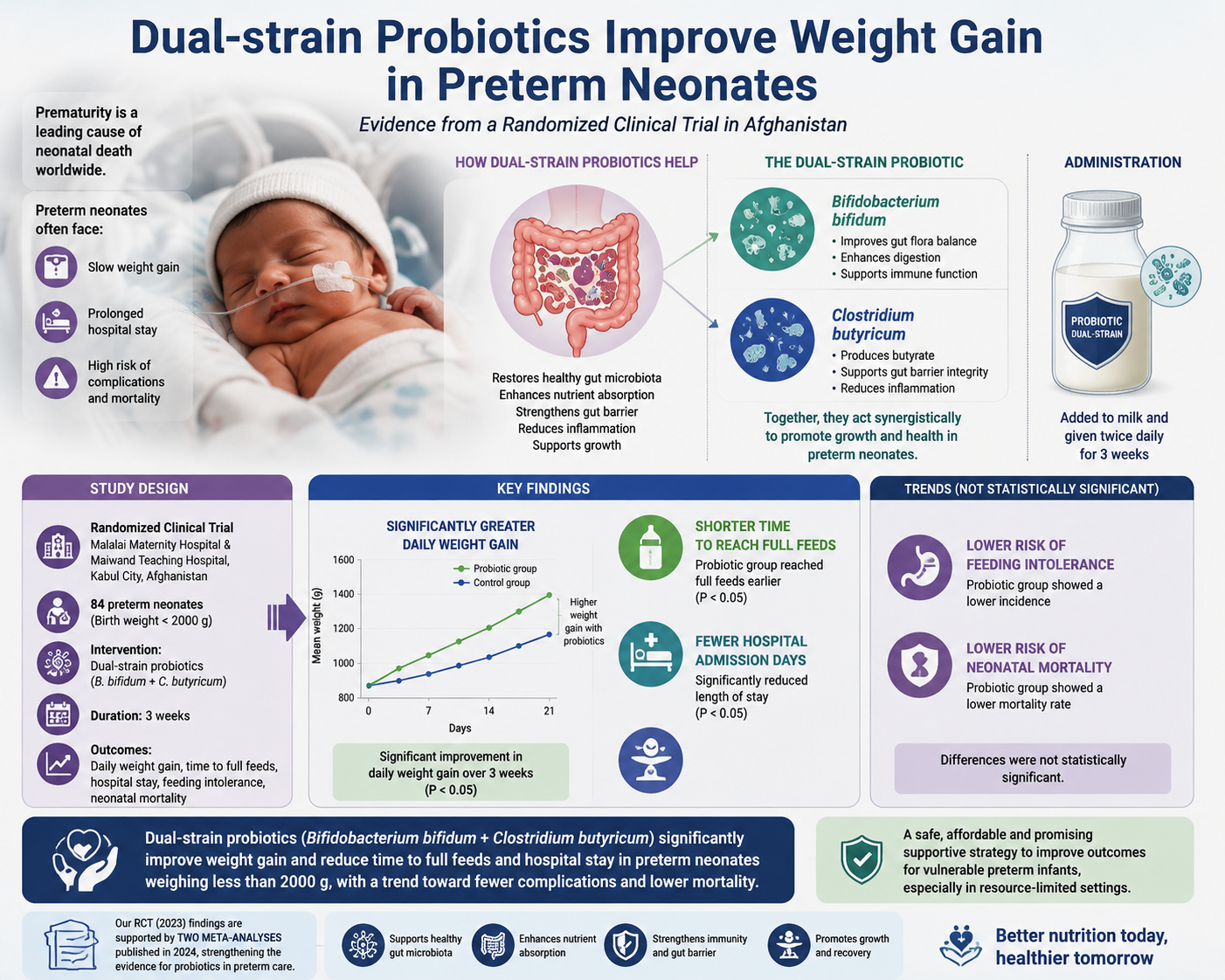
We conducted a randomized clinical trial in the Neonatal Units of Malalai Maternity Hospital and Maiwand Teaching Hospital in Kabul City. A total of 84 premature neonates participated in the study. The intervention consisted of dual-strain probiotics containing Bifidobacterium bifidum and Clostridium butyricum, which were added to milk and administered twice daily for three weeks.
Findings and Conclusion
The study demonstrated that premature neonates in our setting experienced slower weight gain compared with reports from higher-income countries, particularly in the control group. Importantly, supplementation with dual-strain probiotics significantly improved daily weight gain, shortened the time required to achieve full feeds, and reduced hospital admission days among premature infants weighing less than 2000 grams.
Although the risks of feeding intolerance and neonatal mortality were somewhat lower in the probiotic group, these differences did not reach statistical significance. Nevertheless, the findings suggest that probiotic supplementation may represent a promising, low-cost supportive intervention for improving neonatal growth and recovery in resource-limited settings.
This study contributes important evidence from Afghanistan to the growing international literature on probiotics and neonatal health. The recent publication of supportive meta-analyses further highlights the increasing scientific interest in the role of the neonatal microbiome and probiotics in improving outcomes among vulnerable premature infants.
#Neonatology #Prematurity #Probiotics #NICU #GlobalHealth #Pediatrics #NeonatalCare #MedicalResearch #Microbiome #InfantHealth