EBV reactivation priming of the peripheral immune system in multiple sclerosis relapse


Study idea:
I first began studying relapse mechanisms in about 2018. I published with my lab several studies on the correlation of serum neurofilament light chain (NfL) levels as well as other proteins with new gadolinium enhancing MRI lesions and relapses in the multiple sclerosis (MS). We used biosamples from the Comprehensive Longitudinal Investigations in MS at the Brigham (CLIMB) study, initiated by Howard Weiner, that I currently direct, in which patients donate a blood sample annually at their routine clinical visits. This work piqued my interest in understanding the mechanisms of a relapse, and in 2020, I applied for received a grant from the Department of Defense to study biomarkers and mechanisms of a relapse. To this end, we identified peripheral blood mononuclear cells (PBMC) collected at annual CLIMB visits both at the time of a relapse as well as up to 3 months prior to a relapse (pre-relapse), since I hypothesized that the immune mechanisms leading up to a relapse would take several weeks to occur. We found paired “remission” blood samples from the same patient within a year of the pre-relapse sample, on the same treatment.
Initiating the study:
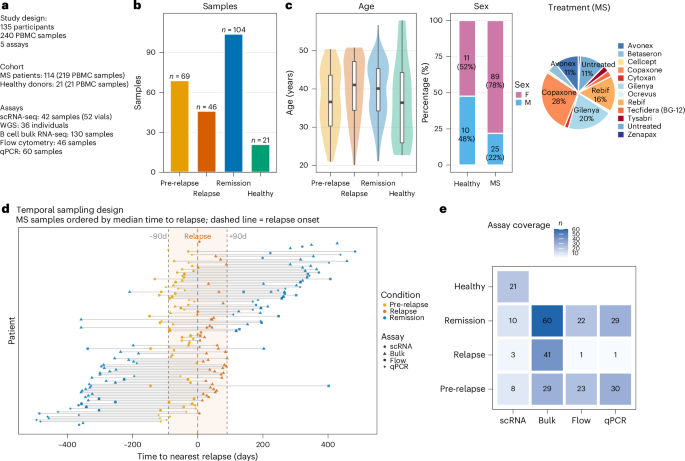
Devin King, who was a new postdoctoral fellow in my lab with a background in bioinformatics and molecular biology took on this project and started to perform single cell RNA sequencing (scRNAseq) on the paired pre-relapse and remission samples. We were surprised to find the most robust differences with paired remission samples were in samples 30-90 days prior to a relapse, and not those taken at the time of a relapse, supporting my initial hypothesis. This incentivized us to find and study additional pre-relapse samples. We were able to assemble a final cohort of 114 MS patients with samples at these various timepoints. Our expanded scRNAseq results confirmed that the most robust differences with remission were in the pre-relapse samples, with the most significant changes seen in B cell subsets and monocytes. We confirmed these findings using bulk RNA sequencing in sorted B cells and monocytes. The differentially expressed genes fell into several categories, however, did not follow the typical immunological changes seen in classical EAE models. In 2022, Alberto Ascherio and colleagues published a seminal study in Science demonstrating the temporal relationship of EBV seropositivity preceding the first signs of MS demonstrated by elevations in serum NfL. I began to look into EBV-related mechanisms and felt that we needed to examine a potential relationship of relapses with EBV lytic reactivation. In order to do so, I asked a colleague, Dr Benjamin Gewurz who is an Infectious Diseases physician at the Brigham and EBV expert, to collaborate and help us decipher EBV-related biology, and he kindly agreed. We first tried to look for EBV gene expression directly in our single cell datasets, which was not fruitful, possibly due to transient and low expression. We searched for host-immune cell responses to specific EBV lytic and latent genes from the literature, and Ben identified a comprehensive study by Arvey et al. We applied these EBV host-immune response gene sets to our data and found that the most robust changes were indeed in the pre-relapse samples compared to remission samples, and especially changes involving EBV lytic genes. Devin presented this work at the ACTRIMS 2025 meeting and was awarded the Best Young Investigator award for an oral presentation.
Validating the findings:
We submitted the work to Nature Medicine in the spring of 2025, however the reviewers, rightly so, requested additional corroborative evidence. Shrishti Saxena in my lab had been conducting flow cytometry on B cell subsets from the pre-relapse and remission samples and Devin using FlowSom analysis, found that atypical B cell subsets were significantly increased pre-relapse, confirming our single cell results. Danielle Caefer led the confirmatory studies using RT-qPCR, which identified LMP1 as significantly increased pre-relapse. We needed to confirm our initial findings in a larger cohort, and the whole lab pitched in during late 2025 to complete these studies. Devin also analyzed the overlap of the differentially expressed genes with the known MS risk genes and found the most robust differences pre-relapse and in ABC cells. We were able to submit a substantially revised manuscript in spring of 2026. The reviewers generally approved of these changes and after some additional revisions the work was fully accepted for publication in August 2026.
Summary of findings and next steps:
We believe this work explains the molecular mechanisms of how lytic reactivation of EBV in B cell subsets results in EBV gene expression including EBNA2 and LMP1; these genes in turn interact with MS risk genes and enhance cell survival to give rise to proinflammatory B cells which initiate MS relapses. This publication focuses the spotlight on EBV lytic reactivation in B cells as the instigator of attacks, and possibly of MS itself. We are currently evaluating potential therapeutic targets from this work and as well as exploring whether these mechanisms are relevant in the earliest stages of MS as well as in progressive forms of MS. We hope that this publication will spur additional research on these themes and will eventually lead to new ways to treat and potentially prevent the debilitating disease MS which affects millions of people worldwide.
We are truly grateful to the patients who donated blood samples to the CLIMB study, study staff and clinicians as well as the funders and supporters of this work.
– Tanuja Chitnis MD

Follow the Topic
-
Nature Medicine
This journal encompasses original research ranging from new concepts in human biology and disease pathogenesis to new therapeutic modalities and drug development, to all phases of clinical work, as well as innovative technologies aimed at improving human health.

Related Collections
With Collections, you can get published faster and increase your visibility.
Clinical Research in Respiratory Medicine
Publishing Model: Hybrid
Deadline: Feb 18, 2027
Cancer Prevention and Control
Publishing Model: Hybrid
Deadline: Feb 19, 2027