When queens cheat and workers cheat back: hormonal power struggles in ant society
Published in Ecology & Evolution, Zoology & Veterinary Science, and Anatomy & Physiology

How it began: evidence within related taxa
At first glance, colonies of social insects such as ants, wasps, and bees may seem like true utopias of cooperation. But this image is only superficial: beneath the apparent order lie surprisingly complex dynamics, with evolutionary tensions and power struggles that shape who gets to transmit their genes to the next generation.
The Argentine ant, native to South America and invasive on every other continent, forms colonies are composed of millions of workers and hundreds of queens. However, every year, about 90% of queens are intriguingly executed by workers (Keller et al., 1989). This raises the question: why waste precious resources raising these individuals only to kill them later? A similar phenomenon occurs in Melipona stingless bee, where around 10% of larvae hijack their own developmental fate to become queens, only for most to be swiftly eliminated by their nestmates (Wenseleers & Ratnieks 2004). Together, these two examples suggest the internal competition can become so intense that societies risk collapsing under the weight of their own conflict.
This body of evidence suggests that our target species, Tapinoma darioi, a supercolonial ant that, like the Argentine ant, builds vast, interconnected nest networks hosting millions of workers and hundreds of queens, is an ideal system in which to study these conflicts. Like all ant colonies, it runs on a strict division of labour: the reproductive caste is the one that passes on genes directly, while workers perform tasks such as foraging, defending their nests, and raising the young. However, in such a large colony, many workers end up caring for queens to whom they bear no genetic relationship. This creates the exact conditions for conflict to flourish and, in particular, for queens to cheat by producing more reproductive offspring than is in the colony’s collective interest.
Can queens load their eggs with a developmental advantage?
Juvenile hormone (JH), a key developmental signalling molecule, has been shown to bias brood development towards a queen fate when present at elevated levels in several ant species (Li et al., 2024), and has even been documented to be transmitted from mother queens to their eggs in others (de Menten et al., 2005). The question we wanted to answer was whether queens could actively exploit this mechanism: could they increase JH deposition into their eggs, effectively giving their offspring a developmental head start towards a reproductive fate, even if it comes at the cost of colony stability?
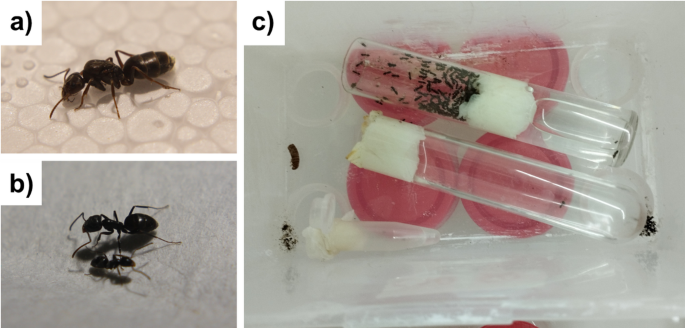
To test this, we experimentally manipulated JH signalling in queens of T. darioi using methoprene, a JH analogue that mimics the hormone's effects, and precocene II, which inhibits its synthesis. We then rigorously monitored what happened to the brood over three months.
What were queens doing, and how did workers respond?
The results were striking. When we artificially elevated JH signalling in queens, we observed a corresponding increase in the rate at which workers cannibalized larvae. Moreover, this cannibalization was proportional to the number of queens present within the colony (Fig. 1).
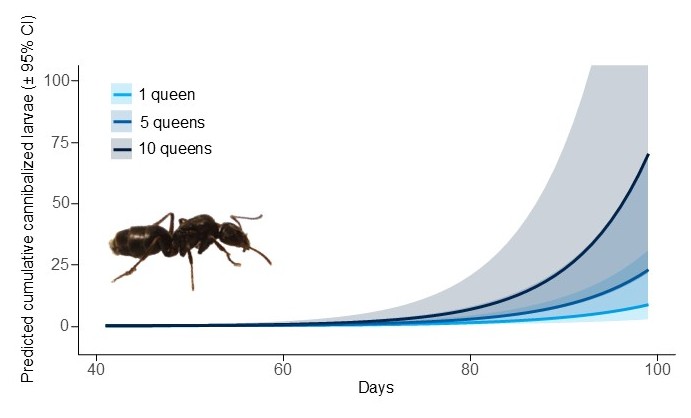
Figure 1: Larval cannibalization increases proportionally with the number of queens present in the colony, while brood production itself remains unaffected by queen number.
Queens appeared to be biasing their offspring towards reproductive fates, and workers seemed to detect this and respond by eliminating the excess larvae before the colony invested further resources in them. Indeed, larvae of queens with elevated JH had significantly higher chances of being cannibalized than those of controls.
Workers were not randomly destroying brood. We identified, for the first time in this species, the exact developmental window at which workers detect the brood's developmental fate and decide to act on it: approximately 25 days after larval emergence. Before that point, workers appear unable to distinguish future queens from future workers.
This timing makes biological sense. In species with clear morphological differences between castes, developmental fates become canalized early during embryogenesis (Qiu et al., 2022), but the external signals that betray that fate to nestmates likely emerge later (Schultner & Pulliainen 2020). The 25-day window is therefore likely the earliest moment when some detectable cue, whether chemical, physical, or behavioural, first becomes detectable to workers. They then act swiftly to avoid cascading investment in unnecessary future queens.
What surprised us
Perhaps the most striking aspect of these findings is how they illustrate an evolutionary arms race between individual and collective interests taking place within a colony. In one hand, queens have evolved mechanisms to bias their offspring towards reproductive fates. On the other hand, workers have evolved counter-mechanisms to detect and remove the excess. This reflects a delicate balance that must be maintained to ensure the colony is neither swamped with queens nor stripped of them entirely.
Our results suggest that workers are not merely passive participants in the colony's reproductive decisions. They retain meaningful influence, at least at this critical developmental stage. Queens may try to take advantage of the situation by shaping the colony's future according to their self-interests, but workers are constantly patrolling the nursery and deciding who survives to pass on the colony's genes to next generations (Fig. 2).
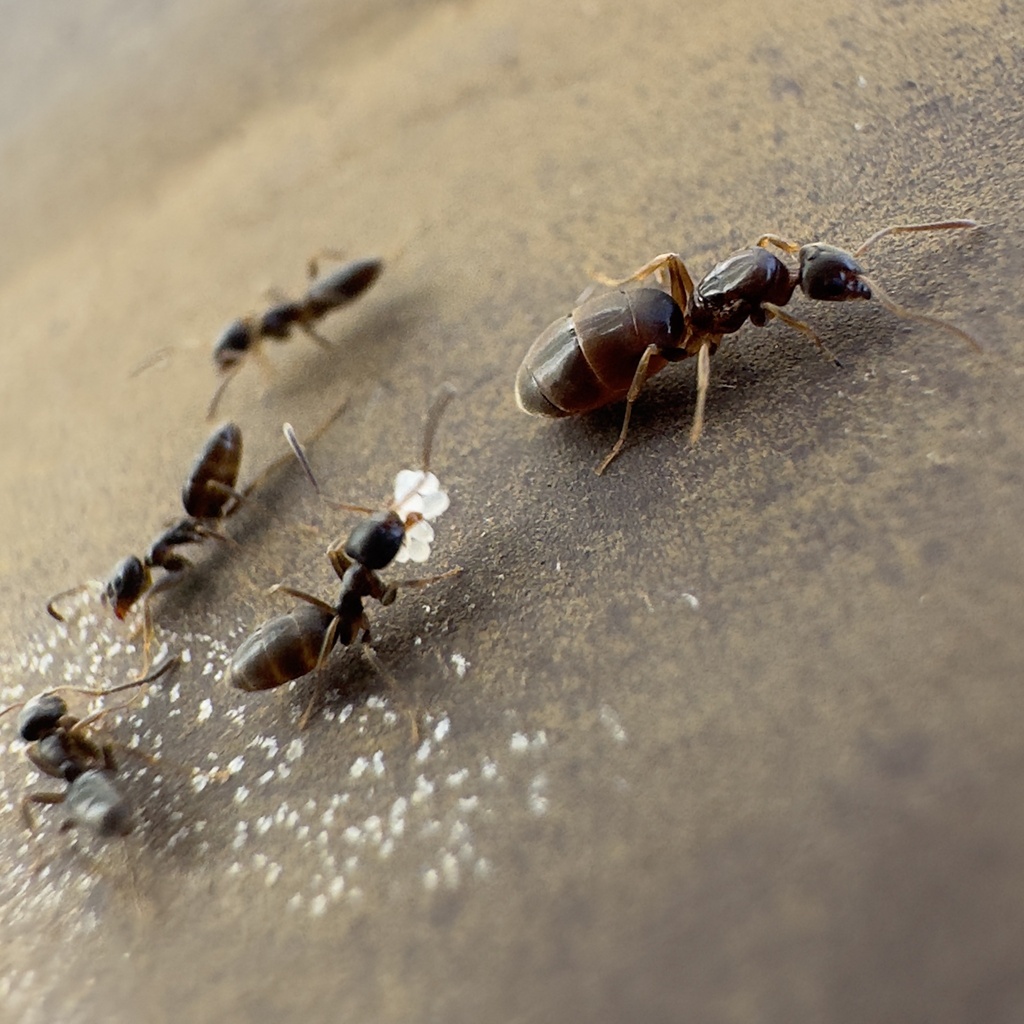
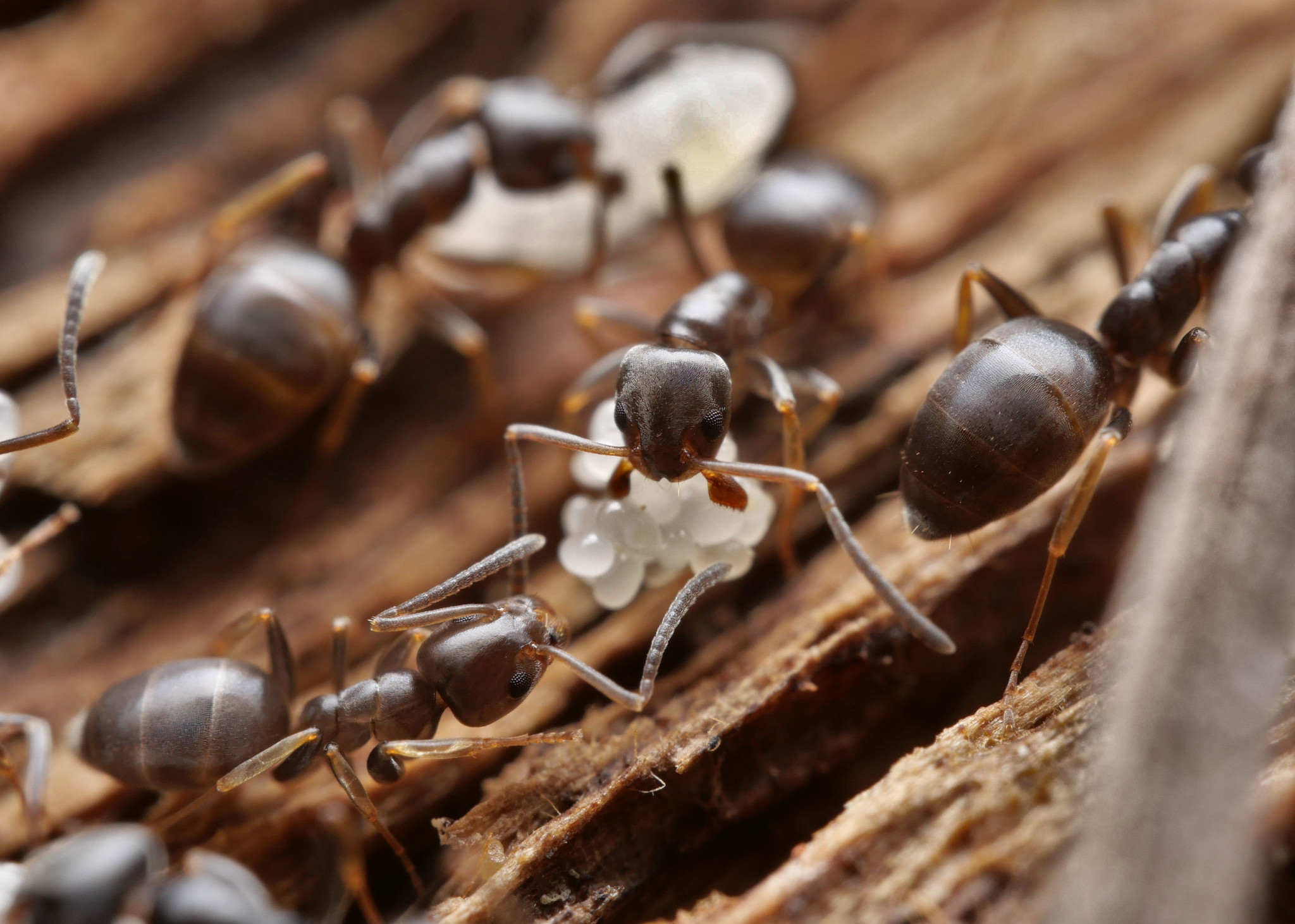
Figure 2: A Tapinoma ant worker carries brood in her mouth while following the queen.
What comes next
Many questions arise from our study. We have shown that JH manipulation in queens is associated with increased larval cannibalism, but the precise mechanisms linking maternal endocrine state to larval developmental outcomes remain to be confirmed. Additionally, how do workers detect a larva's developmental trajectory in the first place? Is it a chemical cue on the larval cuticle? A difference in body size or behaviour? Future work combining endocrine quantification with fine-scale developmental tracking will be needed to answer this.
Our findings illustrate that the balance between cooperation and conflict is actively maintained through behavioural and physiological negotiations between individuals with divergent, and sometimes diverging, evolutionary best interests.
References
de Menten, L., Fournier, D., Brent, C., Passera, L., Vargo, E. L., & Aron, S. (2005). Dual mechanism of queen influence over sex ratio in the ant Pheidole pallidula. Behavioral Ecology and Sociobiology, 58(6), 527–533.
Keller, L., Passera, L., & Suzzoni, J. P. (1989). Queen execution in the Argentine ant, Iridomyrmex humilis. Physiological Entomology, 14(2), 157–163.
Li, R., Dai, X., Zheng, J., et al. (2024). Juvenile hormone as a key regulator for asymmetric caste differentiation in ants. Proceedings of the National Academy of Sciences, 121(46), e2406999121.
Qiu, B., Dai, X., Li, P., et al. (2022). Canalized gene expression during development mediates caste differentiation in ants. Nature Ecology & Evolution, 6(11), 1753–1765.
Schultner, E., & Pulliainen, U. (2020). Brood recognition and discrimination in ants. Insectes Sociaux, 67(1), 11–34.
Wenseleers, T., & Ratnieks, F. L. (2004). Tragedy of the commons in Melipona bees. Proceedings of the Royal Society of London. Series B: Biological Sciences, 271(suppl_5), S310–S312.

Follow the Topic
-
Behavioral Ecology and Sociobiology
This journal publishes reviews, original contributions and commentaries dealing with quantitative empirical and theoretical studies in the analysis of animal behavior at the level of the individual, group, population, community, and species.