Editor story: Dr. Davide Bacco
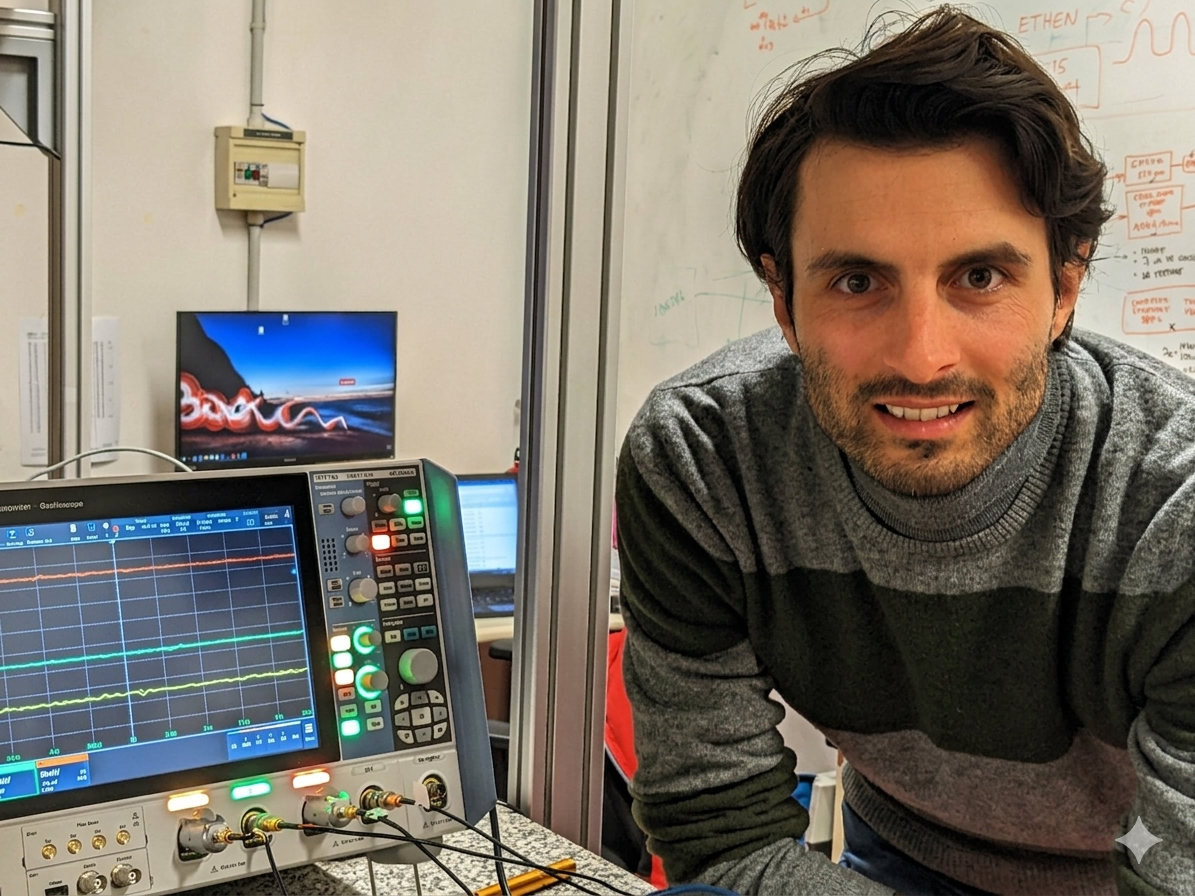
Dr. @Davide Bacco is an Associate Professor of Physics at the University of Florence (UniFI) and Principal Investigator of the ERC project QOMUNE. His research focuses on quantum communications, high-dimensional quantum key distribution, integrated photonics, and multicore optical fibres, with an emphasis on translating advances in quantum optics into scalable quantum-safe telecommunications networks. He has been an Editorial Board Member for Scientific Reports since 2022 and served as a Guest Editor for the collection Integrated Photonics.
***
In this interview, we asked Dr. Davide Bacco to talk to us about his work as an Editor at Scientific Reports. Read on to find out more.
What do you like most about being an Editorial Board Member for Scientific Reports?
I deeply value being part of a platform that prioritizes scientific rigor and technical validity over perceived impact or buzz. It provides an inclusive stage for researchers globally to share robust findings. Navigating diverse submissions across physics and quantum technology keeps me connected to emerging ideas beyond my immediate specialization, while contributing to a transparent, fair peer-review culture.
What do you like most about handling manuscripts at Scientific Reports?
I enjoy seeing the remarkable breadth of international research. Handling manuscripts allows me to help authors refine their work by facilitating constructive, objective feedback. Focusing on the technical soundness of the data rather than speculative claims ensures that solid, reliable science finds its home in the literature quickly.
We know that finding reviewers is one of the hardest parts of an editorial role. Do you have any tricks on finding reviewers?
I look beyond the usual senior names and actively invite promising early-career researchers and postdocs who are publishing actively in the niche topic. They are often exceptionally thorough, up to date with modern methodologies, and eager to contribute. I also scan reference lists carefully to identify authors of related, recent experimental works.
If you were to give a piece of advice to other Editors, what would that be?
Actively guide the review process rather than just accumulating opinions. When reviewer comments conflict, don't leave the authors guessing. In other words, synthesize the feedback, highlight the core technical issues that need resolving, and give clear, decisive directions. Decisiveness saves time for both authors and reviewers.
How important is reproducibility in research? As an Editor, how do you help authors report reproducible results?
Reproducibility is the absolute foundation of trustworthy science. In experimental physics, the result is only meaningful if another lab can replicate it. As an Editor, I ensure authors provide comprehensive supplementary material, detailed parameter descriptions, and raw datasets or open-source scripts whenever possible.
What are the key things journals should do to ensure scientific rigor?
Journals should enforce strict policies on data sharing, code availability, and clear methodological reporting. Encouraging standardized reporting guidelines and providing clear frameworks for reporting negative or null results also prevents cherry-picking and bolsters long-term scientific integrity.
Do you think Scientific Reports help reduce publication bias, and if yes – how?
Yes, significantly. By focusing explicitly on technical correctness rather than subjective novelty or "high impact," Scientific Reports provides a space for negative results, replication studies, and incremental advancements that traditional high-impact journals often reject despite their immense scientific value.
What would you like to share with your fellow researchers on publishing in an inclusive journal?
Inclusivity accelerates global collaboration. Publishing in an open, inclusive journal ensures your work reaches a broad audience across disciplines and geographic regions without artificial barriers, maximizing its real-world utility and reach.
What are the biggest challenges that you see for the future of research and research dissemination?
The sheer volume of publications makes signal-to-noise ratio a massive challenge. Ensuring rigorous peer review at scale while preventing peer-review burnout, alongside managing the transition toward fully open, equitable access without prohibitive costs for developing nations, are critical hurdles ahead.
What are responsible ways to integrate AI into the peer review process, and how can editors feel empowered to explore these new tools to provide helpful solutions for authors, editors, reviewers, and AI experts?
AI can assist in screening for formatting compliance, verifying citations, checking data consistency, or identifying qualified reviewers. However, human judgment must remain central for assessing scientific validity and originality. Editors should embrace AI as an administrative efficiency tool while upholding strict confidentiality and human oversight.
Leaning on your expertise in quantum technology, please give a piece of advice on how to approach/assess quantum secured communication studies, particularly concerning the specific research question and methodology.
Always evaluate whether the physical assumptions align with real-world implementation constraints. Look closely at channel loss model assumptions, detector noise, and phase/time stability over real fiber lengths rather than ideal back-to-back setups. Ensure that security proofs account for practical device imperfections rather than purely ideal theoretical states.

Follow the Topic
-
Scientific Reports
An open access journal publishing original research from across all areas of the natural sciences, psychology, medicine and engineering.

Related Collections
With Collections, you can get published faster and increase your visibility.
Cancer Prevention and Control
Publishing Model: Hybrid
Deadline: Feb 19, 2027
Healthy Aging
Publishing Model: Open Access
Deadline: Dec 31, 2026