Seeing Workforce Variability Before It Becomes Overtime
Published in Healthcare & Nursing, Public Health, and Arts & Humanities

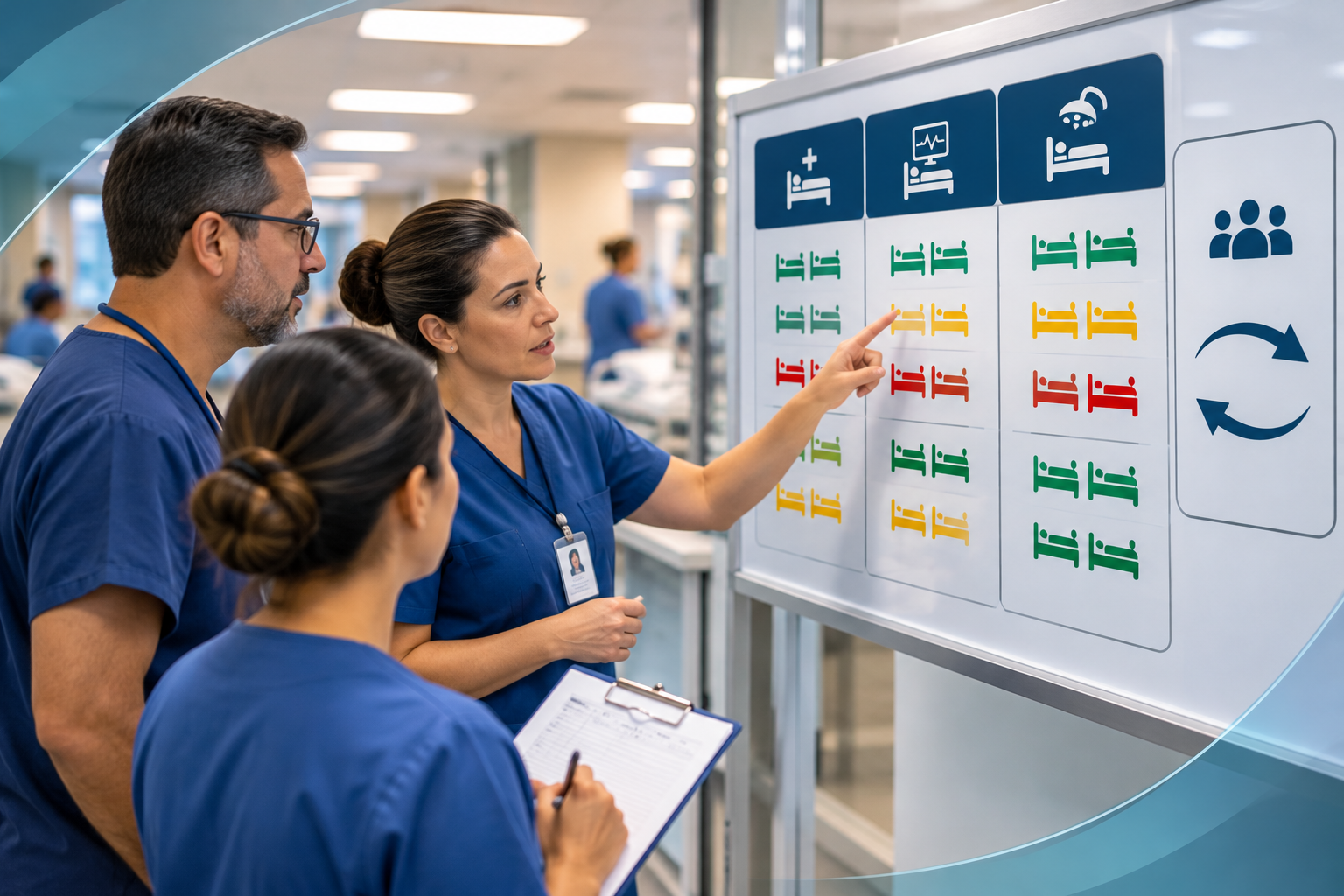

Hospitals rarely operate with perfectly stable demand.
Occupancy changes.
Professionals become unexpectedly unavailable.
Vacancies remain open.
Patient complexity varies.
One clinical area may experience a staffing deficit while another temporarily has capacity that could be safely redeployed.
The traditional response to these situations is often reactive:
a gap appears, and additional coverage is requested.
But what if the organization could identify the imbalance before overtime became necessary?
This question was central to our recently published study, Visual Management of Nursing Staffing to Improve Workforce Balance and Reduce Overtime Coverage: A Longitudinal Quality Improvement Study, in IJQHC Communications.
The intervention was not simply a dashboard
The visual management system combined a Kanban-based workforce board with a structured managerial routine.
Information on planned staffing, absences, vacancies, hospital occupancy, internal redeployment, overtime coverage, and related expenditure was brought into the same decision process.
The underlying logic was:
make imbalance visible → evaluate available capacity → redeploy safely when possible → use overtime as an escalation option
This distinction matters.
Visual management was not treated as a technology project.
It was a decision-support and governance process.
What did we observe?
The study analysed monthly data from January 2024 through May 2026.
Before implementation, mean monthly overtime coverage was 108.8 events.
After implementation, it decreased to 23.4 events, representing a 78.4% reduction.
Mean monthly overtime-related expenditure decreased from BRL 22,221.69 to BRL 6,071.42, a 72.7% reduction.
During follow-up, 459 internal staff redeployments were recorded, with estimated avoided expenditure of approximately BRL 99,916.
Hospital occupancy remained sustained during the post-implementation period.
Interrupted time-series analysis also identified a substantial immediate level reduction following implementation.
These findings should, however, be interpreted appropriately.
This was a single-centre quality improvement study. The intervention was temporally associated with the observed changes; it does not establish that visual management alone caused them.
That limitation is important.
But so is the operational question raised by the findings.
Perhaps the problem is not only workforce quantity
Healthcare workforce discussions frequently focus on numbers:
How many professionals do we have?
How many vacancies exist?
How much overtime are we using?
These are necessary questions.
But they may not be sufficient.
Another set of questions concerns organizational capability:
Can leaders see staffing imbalance early?
Can they compare demand and available capacity across units?
Can professionals be safely redeployed?
Are decisions based on shared information?
Is overtime the first response—or the final escalation option?
These are workforce governance questions.
Visibility changes when decisions happen
One of the most relevant lessons from the intervention was not simply that information became available.
It became available before the decision.
That difference is fundamental.
Retrospective indicators explain what happened.
Operational visibility can influence what happens next.
If a staffing deficit is recognized only after a unit is already under pressure, options are limited.
If the same deficit is identified earlier, managers may have time to evaluate capacity elsewhere, coordinate redistribution, and avoid unnecessary extraordinary coverage.
Visibility therefore changes the timing of management.
And timing changes the range of possible decisions.
From staffing management to workforce governance
This also connects with our previous research on organizational maturity and quality governance.
In Organizational Maturity as a Tool for Quality Governance, we observed that organizational maturity evolved through capabilities involving coordination, monitoring, standardization, and sustained improvement.
The workforce intervention provides a practical example of how those capabilities can become visible in daily operations.
Organizational maturity supports governance.
Governance organizes information and accountability.
Operational visibility supports earlier decisions.
Those decisions can influence measurable outcomes.
This suggests that workforce management should not be separated from the broader discussion on healthcare quality governance.
More data are not necessarily the answer
Hospitals already generate enormous amounts of information.
The challenge is often not data scarcity.
It is connecting the right information to the right decision at the right time.
A dashboard without a management routine may become decoration.
An indicator without responsibility may become noise.
Visibility without authority to act may produce frustration rather than improvement.
For visual management to function as a governance mechanism, information must be connected to:
-
responsibility;
-
decision-making;
-
escalation rules;
-
coordination between units;
-
follow-up;
-
and organizational learning.
Questions for healthcare leaders
Instead of asking only whether staffing is adequate, perhaps we should also ask:
Can we detect imbalance before it becomes overtime?
Do we distinguish structural workforce shortages from temporary operational variation?
Can capacity be safely shared across units?
Are staffing, absenteeism, occupancy, and demand analysed together?
Do our dashboards trigger decisions—or simply produce reports?
Do recurring overtime events generate organizational learning?
These questions move the discussion from scheduling toward governance.
And that may be increasingly important as hospitals face workforce shortages, financial constraints, rising complexity, and greater pressure to maintain safe care.
The objective should not be to minimize staffing.
It should be to use available workforce capacity more intelligently while protecting patients and professionals.
Perhaps this is the broader lesson from visual workforce management:
before adding resources, organizations should first understand whether they can see, coordinate, and use the resources they already have.
Related research
Diniz Rodrigues Filho RN, Barbosa MCP, Miranda GFS, Morais LG. Visual Management of Nursing Staffing to Improve Workforce Balance and Reduce Overtime Coverage: A Longitudinal Quality Improvement Study. IJQHC Communications. 2026. DOI: 10.1093/ijcoms/lyag046.
Diniz Rodrigues Filho RN, Morais LG. Organizational Maturity as a Tool for Quality Governance: A Longitudinal Study in a Brazilian Hospital. IJQHC Communications. 2026. DOI: 10.1093/ijcoms/lyag022.
Follow the Topic
-
BMC Nursing
This is an open access, peer-reviewed journal that considers articles on all aspects of evidence-based nursing care; nursing research methods; nursing service delivery, utilization, and evaluation; nursing administration and human resources.
-
Research in Science Education
-
BMC Health Services Research
An open access, peer-reviewed journal that considers articles on all aspects of health services research, focusing on digital health, governance, policy, system quality and safety, delivery and access, financing and economics, implementing reform, and the workforce.



Related Collections
With Collections, you can get published faster and increase your visibility.
Argumentation and the problem of misinformation in science education
While argumentation has long been a focus of science education research, the broad societal landscape is being reshaped by digital technologies and the diverse ways in which individuals engage with (mis)information in both public and educational spaces. The pressing issue has become particularly visible and urgent as various online platforms including social media emerge as dynamic public arenas for the exchange of information and opinions.
This collection explores the intersections of scientific literacy with the argumentation and other reasoning skills necessary to navigate information in the classroom, public debates or online. The articles examine how people navigate scientific information in a range of settings, and the role of traditional and digital interventions in enhancing access to scientific knowledge while critically examining the risks posed by misinformation and information overload. They also explore how learning opportunities can be created for collaborative and dialogic argumentation for students and adults. A recurring theme is the need for critical reasoning skills to identify credible sources and construct evidence-based arguments, particularly in environments rife with conflicting claims and lacking conclusive evidence.
The collection provides a nuanced understanding of how critical engagement with misinformation and promotion of evidence-based reasoning are evolving across diverse educational contexts. It also serves as a timely contribution to ongoing discussions about preparing learners and teachers to engage thoughtfully and responsibly with science in a rapidly changing world.
We invite future contributions that broaden the themes represented in the collection, for example, by exploring the integration of emerging digital tools and platforms, and the different political, cultural and scientific contexts where misinformation may originate and spread. Further research on justice and equity-oriented perspectives are also invited to contribute to the understanding of how scientific literacy and argumentation skills can be enhanced in the age of misinformation. Methodologically, we welcome a range of approaches, from systematic reviews and experimental interventions to conversation analysis and ethnography.
Publishing Model: Hybrid
Deadline: Dec 31, 2026
Multimodal literacies and representations for learning
In science education, students engage in reading, writing, drawing and representing across multiple modes for a range of reasons, in a range of contexts. Whilst these activities can be seen as having primarily a communication purpose, this Topical Collection focuses on their connection to learning. This connection has been well established in the literature, where the argument is made that these activities are not simply expressions of learning, but are core to the learning process.
This Topical Collection gathers a variety of themes around language and literacy in science that represent an increasing recognition of the critical role of language in framing cognition and/or emotion, and learning, and a widening perspective on the multimodal nature of languages including visual, material and embodied representational modes.
The collection recognises the distinction, but close relationship between representing as part of the process of sense making by individuals’ and/or collectives, and communication processes involving collaborative and public production of language forms (e.g. explaining, interpreting, demonstrating, reporting etc.). There is a similarly close connection between science disciplinary literacies and languages for learning science.
This topical collection consists of papers focused on the presentation, assessment, teaching and theorising of students’ material and embodied representation, communication or literacies in science across all educational levels. Articles in this collection include: semiotic analyses of language and learning; the role of teachers in supporting multimodal literacies; teacher professional learning for literacy support; typologies of language use or language structures; visual literacy; translanguaging and trans-semiotizing; language, power and equity; textbook analyses; literacy-focused assessment.
The topical collection will remain open for the addition of further articles focusing on science-specific language and literacies. All theoretical perspectives are welcome, including social semiotics, systemic functional linguistics, as well as cognitive model-based approaches and perspective on emotive-cognitive interplay. We encourage interested readers to follow the cited references and more recent research to explore the area and help to develop this field further.
Publishing Model: Hybrid
Deadline: Dec 31, 2026