Patient Flow Is Not Only an Operational Problem: It Is a Governance Challenge

Patient flow is often treated as an operational issue. But delays, overcrowding, workforce imbalance, and discharge bottlenecks frequently reflect deeper governance challenges involving coordination, visibility, accountability, and decision-making.
Patient Flow Is Not Only an Operational Problem: It Is a Governance Challenge
Like

Share this post

Choose a social network to share with, or copy the URL to share elsewhere

This is a representation of how your post may appear on social media. The actual post will vary between social networks

Patient flow is one of the most visible expressions of hospital performance.

When flow works well, patients move through the system with greater continuity, teams coordinate more effectively, beds are used more appropriately, and care delivery becomes safer and more predictable.

When flow fails, the consequences appear quickly.

  1. Emergency department overcrowding.
  2. Delayed admissions.
  3. Prolonged length of stay.
  4. Discharge bottlenecks.
  5. Workforce overload.
  6. Reactive decisions.
  7. Increased risk for patients and professionals.

For this reason, patient flow is often treated as an operational problem.

And it is.

But it is not only operational.

It is also a governance challenge.

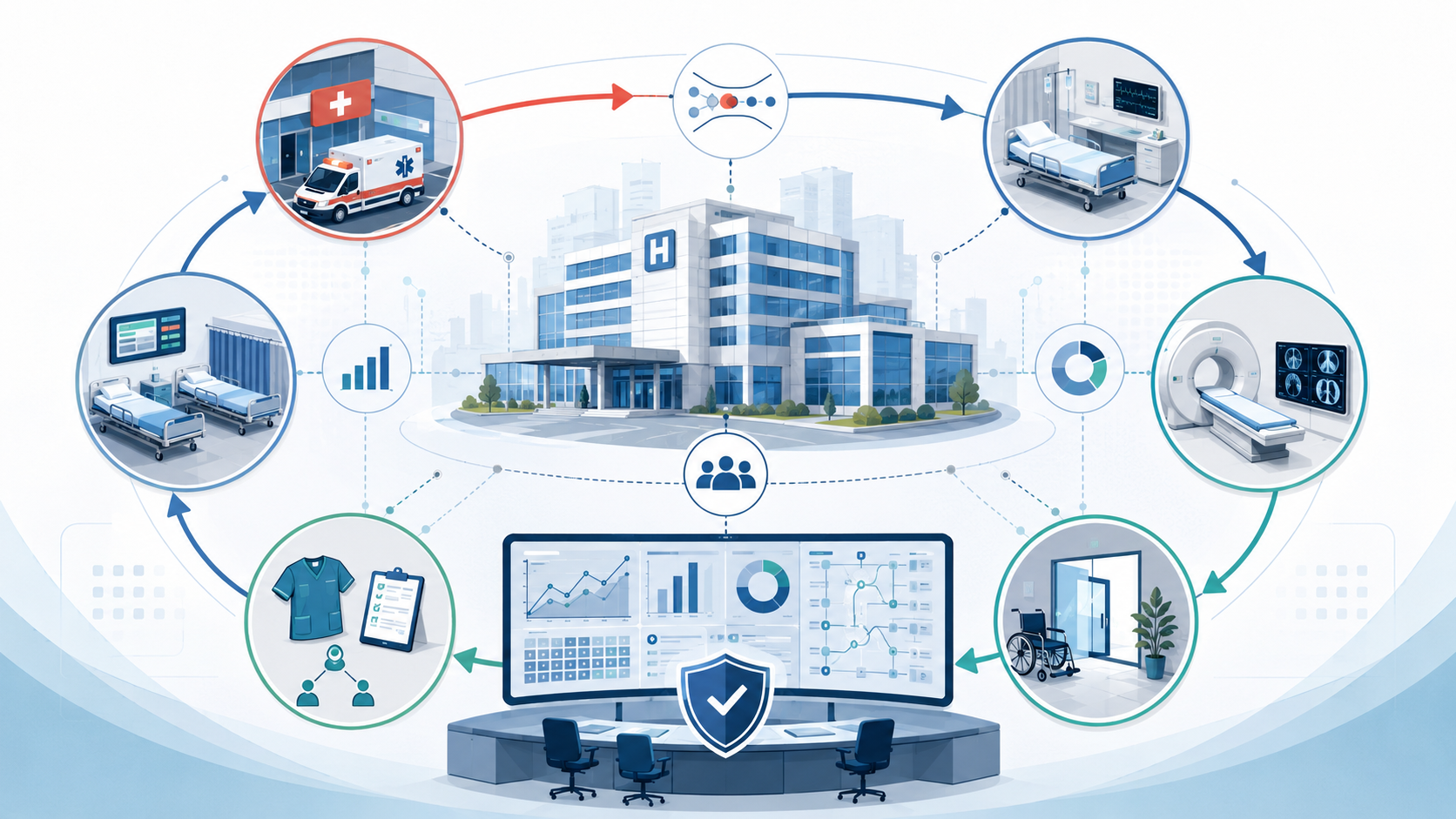
In complex hospitals, flow depends on the interaction of multiple systems: emergency care, inpatient wards, intensive care units, diagnostic services, surgical scheduling, discharge planning, bed management, nursing workforce allocation, medical decision-making, and administrative coordination.

No single department controls patient flow alone.

That is why isolated interventions often produce limited results.

A hospital may create a discharge protocol.

A bed management dashboard.

A multidisciplinary round.

A length-of-stay indicator.

A patient flow committee.

All of these tools may be useful.

But if communication remains fragmented, responsibilities are unclear, data are delayed, and leadership routines are disconnected from frontline reality, flow improvement may not be sustained.

The problem is rarely lack of effort.

More often, it is lack of coordination.

This perspective connects with our recent work on organizational maturity and quality governance.

In our longitudinal study, Organizational Maturity as a Tool for Quality Governance: A Longitudinal Study in a Brazilian Hospital, we explored how organizational maturity evolved across governance and quality-related domains in a Brazilian hospital.

The findings suggested that sustainable quality improvement depends not only on adopting tools or standards, but on developing organizational capabilities to coordinate, monitor, standardize, and sustain change over time.

Patient flow requires exactly this type of capability.

It requires timely information.

Clear accountability.

Shared priorities.

Operational visibility.

Leadership alignment.

A system capable of learning from variation.

A second example comes from our quality improvement preprint on visual management of nursing schedules and workforce balancing.

That intervention integrated nursing schedules, absenteeism, hospital occupancy, internal staff redistribution, overtime coverage events, and associated costs into a visual workforce management process.

Although the focus was nursing workforce balancing, the broader lesson applies directly to patient flow: visibility changes the quality of operational decisions.

When workforce imbalance becomes visible earlier, leaders can act before pressure becomes crisis.

The same principle applies to flow.

When bed occupancy, discharge barriers, staffing constraints, diagnostic delays, and admission demand are visible in time, the hospital can respond proactively rather than reactively.

This is where governance becomes practical.

Governance is not only a boardroom concept.

It is the set of structures, routines, responsibilities, and information flows that allow an organization to make better decisions under pressure.

In patient flow, governance means asking:

  • Who is responsible for identifying barriers?
  • Who has authority to act?
  • Are teams using the same information?
  • Are delays visible early enough?
  • Are decisions escalated appropriately?
  • Are clinical and operational priorities aligned?
  • Does the organization learn from recurring bottlenecks?

Without these mechanisms, patient flow becomes dependent on individual effort, informal communication, and daily improvisation.

With them, patient flow becomes a coordinated organizational capability.

This distinction matters because overcrowding and delays are not only signs of demand exceeding capacity.

They may also be signs of fragmented governance.

Fragmented decision-making.

Fragmented information.

Fragmented accountability.

Fragmented priorities.

Fragmented learning.

Hospitals cannot solve patient flow only by asking teams to work harder.

They need systems that allow teams to work with better coordination.

This does not mean that governance alone solves all flow problems. Structural capacity, workforce availability, case complexity, payment models, and external system constraints also matter.

But governance determines how well an organization uses the capacity it has.

It determines whether data become action.

Whether meetings produce decisions.

Whether indicators trigger learning.

Whether problems are escalated before they become crises.

Perhaps one of the most important lessons from healthcare operations is that patient flow is not simply the movement of patients through beds.

It is the movement of decisions through an organization.

And when those decisions are delayed, fragmented, or poorly coordinated, patients wait.

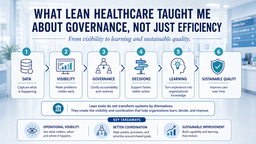
Sustainable patient flow improvement therefore depends not only on operational tools, but on mature governance systems capable of seeing, deciding, acting, and learning continuously.

Related research

Rodrigues Filho RND, Morais LG. Organizational Maturity as a Tool for Quality Governance: A Longitudinal Study in a Brazilian Hospital. International Journal for Quality in Health Care Communications. 2026. DOI: 10.1093/ijcoms/lyag022.

Rodrigues Filho RND, Barbosa MCP, Miranda GFS, Morais LG. Visual Management of Nursing Schedules for Workforce Balancing and Reduction of Overtime Coverage: A Longitudinal Quality Improvement Study. Research Square Preprint. DOI: 10.21203/rs.3.rs-10121229/v1.

Related literature: patient flow, hospital overcrowding, healthcare governance, operational visibility, Lean Healthcare, organizational maturity, and sustainability of quality improvement interventions.


Please sign in or register for FREE

If you are a registered user on Research Communities by Springer Nature, please sign in

Follow the Topic

Practice and Hospital Management
Life Sciences > Health Sciences > Health Care > Practice and Hospital Management
Health Policy
Life Sciences > Health Sciences > Public Health > Health Policy
Organizational and Strategic Communication
Humanities and Social Sciences > Media and Communication > Organizational and Strategic Communication
Health Care
Life Sciences > Health Sciences > Health Care
Health Administration
Life Sciences > Health Sciences > Public Health > Health Administration

Related Collections

With Collections, you can get published faster and increase your visibility.

Advancing Research Prioritization: Monitoring, Evaluation, and Implementation Strategies

Despite the critical role of research prioritization in optimizing funding allocation and shaping research agendas, there remains a notable gap in the literature on how these processes are assessed and implemented in practice. This special series aims to bridge this gap by bringing together studies that examine the frameworks, methodologies, and real-world applications of monitoring, evaluation, and implementation in research prioritization. We encourage submissions that explore both theoretical and empirical perspectives, with a focus on identifying best practices, challenges, and innovations in priority-setting mechanisms. Contributions may range from methodological discussions to case studies and policy analyses that shed light on how research prioritization efforts are designed, executed, and measured.

All submissions in this collection undergo the journal’s standard peer review process. Similarly, all manuscripts authored by a Guest Editor(s) will be handled by the Editor-in-Chief. As an open access publication, this journal levies an article processing fee (details here). We recognize that many key stakeholders may not have access to such resources and are committed to supporting participation in this issue wherever resources are a barrier. For more information about what support may be available, please visit OA funding and support, or email OAfundingpolicy@springernature.com or the Editor-in-Chief.

Publishing Model: Open Access

Deadline: Oct 08, 2026

Enabling Environments for Learning Health Systems: Capabilities, Cultures, and Conditions for Learning and Transformation

Health systems globally are under pressure to become learning organizations—capable of generating, sharing, and applying knowledge rapidly and equitably. However, the enabling conditions that make this possible remain under-theorized and inconsistently acted upon.

This Collection invites work that advances the science of enabling environments—the structural, cultural and capability-building conditions that support continuous, adaptive learning within health systems. We welcome conceptual, empirical, and practice-based contributions that explore, examine, and evaluate the enabling environment of learning health systems, including those that deepen collective understanding of the workforce capabilities, organizational cultures, and system conditions that sustain learning in health systems.

Suggested Subtopics

• Culture & Leadership

• Building a culture of curiosity, inclusion and psychological safety

• Roles of leadership and champions in advancing learning

• Embedding equity, patient and caregiver participation in learning practices

• Governance & Policy

• Governance models that promote distributed decision-making and learning

• Policies and incentives that enable experimentation and adaptive improvement

• System-level alignment of priorities, ethics review, and accreditation for learning systems

• Data & Digital Infrastructure

• Data literacy, interoperability and real-time analytics for learning

• Leveraging qualitative and experiential data alongside quantitative measures

• Digital tools and dashboards that support feedback loops and knowledge mobilization

• Funding & Investment Models

• Funding strategies tied to learning goals and long-term capacity building

• Models supporting dedicated time, embedded research roles and sustainability

• Aligning investment with community-identified priorities and system learning cycles

• Knowledge & Capacity Building

• Competency frameworks, continuing education and professional development for learning systems

• Research internships, embedded scientist models and mentorship programmes

• International learning collaboratives, communities of practice and peer-exchange networks

• Practice and Case Studies

• Case studies of health systems operationalizing enabling environments

• Implementation narratives from healthcare organizations, networks, or systems

• Evaluations of learning system maturity or embedded improvement practices

• Methodological Innovations

• Tools and measures for assessing learning system maturity

• Participatory methods, realist evaluation, developmental evaluation in learning systems

• Studies of learning ecosystems and co-design approaches

All submissions in this collection undergo the journal’s standard peer review process. Similarly, all manuscripts authored by a Guest Editor(s) will be handled by the Editor-in-Chief. As an open access publication, this journal levies an article processing fee (details here). We recognize that many key stakeholders may not have access to such resources and are committed to supporting participation in this issue wherever resources are a barrier. For more information about what support may be available, please visit OA funding and support, or email OAfundingpolicy@springernature.com or the Editor-in-Chief.

Publishing Model: Open Access

Deadline: Sep 17, 2026