Exploiting the Optoelectronic Nature of Antibiotics to Enhance the Efficiency of Organic Light-Emitting Diodes
Published in Electrical & Electronic Engineering
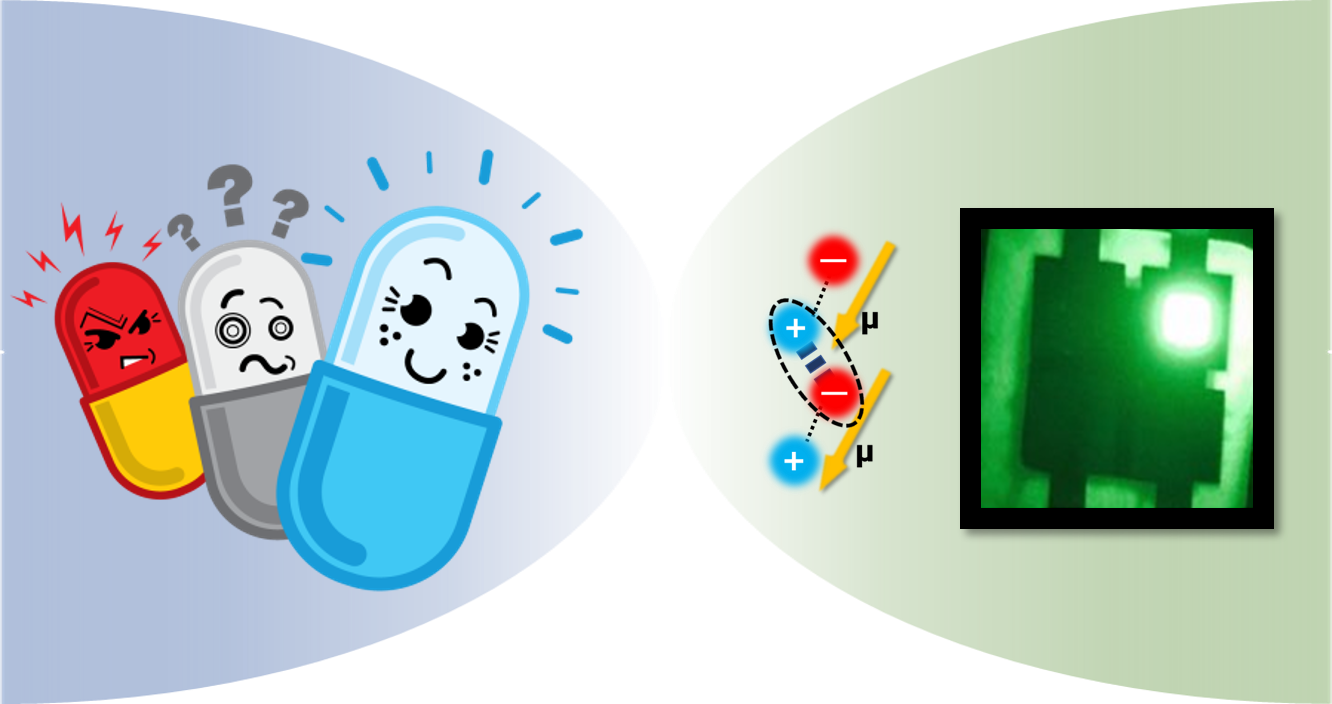

- Towards overcoming the efficiency barriers:
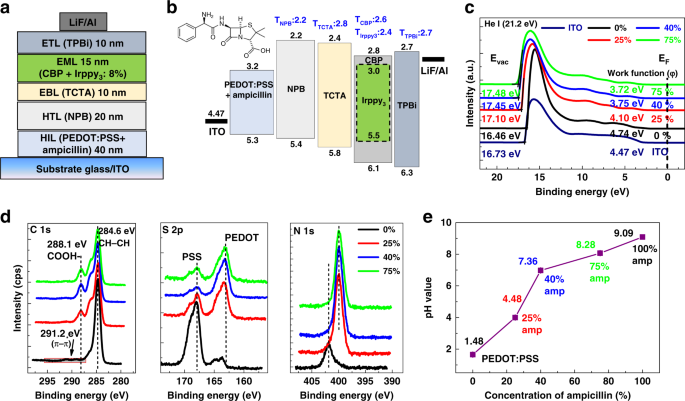
The developments in the field of organic light-emitting diodes (OLEDs) have enabled us to revolutionize the electronics, biomedical and display industry. The industrial demands due to recent energy crisis have shifted towards the fabrication of energy efficient and high throughput phosphorescent OLEDs. Attempts were made to overcome the efficiency barriers by introducing new techniques and methods but the phosphorescent OLEDs have a limitation of presenting a maximum of 25% external quantum efficiency (EQE) without out-coupling aid. As EQE of a device depends on various factors including charge balance, work function of the layers, efficient recombination, interface modifications etc., thus a material capable of tuning these parameters could enhance the efficiency by many factors.
- Search for an appropriate material:
In the quest to enhance the efficiency of the OLEDs, we received three different types of materials from department of life science and biochemical engineering, Sunmoon University. A bacterium germ (colon bacillus), a DNA protein and ampicillin. The preservation of bacteria was a strong challenge and their incorporation into the OLEDs could have caused instability. The DNA protein was added to the widely known optoelectronic material Poly(3,4-ethylenedioxythiophene): poly(styrenesulfonate) (PEDOT:PSS) but was found to have miscibility problem because of which a homogenous mixture was not achieved. Therefore, the first two materials were not investigated for the optoelectronic properties. Ampicillin, on the other hand formed a homogenous solution with PEDOT:PSS, however, initially controlling and optimizing the affiliated parameters such as pH and storage conditions was a challenge and demanded a considerable attention.
- Optoelectronic properties of ampicillin and device performance:
The specific molecular structure of ampicillin was found to be very interesting for the device performance in terms of enhancement in optical and electronic properties. The explicit charge distribution over the ampicillin monomer due to the presence of amine (-NH2) and carboxylic group (-COOH) presented the presence of an interfacial dipole (Fig. 1a) with a high magnitude (30.28 Debye). Interestingly, when the ampicillin was added in PEDOT:PSS with various concentrations (25, 40 and 75%) the changes in the pH resulted in different interactions of ampicillin with the polymer matrix. At 25% concentration, the monomers were stable and aligned themselves in a horizontal fashion to form J-aggregations (Fig. 1a, b) and the resultant interfacial dipole presented a decrease in the work function. The J-aggregated excitons contributed to the device efficiency by formation of additional excitons (Fig. 1c) while, the decrease in work function provided a charge balance in the device. As a result, the highest external quantum efficiency of ~35% (Fig. 1d) was obtained with 25% addition of ampicillin in the OLED devices.

Figure 1. (a) Ampicillin monomers arrange themselves in a horizontal fashion forming J-aggregations. (b) J-aggregated excitons analyzed by time-resolved photoluminance spectra. (c) Schematic of the overall mechanism of the efficiency enhancement. Inset showing the schematic of J-aggregation and interfacial dipole of ampicillin. (d) Ampicillin-PEDOT:PSS devices with a maximum EQE of 35.1% in comparison with penicillin-PEDOT:PSS devices. Inset showing the difference between the ampicillin and penicillin’s chemical structures. Errors for 25% ampicillin are standard deviation from the mean, obtained averaging eight measurements.
Even though devices were fabricated with the addition of penicillin in the PEDOT:PSS (Fig. 1d) with the same concentrations, but due to the absence of primary -NH2 group, similar optical and electronic properties as well as device efficiencies were not attained. This cross-evaluated the highest efficiency by the 25% ampicillin incorporation due to horizontal interfacial dipole, J-aggregated excitons and appropriate charge balance. The wide range of properties attained by the utilization of ampicillin in OLEDs is a big step towards the realization of highly efficient biomedical, photonic and optoelectronic devices.
More details about the research work can be found here: The effect of introducing antibiotics into organic light-emitting diodes

Follow the Topic
-
Communications Physics
An open access journal from Nature Portfolio publishing high-quality research, reviews and commentary in all areas of the physical sciences.

Related Collections
With Collections, you can get published faster and increase your visibility.
Quantum machine learning: understanding capabilities, limitations, and perspectives for quantum advantage
Publishing Model: Open Access
Deadline: Dec 31, 2026
Nonlinear dynamics of living systems
Publishing Model: Open Access
Deadline: Nov 09, 2026
