Flexible Sensors for Battery Health Monitoring
Published in Chemistry, Materials, and Computational Sciences
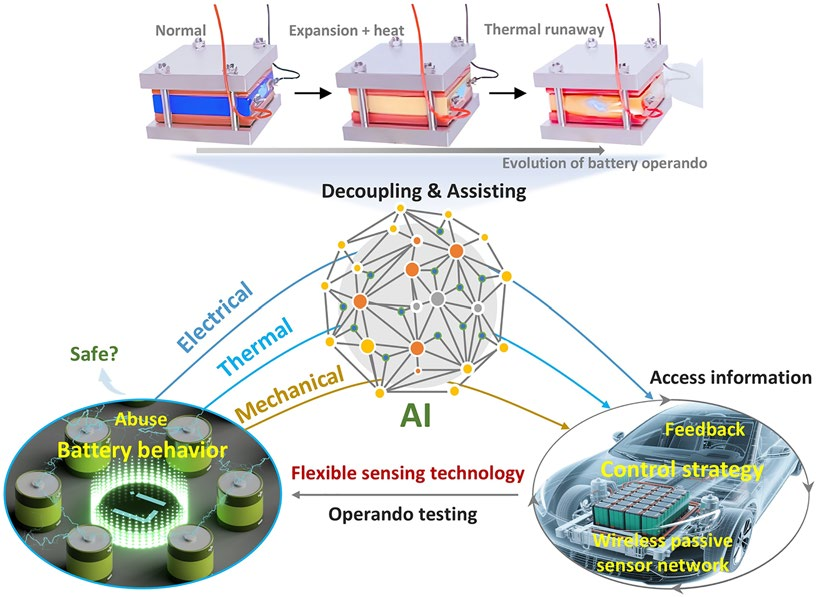
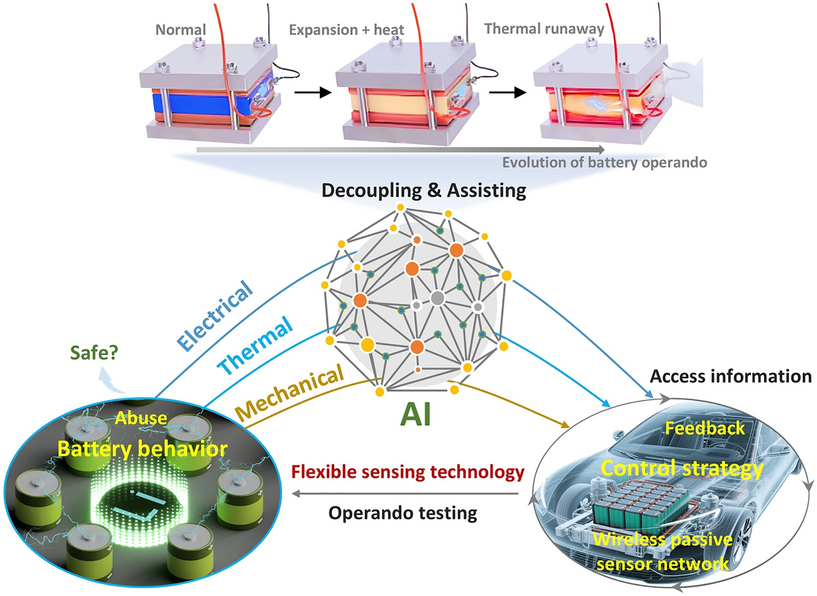

With the widespread application of lithium batteries in electric vehicles and energy storage systems, battery-related safety and reliability issues have become increasingly prominent. Conventional monitoring methods often struggle to address dynamic changes under complex operando. In recent years, flexible sensing technology has emerged as a promising solution for battery health monitoring due to its high adaptability and conformability to complex structures. Meanwhile, empowered by artificial intelligence (AI) for data analysis, the collected data enables efficient and accurate state assessment, offering robust support for accident prevention. Against this background, this paper first explores the integrated applications of flexible sensors in battery health monitoring and their unique advantages in addressing complex battery operating conditions, while analyzing the potential of AI in battery state analysis. Subsequently, it systematically reviews mainstream flexible sensing technologies (e.g., film sensors, thermocouples, and optical fiber sensors), elucidating their mechanisms for revealing intricate internal battery processes during operation. Finally, the paper discusses AI’s role in enhancing monitoring efficiency and accuracy, and envisions future research directions and application prospects. This work aims to provide technical references for the battery health monitoring field as well as promote the application of flexible sensing technologies in improving battery system safety and reliability.

Editor of Nano-Micro Letters, which is an Open-Access, peer-reviewed journal reported papers that have at least one dimension ranging from a few sub-nanometers to a few hundreds of micrometers. The journal is published by Springer Nature and indexed by SCI, EI, SCOPUS, Pubmed, etc. The 2025 JCR Impact Factor is 38.5. The 2025 CiteScore is 58.9.
Follow the Topic
-
Nano-Micro Letters
Nano-Micro Letters is a peer-reviewed, international, interdisciplinary and open-access journal that focus on science, experiments, engineering, technologies and applications of nano- or microscale structure and system in physics, chemistry, biology, material science, and pharmacy.