From a WhatsApp Group to BMC Artificial Intelligence: The Story Behind Our Paper
Published in Computational Sciences and Public Health

The idea
Pharm. Abbas Bashir Umar created that group on 14 February 2025, after we'd talked about writing something together on machine learning and disease surveillance in Nigeria. Abbas shaped the initial framing: look at both the promise and the real-world barriers to using ML for surveillance, not just one or the other.
We were healthcare professionals and researchers scattered across institutions, with different levels of research experience, limited access to real-time surveillance data, and full-time jobs. On paper, it was a lot to coordinate. In practice, it became a lesson in how research actually gets done, in fragments, over months, between other responsibilities.
Building the first draft
By 15 February, we'd split the work: Hafsat Yahaya on the introduction, Saifuddeen Kamfut Sani on the state of disease surveillance in Nigeria, myself on the opportunities section and conclusion, Abbas on challenges and barriers, and Ahmed Haruna Danjuma on policy recommendations. Each of us was to bring roughly 600 words in ten days, Vancouver style. It was an ambitious deadline that taught us how to actually run a distributed academic workflow: shared docs, Zotero, deadlines, and nudges.
Two more people joined as gaps appeared in our work. Mubarak Zubairu came in on 25 February to cover successful ML surveillance implementations from other countries, pushing the paper beyond Nigeria's borders. Usman Abubakar Haruna joined on 3 March to review the compiled draft, tighten it, and help scout journals. Usman’s role became super important as we eventually reached the editorial gauntlet. We submitted on 4 April 2025, cautiously optimistic.
The reviewers had other plans.
On 17 May, we got the verdict: major revisions required. The reviewers' concerns were extensive enough that one of us described it as "doing the work all over again."
Instead of treating that as a setback, we turned it into a task list involving seven workstreams, each owned by someone:
- Saifuddeen added technical depth: supervised vs. unsupervised learning, model architectures, selection and validation.
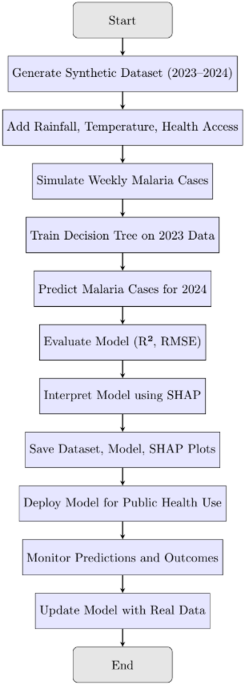
- I built a synthetic malaria dataset to demonstrate an actual ML-based surveillance workflow.
- Usman designed the technical visuals: a pipeline diagram and an annotated flowchart.
- Abbas expanded the explainability section, bringing in SHAP and LIME.
- Hafsat brought in Nigerian case studies.
- Ahmed developed the cost-benefit analysis and policy recommendations.
- Mubarak added comparative benchmarks from Rwanda and Kenya.
This revision is really where the paper became itself. The synthetic malaria simulation let us walk through a complete pipeline across data generation, predictive modelling, temporal validation, and SHAP-based interpretation, while being explicit that it was illustrative, not evidence of real-world performance. That distinction mattered a lot to us: we wanted to be technically ambitious without overclaiming.
The long middle
Revisions don't happen on a straight line. By 26 July 2025, Abbas was still chasing outstanding sections. Then, on 11 March 2026, nearly a year after our first submission, a second round of reviewer comments arrived, with a resubmission deadline of 1 April.
Throughout all of it, Abbas, as corresponding author, kept the manuscript moving. He absorbed the delays, kept people accountable, and refused to let the project quietly die in a chat thread, which is exactly how most collaborative papers actually die. That persistence is the reason this paper exists, and it's worth saying so plainly.
Acceptance
The paper was accepted on 28 May 2026. The WhatsApp group, the same one that had gone quiet for weeks at a stretch, filled with short congratulatory messages. They didn't need to be long. Everyone in that thread knew exactly what those messages were carrying: the original pitch, the missing sections, the "doing the work all over again" moment, two rounds of reviews, and over a year of intermittent, stubborn effort.
What we took from it
Seven authors each contributed something distinct: conceptualization, writing, ML analysis, public-health framing, technical review, visualization, and benchmarking.
The published paper is the visible result. The less visible one is what got us there: a project that survived long silences because enough people were willing to come back to it, and a shared insistence that AI-for-health research should be as honest about its limits as it is ambitious about its potential.
From a WhatsApp group on 14 February 2025 to a published paper on 1 September 2026; eighteen months, almost to the day.