Interview with Mike Henson-Garcia – winner of the 2025 Jess Kraus Award 🏆
Published in Research Data, Biomedical Research, and Public Health



Hi, Dr. Henson-Garcia, congratulations to you and your coauthors on winning the Jess Kraus Award in Injury Epidemiology! Would you please briefly introduce yourself and your multidisciplinary research team?

Sure! Thank you so much for this recognition; my colleagues and I are deeply honored to have received this award.
My name is Mike Henson-Garcia and I’m currently wrapping up my first year in the T32 postdoctoral fellowship at the Institute for Firearm Injury Prevention at the University of Michigan. This paper, though, began during my time as a doctoral student at the University of Texas Health Science Center at Houston (UTHealth Houston) School of Public Health where I graduated in May 2025 with a PhD in Behavioral Sciences and Health Promotion and a minor in Epidemiology. My training there centered on injury and violence prevention science with a particular emphasis on the prevention of firearm injury and dating violence among adolescent youth.
This paper really took shape through my involvement on several projects at UTHealth Houston including the Dating It Safe longitudinal cohort from which the data in this manuscript are drawn. The team behind this paper reflects that history. It includes the study’s principal investigators, Drs. Jeff Temple, Melissa Peskin, and Elizabeth Baumler, who have been close mentors throughout my training. It also includes Drs. Alexander Testa and Yu Lu, subject matter experts in interpersonal violence and firearm injury prevention who work very closely with the PIs on the project and who have also been a critical part of my mentoring team. Rounding out the team are Drs. Sitara Weerakoon and Lauren Malthaner, who first started as peers in my doctoral program but became close friends through applied research experiences like this one.
Use of alcohol and other drugs is known as an important risk factor for injury morbidity and mortality. What motivated you to examine the association between polysubstance use trajectory and firearm-related risk behaviors?
As I mentioned, graduate school gave me the chance to connect with other doctoral students who shared similar interests to mine. One of those people was Dr. Sitara Weerakoon who is an epidemiologist that studies environmental influences of adolescent polysubstance use and currently serves as an Associate Research Scientist at the Yale School of Public Health. Over time, we found ourselves curious about what might happen at the intersection of our work: specifically, whether polysubstance use in adolescence had longitudinal associations with firearm-related risk behaviors in adulthood.
Sitara and I actually had previously collaborated on a cross-sectional analysis of YRBS data examining how a syndemic of behavioral risk related to adolescent polysubstance use. We found that the odds of frequent polysubstance use (across all combinations of use) were highest among those youth who also reported carrying weapons. A few limitations of this dataset, however, was that its cross-sectional design meant we couldn’t observe change in polysubstance use over time and the “weapon carrying” variable is a broad concept that may mask weapon-specific effects.
So, we started thinking about how to extend the work longitudinally. That’s when I reached out to Drs. Temple, Peskin, and Baumler with a project proposal to see if this was even a question that could be explored with the DIS dataset. And, that conversation is really where this entire project all began.
Your paper is based on data from the Dating It Safe cohort study. Would you please tell us what the Dating It Safe project is about?
The Dating It Safe study is a longitudinal cohort study that was initiated by Dr. Temple and his team in 2010 with a little over 1,000 high school-aged youth (primarily freshmen and sophomores) who resided in southeast Texas. Its original aim was to better understand how dating violence behaviors, along with their associated risk and protective factors, change over time. The project has been sustained for over 15 years with funding from several federal entities including the National Institutes of Health and the National Institute of Justice. Today, Dating It Safe is one of the nation’s longest running studies of risk and protective factors for dating violence, with participants who remain enrolled now between the ages of 28 and 30.
You constructed the exposure measure using the latent variable method. Would you please explain briefly what the five latent groups are?
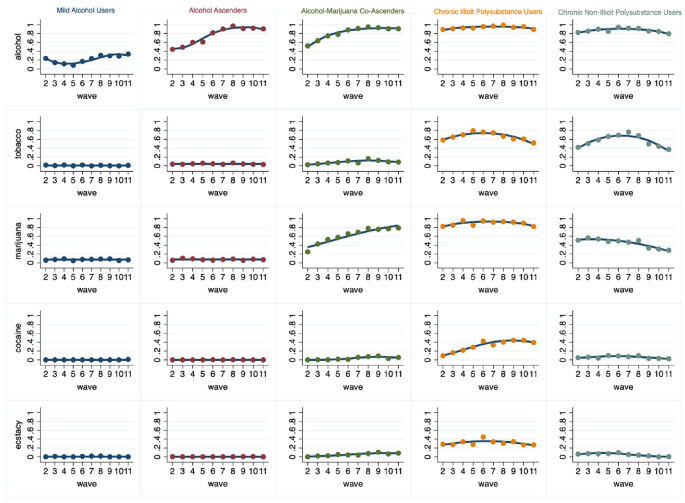
Yes. We used a latent variable technique called group-based multitrajectory modeling to identify patterns of polysubstance use within the dataset as participants moved throughout adolescence and into young adulthood. Based on the results of this analysis, five different trajectory groups emerge including the Mild Alcohol Users, the Alcohol Ascenders, the Alcohol-Marijuana Co-Ascenders, the Chronic Illicit Polysubstance Users, and finally the Chronic Non-Illicit Polysubstance Users.
First, the Mild Alcohol Users were the most restrained group. Alcohol was the primary substance reported across the trajectory and use in this group remained relatively low compared with everyone else. This represented the smallest of the groups.
Next, the Alcohol Ascenders looked very similar to the Mild Alcohol Users in that the primary substance used across the trajectory was alcohol; however, their alcohol use was more elevated than the Mild Alcohol Users and started increasing around Wave 4.
Third, the Alcohol-Marijuana Co-Ascenders were characterized by high co-use of alcohol and marijuana across their trajectory. Their trajectory started increasing early at Wave 2 and begins to level off around Waves 6 and 7. This represented the largest of the groups.
The final two groups were both chronic polysubstance users and they had similar trajectories of elevated, chronic alcohol, tobacco, and marijuana use across time. What separated these two groups, however, was their use of illicit substances with the Illicit Polysubstance Users reporting the use of cocaine and ecstasy across waves whereas the Non-Illicit Polysubstance Users only report poly-use of alcohol, tobacco, and marijuana.
What specific firearm-related risk behaviors are included in the study outcome measures?
So, we examined four different firearm-related risk behaviors in the study. The first was firearm access, which roughly 57% of the entire sample reported. The remaining three behaviors were assessed only among respondents who reported having access to a firearm; these behaviors included (1) improper firearm storage (defined as storing any firearm in a place other than a locked cabinet or gun safe); (2) improper ammunition storage (defined as storing ammunition alongside a firearm as opposed to separately); and (3) frequent firearm carrying (defined as responses that reported often or always carrying a firearm in the past year).
Based on the results, how would you characterize the relationships between different polysubstance use trajectories and subsequent firearm-related risk behaviors?
In general, the results of our analysis suggest that heavier and escalating substance use trajectories in adolescence are linked to greater odds of engaging in specific firearm-related risk behaviors in adulthood – though this is not uniform across every risk behavior.
Relative to the Mild Alcohol Users, members in the remaining four trajectory groups had higher odds of reporting access to firearms and more frequent firearm carrying behavior as they emerge into adulthood. Interestingly, the Alcohol Ascenders were the only group that demonstrated significantly elevated odds of improper firearm storage relative to other groups, and we found no associations at all between trajectory group membership and improper ammunition storage.
What are the take-home messages from your study? What are their implications for firearm-related injury research and prevention?
I think the take home message is that more work is needed to understand the longitudinal associations between polysubstance use and firearm-related risk behaviors among youth. For instance, this study was only able to assess associations between locked storage and ammunition storage, but we couldn’t examine how polysubstance use trajectories might shape whether firearms are kept loaded or unloaded… which is critically important to injury risk. I think it’s also worth noting that our sample was community-based and drawn from Texas; whether these patterns hold in other settings – clinical populations, other geographic regions – is an open question and a very important one that I hope the field will continue to explore.
I have a hunch that this award-winning paper might be part of your doctoral dissertation. If that is the case, would you please share a few lessons and tips with our graduate students working on their theses and dissertations?
This project wasn’t formally part of my dissertation, but it did give me a chance to get acquainted with the dataset that would become essential to that work. Regardless, along the way, I picked up a few lessons I’d want to pass along to other graduate students working on their own scholarly products.
First, I cannot emphasize enough the importance of team science. This paper was the product of relationships I built throughout graduate school – with peers and with mentors – and it simply wouldn’t exist without them. So, reach out to the scholars whose work inspires you. I know cold emailing can feel anxiety-inducing, but in my experience, the vast majority of faculty are eager to mentor students and often have opportunities for you to get involved.
On dissertations and theses specifically, I would say it’s important to start early, write every day, and take it chunk by chunk. Expect the process to be iterative, too. After what I thought was the final draft of my literature review, I came across several newly published papers on my topic that had to be worked in while I was already deep into my analyses. And the best advice I received on this topic was from my dissertation supervisor who would remind me frequently in our meetings that the best dissertation is a done dissertation. She pointed out that doctoral students tend to feel like the dissertation has to be the most groundbreaking discovery they’ll ever produce and that is simply not the case. Its job is to demonstrate that you can design a study, defend your choices, and see it through the end. At some point you have to decide it’s good enough, let it rest, and trust that there will be more chances to say something new.
Thank you for taking the time to conduct this interview. I look forward to your special lecture in our injury epidemiology seminar series at Columbia University this fall.
Read Dr. Henson-Garcia's award-winning article: Examining longitudinal associations between polysubstance use and firearm-related risk behaviors from adolescence into emerging adulthood: a group-based multi-trajectory modeling approach
Follow the Topic
-
Injury Epidemiology
This journal aims to be the premier venue for communicating epidemiologic studies of unintentional and intentional injuries and is dedicated to advancing the scientific foundation for injury prevention and control through timely publication and dissemination of peer-reviewed research.

Related Collections
With Collections, you can get published faster and increase your visibility.
Surveillance of Political Violence
In response to the current global political climate, journal of Injury epidemiology continues its efforts to bring into focus the critical issue of political violence. In this endeavor, the journal presents its long-standing Collection on political violence as annual Collection series.
The first Collection of the series, Surveillance of Political Violence, aims to shed light on the systematic collection, monitoring, and analysis of data on politically motivated violent acts. Leveraging research advances in the methodologies, including machine learning, geospatial analytics, and real-time data streams from conflict databases, social media, and governmental sources, to identify patterns and forecast potential outbreaks, the collection will highlight developments to generate robust early-warning systems that inform policy interventions, humanitarian responses, and peacebuilding strategies. This Collection aims to enhance our understanding of the drivers of political violence and improve global and regional capacities for prevention and mitigation.
This Collection supports and amplifies research related to SDG 16, Peace, justice and strong institutions.
All submissions in this collection undergo the journal’s standard peer review process. Similarly, all manuscripts authored by a Guest Editor(s) will be handled by the Editor-in-Chief. As an open access publication, this journal levies an article processing fee (details here). We recognize that many key stakeholders may not have access to such resources and are committed to supporting participation in this issue wherever resources are a barrier. For more information about what support may be available, please visit OA funding and support, or email OAfundingpolicy@springernature.com or the Editor-in-Chief.
Publishing Model: Open Access
Deadline: Dec 11, 2026
Emerging risk factors for self-injury in youth in the current milieu of growing mental health crisis
The interplay between mental health issues and self-injury in the evolving societal landscape among youth presents a multifaceted challenge that demands our attention. Rising rates of depression, anxiety, trauma-related symptoms, and emotional dysregulation continue to constitute core predictors, while newer influences—such as digital media exposure, cyberbullying, and online communities that may normalize self-harming behaviors—have intensified concern. Additionally, structural pressures including academic stress, social isolation, discrimination, and limited access to youth‑appropriate mental health services contribute to heightened vulnerability.
By synthesizing current research on these emerging influences, this Collection aims to highlight the need for integrative prevention strategies that address both individual-level mental health challenges and broader sociocultural contexts. Improved early identification, digital literacy initiatives, and equitable access to tailored mental health support are essential for mitigating self-injury risk in contemporary youth populations. This Collection intends exploring innovative methodologies and interdisciplinary approaches to uncover novel insights that inform targeted interventions. We invite researchers to contribute to this special Collection focused on emerging risk factors for self-injury, with a particular emphasis on mental health issues in youth. Topics of interest include but are not limited to:
- The role of substance misuse in self-injury
- Social media influence on youth self-harm
- Mental health interventions for at-risk populations
- Longitudinal studies on self-injury patterns
- Community support systems and their impact
- Risk factors in specific demographic groups
- Coping strategies and resilience-building among youth
This Collection supports and amplifies research related to SDG10, Reduced Inequalities
All submissions in this Collection undergo the journal’s standard peer review process. Similarly, all manuscripts authored by a Guest Editor(s) will be handled by the Editor-in-Chief. As an open access publication, this journal levies an article processing fee (details here). We recognize that many key stakeholders may not have access to such resources and are committed to supporting participation in this issue wherever resources are a barrier. For more information about what support may be available, please visit OA funding and support, or email OAfundingpolicy@springernature.com or the Editor-in-Chief.
Publishing Model: Open Access
Deadline: Nov 27, 2026