Season of the Tick
Published in Ecology & Evolution, Microbiology, and General & Internal Medicine

Each year, when the weather cools, I breathe a sigh of relief that ankle-checking season has passed and I can once again hike in peace. The ticks that have ruled my North American East Coast forests have dwindled, and my fear of Lyme disease can rest for another year.
But recently, the abundance of ticks in North America and Europe have failed to drop in the later months. The seasons stay warmer longer and the ticks thrive. A recently published blog in BugBitten, written by Dr. Karina Mondragon-Shem, gives a spectacular overview of the effects that warm weather has on these tiny harbingers. The paper that she reviews modeled tick activity as affected by climate change, and successfully predicted real tick activity changes in 20 countries. However, as Dr. Mondragon-Shem further explains in her blog, the model doesn’t take into account the relationships between ticks and their hosts.
So we are left wondering: does climate change impact the tick-host species interaction?
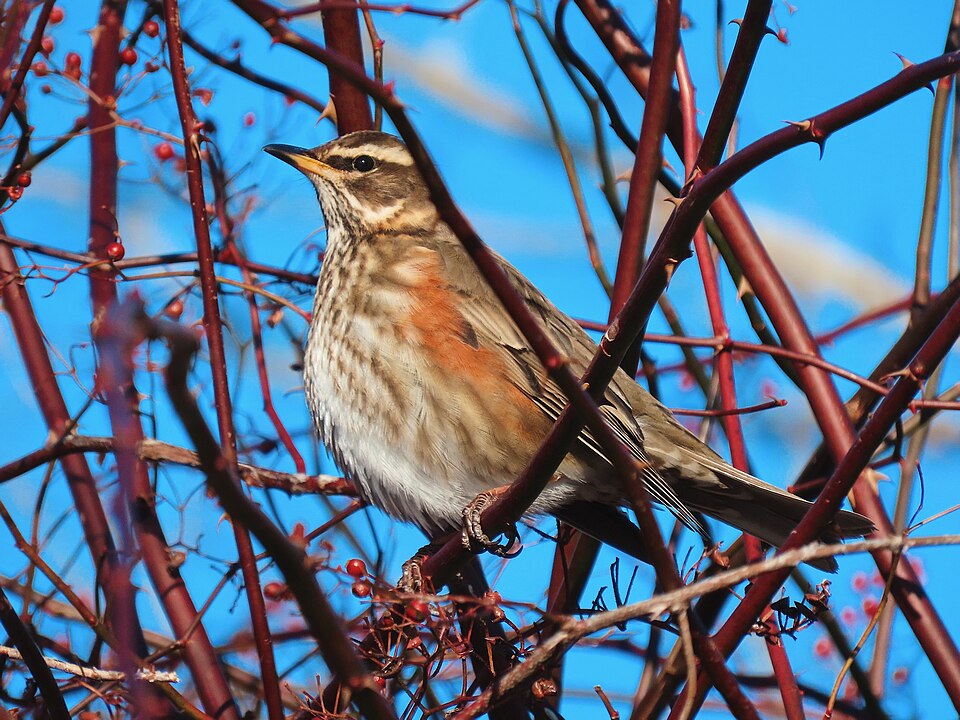
Redwings and their passengers
A new paper published in Parasites & Vectors explores this very question. In "Lyme beyond the season: late-autumn dissemination of infected ticks by southward migrating redwings (Turdus iliacus)", Dr. Dieter Heylen and his colleagues explore the tick infestation rates of redwings (Turdus iliacus), the tick infection rates with zoonotic diseases (diseases passed between human and animals), and the species-specific interactions between the ‘bugs’ and the birds.
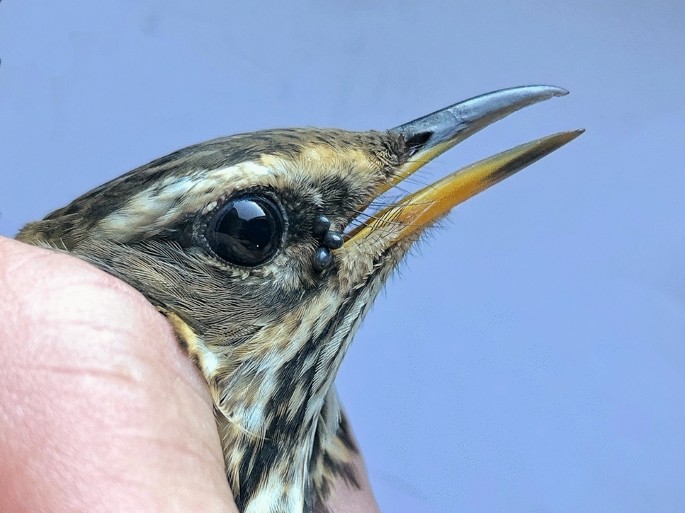
When the ticks are young and still nymphs, they're in their active phase and on the hunt for blood. They frequently choose the redwing as a host; a large-bodied European thrush that feeds primarily from the ground. The tick latches, the bird begins to migrate, and the tick has begun its international journey. Alongside the bird and the parasite ride diseases, such as tick-borne encephalitis virus (TBEV) and various Borrelia genospecies (which cause Lyme disease).
The late-autumn season should be beyond the active period of Ixodes ricinus, a common European tick, while the bird-specialized tick Ixodes frontalis is more likely to host-seek in the winter. The thrush’s migration is driven by light rather than temperature, and historically occurs in the late-autumn, missing the peak of both ticks’ active periods. But as the weather stays warm and the active period of I. ricinus creeps closer to its winter counterpart, will we see an uptick (no pun intended) in the infestation rates of these migratory birds, and thus the spread of disease?
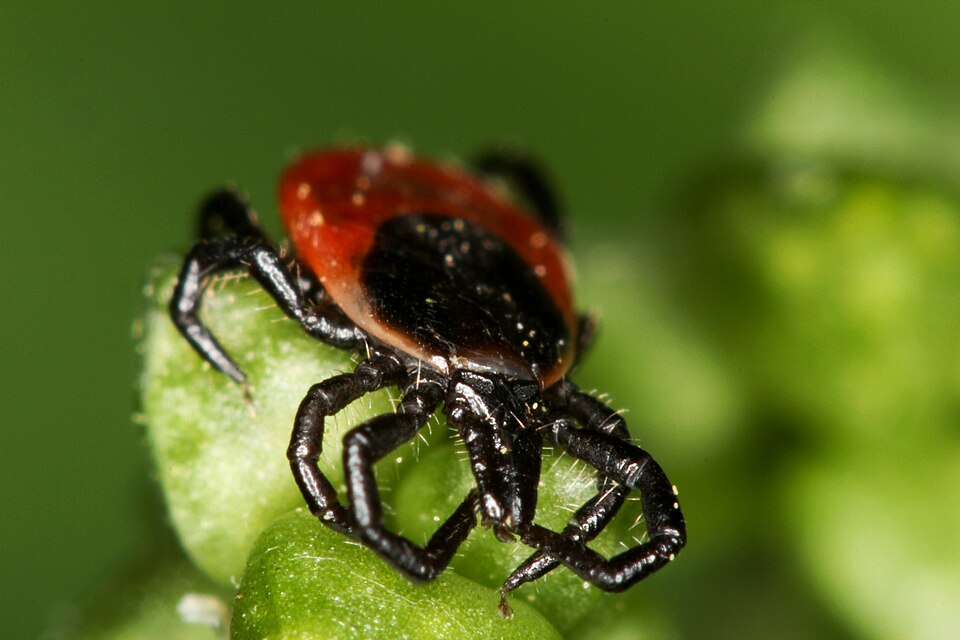
Ixodes ricinus from England.
Andy Murray, CC BY-SA 2.0, via Wikimedia Commons
Methods
The researchers chose Flanders, Belgium, as their field site to capture the redwings. This location marks the intersection of three of the redwings’ major migration paths and is a hub of thrush activity. There, they captured the redwings during the late autumn of 2022 and 2024, checking the birds’ ages, infestation levels, and collecting ticks from the infested individuals. They later went on to screen these ticks (I. ricinus and I. frontalis) for tick pathogens (TBEV and Borrelia).
Results
Tick species
The prevalence of these tick species did not change between the two years. However, the researchers found significant interactions between the birds and the ticks at the species level and at the stage level; I. ricinus nymphs fed on the thrushes, while the adults preferred large mammals. Adult I. frontalis, on the other hand, being more specialized to birds, enjoyed the thrushes just fine. Overall, I. rictus was significantly more abundant on the birds than I. frontalis, and the two species, in a few cases, were found sharing individual hosts.
Bird species
Other thrush species besides T. iliacus were also examined for ticks, and the researchers found that foraging and roosting behaviors had a significant effect on the tick load of the birds. Species that tended to forage in wooded areas were more exposed to ticks, while those who foraged in the open were less likely to be infested.
Additionally, the age of the bird played a role; older birds tended to be less infested. The researchers speculate that this could come with a built resistance, or perhaps a learned behavior of avoiding or preening away the pests.
Diseases
After extraction, amplification, and sequencing, the researchers found six B. burgdorferi s.l. genospecies (with 17 potential genotypes) as well as B. miyamotoi. Some of these genospecies were specific to mammals, while some were avian-associated. TBEV was not found at all in any ticks. Overall, 12.9% of all sampled ticks (including both species) carried Borrelia genospecies, and some ticks even carried multiple of these genospecies at once.
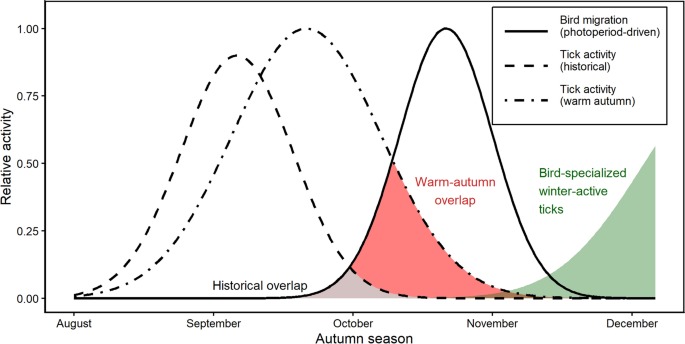
Predicting the future overlap between redwing migration and summer tick activity.
Heylen, D.J.A., Ledegen, I., Grimon, M. et al. Lyme beyond the season: late-autumn dissemination of infected ticks by southward migrating redwings (Turdus iliacus). Parasites Vectors 19, 397 (2026). https://doi.org/10.1186/s13071-026-07673-x
Conclusions
From this informative web of bacteria, animals, timing, and temperature, Dr. Heylen and his colleagues draw one primary conclusion. It seems indeed that the summer ticks have begun sharing their active season with that of the winter ticks. For this reason, the two species have begun to also share diseases and their hosts, which carry the infected arachnids with them on their southward journey across Europe.
In the future, the authors speculate, as the birds continue migrating according to their historic timeline, the active tick period will continue to creep up and up, closing the gap between the thrush migration and the host-hunting season, turning our new warm autumns into the season of the tick.
Cover image: Redwing (Turdus iliacus). Tova, CC BY-SA 4.0, via Wikimedia Commons

Follow the Topic
-
Parasites & Vectors
This journal publishes articles on the biology of parasites, parasitic diseases, intermediate hosts, vectors and vector-borne pathogens.
-
BugBitten
A blog for the parasitology and vector biology community.

Related Collections
With Collections, you can get published faster and increase your visibility.
Translational leishmaniasis
This collection focuses on leishmaniasis as a central model while also encompassing related parasites that share comparable biological traits, pathogenic mechanisms, and clinical relevance. The aim is to create a translational bridge between basic research and practical applications, highlighting insights that can be extended across the spectrum of kinetoplastids and other closely linked parasites.
Topics of interest include:
• Analytical and omics-based advances for parasite detection, monitoring, and characterization.
• Comparative biology of Leishmania and related parasites, with emphasis on shared mechanisms of infection and survival.
• Host-pathogen interactions and immune responses.
• Epidemiology and transmission dynamics, including drawing parallels between leishmaniasis and other parasitic infections.
• Translational strategies in drug discovery, vaccine development, and therapeutic interventions applicable to leishmaniasis and related parasitic diseases.
By linking leishmaniasis with other parasitic diseases of similar characteristics, this collection seeks to foster integrative approaches, stimulate cross-disciplinary dialogue, and accelerate the translation of knowledge into innovative diagnostic, preventive, and therapeutic solutions.
Publishing Model: Open Access
Deadline: Nov 27, 2026
Credelio Quattro
This collection was created to facilitate access to manuscripts published in Parasites & Vectors focusing on Credelio Quattro™ (lotilaner, moxidectin, praziquantel, and pyrantel chewable tablets).
Articles published in the collection have already gone through the systematic peer review process of the journal.
Publishing Model: Open Access
Deadline: Ongoing




.jpg#filelinks)
