Two Steps Forward: Toxoplasmosis vaccine and the One Health paradigm
Published in Bioengineering & Biotechnology and Microbiology
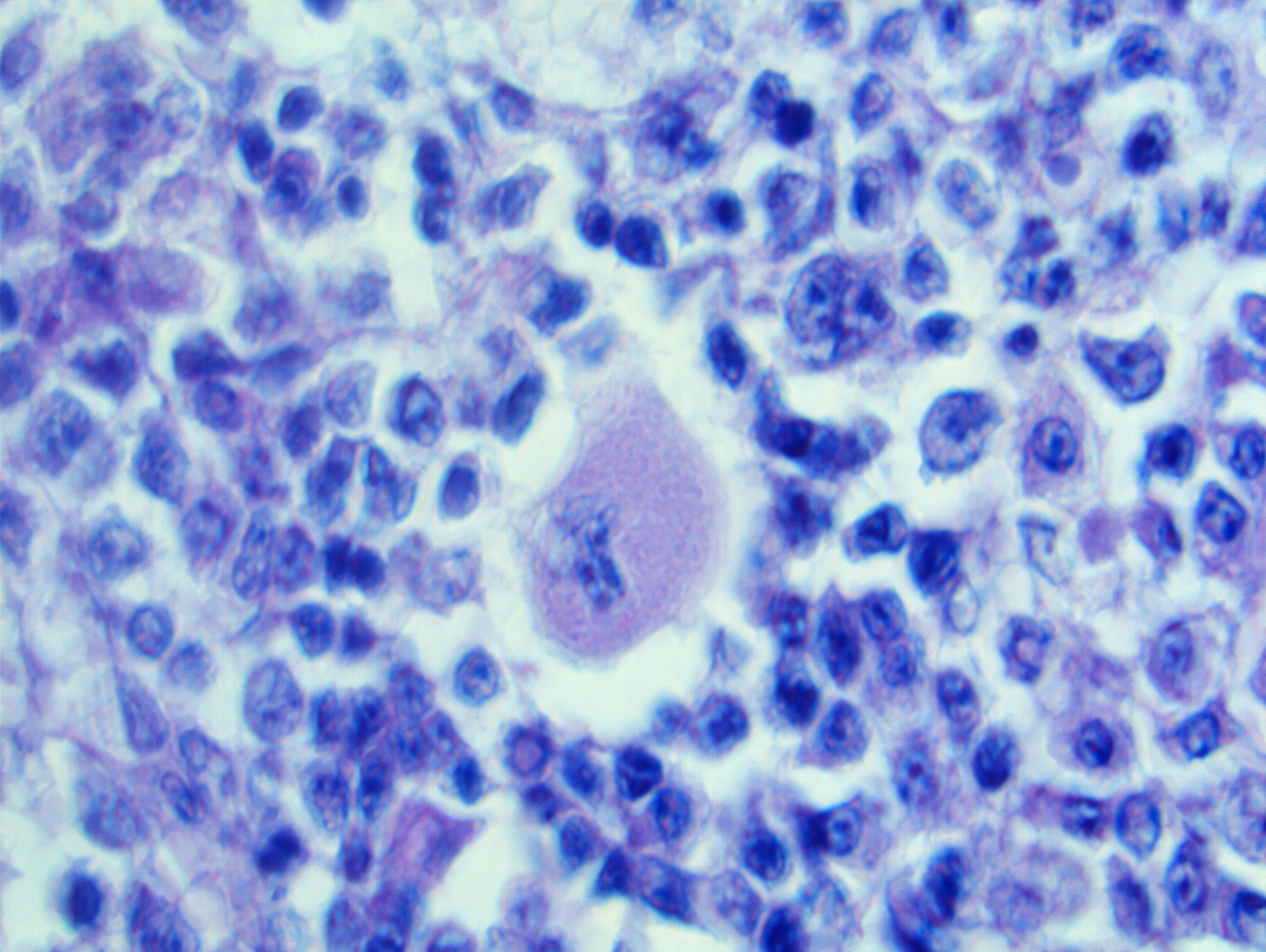
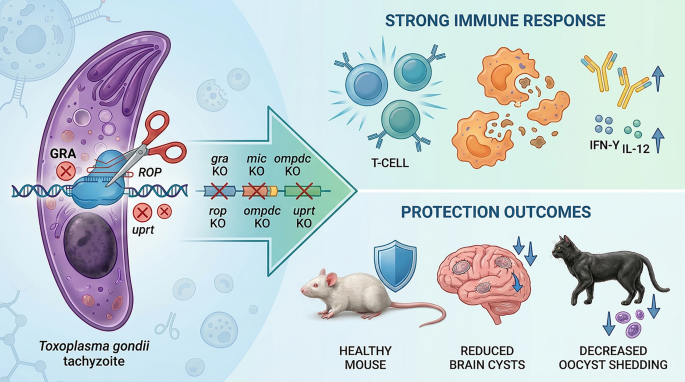

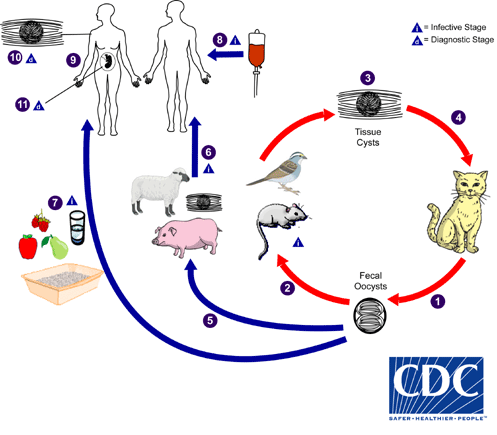
There is something uniquely fascinating to me about parasites that cross species boundaries into human spheres. Toxoplasmosis has all the makings of a perfect have-you-heard topic; it blends parasitic infection, pet health, embryo development, epigenetics, vaccine advancements, and a heavy dose of prevalence.
The study Gene-edited live-attenuated vaccines against Toxoplasma gondii : recent advances and future frontiers by Sang et al., recently published in Parasites & Vectors, makes the case that the study of Toxoplasma gondii fits snugly into the One Health paradigm. The inseparability of wildlife, livestock, pets, and humans means that if one becomes sick, so do we all. The protection against T. gondii, then, must branch into every sphere for the work to be truly beneficial.
In June, Parasites & Vectors published three papers regarding vaccine development targeting T. gondii. The first explores two potential vaccine strains to target T. gondii infection in sheep. The second article examines a different form of T. gondii vaccine in mice. The third paper, as previously referenced, reviews vaccine advances and offers a zoomed-out understanding of how T. gondii impacts us all.
Here, I’ll offer a summary of both research articles and then explore how the review further connects vaccine development with the One Health concept.
Live-attenuated vaccines in sheep
Attenuation in vaccine development is the process by which a pathogen is disarmed just enough that it can be used to trigger the immune response without causing full infection in the subject. Live-attenuation refers to the process of weakening the pathogen without killing it.
Live-attenuation can result in longer, stronger immune responses, which makes it more effective for defense against future infection. This method also mimics natural infection, further strengthening the immune system against attack. However, it also risks virulence reversion, where the weakened pathogen mutates and becomes activated once more.
The study Vaccination with live-attenuated Toxoplasma gondii mutants RHΔtkl1 and PruΔpp2a-c induces protective immunity in sheep by authors Wu et al. uses two live-attenuated strains of T. gondii, RHΔtkl1 or PruΔpp2a-c, to immunize sheep.
Methods
Twenty-four lambs were used in this study, split into six groups of four. The sheep were immunized with either RHΔtkl1 or PruΔpp2a-c, and then challenged (infected) with the T. gondii Pru (type II) strain, first orally and then via injection. Group 5 was not immunized but was infected, and Group 6 acted as a negative control. The sheep’s body temperatures were monitored as infection took hold.
The study lasted 112 days, after which the sheep were euthanized. Their tissues were studied to determine immune response, number of cysts in the brain, and parasite load. Additionally, the researchers used the immunized sheep brain tissues to inoculate mice and further test the efficacy of the vaccine.
Results
The researchers found that, after immunization, the sheep experienced no adverse reaction to the vaccine besides a small increase in temperature. Body temperature rose again after the first and second challenge, triggered by longer and more severe immune responses, but to a lesser degree if the sheep were immunized. In almost all tissue studies, the immunized sheep showed less severe impacts of infection than the un-vaccinated.
While the sheep injected with the RHΔtkl1 strain had higher antibody loads initially than those injected with PruΔpp2a-c, the groups immunized with PruΔpp2a-c had longer, stronger immune responses and fewer cysts. Ultimately, strain PruΔpp2a-c wins out as a more effective control for chronic infection in sheep.
Summary
The authors make the argument that these findings could help reduce the presence of T. gondii in sheep, and potentially offer a more stable alternative to the current commercial vaccine. In the long term, a reduction of T. gondii in the sheep will lead to a reduction of T. gondii in us.
mRNA vaccines in mice
In some cases, especially when a disease has several distinct strains, researchers opt for a multi-epitope vaccine, or one that targets several unique antigens at once rather than focusing on just one. This also means that multi-epitope vaccines can continue to target the pathogen even when a pathogenic antigen mutates.
Methods
In the study, Multi-epitope mRNA vaccine and protein vaccine protect mice against Toxoplasma gondii, authors Cui et al. develop a multi-epitope antigen to target all three strains of T. gondii. They call the antigen T-SGR, and use it to create two vaccines; a lipid nanoparticle vaccine (LNP), and a recombinant protein vaccine. The first uses a microscopic lipid bubble to deliver mRNA that codes for antigens. The second delivers antigen protein fragments directly. Both will trigger the immune system.
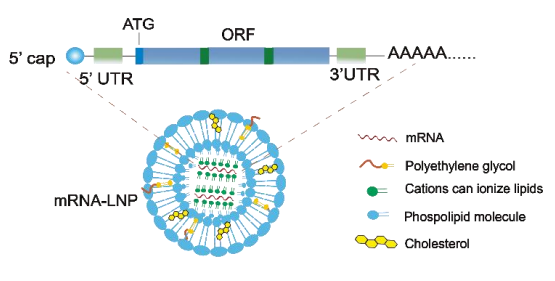
Figure 2D: Schematic diagram of the LNP T-SGR mRNA vaccine construct, consists of a 5′ cap, UTRs, ORF, and poly(A) tail. Cui, Y., Qu, H., Zhou, C. et al. Multi-epitope mRNA vaccine and protein vaccine protect mice against Toxoplasma gondii. Parasites Vectors (2026). https://doi.org/10.1186/s13071-026-07447-5
The researchers immunized 45 female mice in three groups; group 1 received the mRNA vaccine, group 2 received the protein vaccine, and group 3 acted as a control. All mice were immunized and then given two booster shots. Four weeks later, all mice were challenged by the RH strain of T. gondii. All mice were euthanized 45 days after being challenged.
Results
While both versions of the vaccine triggered immune responses in the mice, the mRNA vaccine resulted in significantly higher levels of IgG (an antibody), as well as IFN-γ, IL-10, IL-12, and IL-2 (cytokines). The vaccine, surprisingly, resulted in 100% survival against one of the strains of T. gondii.
Summary
The best performing vaccine in this study used mRNA that encodes multi-epitope antigen proteins, which triggered the strongest immune responses in mice. The researchers argue that this method removes several risks; virulence reversion of the vaccine, being unable to target all three strains, and being unable to target a mutated pathogen. In our aim to protect humanity, they argue, this method suits our needs quite nicely.
The future of the T. gondii vaccine
In the review Gene-edited live-attenuated vaccines against Toxoplasma gondii : recent advances and future frontiers, authors Sang et al. walk through the current uses of live-attenuated vaccines (LAVs). The only current commercially available T. gondii vaccine, they explain, is Toxovax®; a fairly non-shelf stable and expensive vaccine that risks virulence reversion, and can only be used for sheep.
The authors highlight several gene knockout LAVs that have shown to have a 100% survival rate against even the most virulent strains of T. gondii (type I), a breakthrough that has not yet occurred in mRNA vaccines.
Additionally, the paper argues that LAVs uniquely limit cyst development in the brain. Keeping in mind that the parasites can lie dormant in cysts for years before regaining virulence, even after vaccination, it becomes clear that limiting cyst development is key.
One Health Paradigm
The movement of this parasite across species boundaries, the paper argues, exemplifies the importance of the One Health concept. If a sheep falls ill, then other sheep are at risk, and the dogs, and the cats, and the people. If even one person lacks access to the resource (due to manufacturing costs or shelf-stability), then we must keep working.
“Rather than relying on a single solution,” Sang et al. say, “progress may come through multiple vaccines serving distinct roles.” In the end, there will likely not be one huge breakthrough discovery for a T. gondii vaccine, but this is how science has always worked; one precious step at a time.
Sang, X., Zhang, H., Zhang, Y. et al. Gene-edited live-attenuated vaccines against Toxoplasma gondii: recent advances and future frontiers. Parasites Vectors (2026). https://doi.org/10.1186/s13071-026-07454-6
Wu, ZX., Kang, Y., Hao, WB. et al. Vaccination with live-attenuated Toxoplasma gondii mutants RHΔtkl1 and PruΔpp2a-c induces protective immunity in sheep. Parasites Vectors (2026). https://doi.org/10.1186/s13071-026-07516-9
Cui, Y., Qu, H., Zhou, C. et al. Multi-epitope mRNA vaccine and protein vaccine protect mice against Toxoplasma gondii. Parasites Vectors (2026). https://doi.org/10.1186/s13071-026-07447-5

Follow the Topic
-
Parasites & Vectors
This journal publishes articles on the biology of parasites, parasitic diseases, intermediate hosts, vectors and vector-borne pathogens.
-
BugBitten
A blog for the parasitology and vector biology community.


Related Collections
With Collections, you can get published faster and increase your visibility.
Translational leishmaniasis
This collection focuses on leishmaniasis as a central model while also encompassing related parasites that share comparable biological traits, pathogenic mechanisms, and clinical relevance. The aim is to create a translational bridge between basic research and practical applications, highlighting insights that can be extended across the spectrum of kinetoplastids and other closely linked parasites.
Topics of interest include:
• Analytical and omics-based advances for parasite detection, monitoring, and characterization.
• Comparative biology of Leishmania and related parasites, with emphasis on shared mechanisms of infection and survival.
• Host-pathogen interactions and immune responses.
• Epidemiology and transmission dynamics, including drawing parallels between leishmaniasis and other parasitic infections.
• Translational strategies in drug discovery, vaccine development, and therapeutic interventions applicable to leishmaniasis and related parasitic diseases.
By linking leishmaniasis with other parasitic diseases of similar characteristics, this collection seeks to foster integrative approaches, stimulate cross-disciplinary dialogue, and accelerate the translation of knowledge into innovative diagnostic, preventive, and therapeutic solutions.
Publishing Model: Open Access
Deadline: Nov 27, 2026
Credelio Quattro
This collection was created to facilitate access to manuscripts published in Parasites & Vectors focusing on Credelio Quattro™ (lotilaner, moxidectin, praziquantel, and pyrantel chewable tablets).
Articles published in the collection have already gone through the systematic peer review process of the journal.
Publishing Model: Open Access
Deadline: Ongoing