From Ada to Weija: Access to Comprehensive Emergency Obstetric and Newborn Care in Greater Accra
Published in Public Health





Most of the world's fastest growing cities today are in low and middle-income countries (LMICs), and increasingly in sub-Saharan Africa. By 2050, 40% of the world’s 2.5 billion new urban residents will concentrate in African cities.
In many of these cities, ambulance services are limited or absent altogether. When something goes wrong during labour, women and their families are left to find their own way to care. This is what that journey can look like: a family bundles a woman in labour into a car and sets off for the hospital. This is when the uncertainty begins. Will the road be clear, or will they sit in congested traffic, behind a market spilling onto the road, or stuck at a police checkpoint? When they finally arrive, will that hospital even be adequately equipped and staffed to handle what is unfolding? Many obstetric emergencies require comprehensive emergency obstetric care (EmOC), which is only available at higher level facilities. This scene plays out daily across rapidly urbanising cities.

Credit: Eric Agyeman Duah
Why timely access to EmOC matters
Access to EmOC is very time sensitive. Severe bleeding, obstructed labour, and eclampsia are difficult to predict and can quickly become fatal for women and especially for newborn babies. Ever since WHO's 2009 Handbook on EmOC monitoring drew attention to timely access to care, researchers and public health practitioners have asked two key questions: how long it takes to reach care from home, and how long it takes to move between facilities when a referral is needed?
Unique barriers to access and mobility in African cities
Rural areas are typically thought of as the classic "access problem" in maternal health: few health facilities spread across vast distances connected by roads in poor condition, and even those that exist frequently lack the capacity to manage obstetric emergencies. Cities, by contrast, are assumed to have it easier: short distances, paved roads, hospitals nearby. Yet, across African cities, urban travel brings its own barriers. Health facilities that can provide EmOC tend to cluster in the older, already built-up parts of the city, together with most other services, jobs, and the traffic that comes with it. This creates a paradox common to many growing LMIC cities: the facilities best equipped to save lives are surrounded by the very congestion that delays reaching them.
Meanwhile, continued expansion of peri-urban settlements outpaces that of health infrastructure. These newer communities are often counted as part of the city, but in fact sit far from the nearest hospital capable of handling an obstetric complication, leaving people with an "urban" address yet lack the level of care we associate with being urban.
Furthermore, traffic is often slow and hard to predict. A route that takes twenty minutes one evening might take well over an hour the next morning, simply because of what's happening on the road at that particular time. That makes modelling travel time in a sprawling, congested LMIC city a tricky problem.
Common approaches, such as assigning fixed speeds to "major", “primary”, and "minor" roads or estimating distance from satellite imagery of road networks, are useful starting point, but they may not fully capture how unevenly traffic moves on the ground. This creates another misclassification problem: a "major road" in one part of a city might be a smooth highway, while elsewhere it's a single congested lane shared with hawkers, parked cars, and pedestrians, so the same road category can have very different actual travel speeds.
Using real traffic data to model EmOC access
This is where real-world traffic data can fill the gap. In this project, we partner with Google to draw on crowdsourced traffic data from the Google Maps Directions API, the same technology many people rely on to estimate arrival times when stuck in traffic.

Credit: Gerard Nartey
Our new study puts this approach to work in Greater Accra Region, Ghana's largest and fastest urbanizing region. We treat Greater Accra as a case study, but the lessons apply to similar fast-growing cities around the world. We obtained travel times to all 59 comprehensive EmOC facilities across Greater Accra for both heavy and light traffic conditions and matched that against where women of reproductive age live and how wealthy or poor their neighbourhoods are. Beyond a single average travel time, we estimated the proportion of women in each area who could reach a comprehensive EmOC facility within 15, 30, and 60 minutes, as well as how many such facilities were realistically reachable within those windows, and how that number shrinks once traffic gets bad.
What we found
Overall, Greater Accra is reasonably well served, with nearly 90% of women within 30 minutes of a capable hospital. In peri urban districts like Ga South and Ningo/Prampram, however, heavy traffic can wipe out access to the only reachable public hospital ≤30 minutes, dropping coverage from "at least one facility" to "zero." Delays to care land the hardest on women who can least afford them, as we observed that poorer households consistently face longer travel times to care [Figure 1].
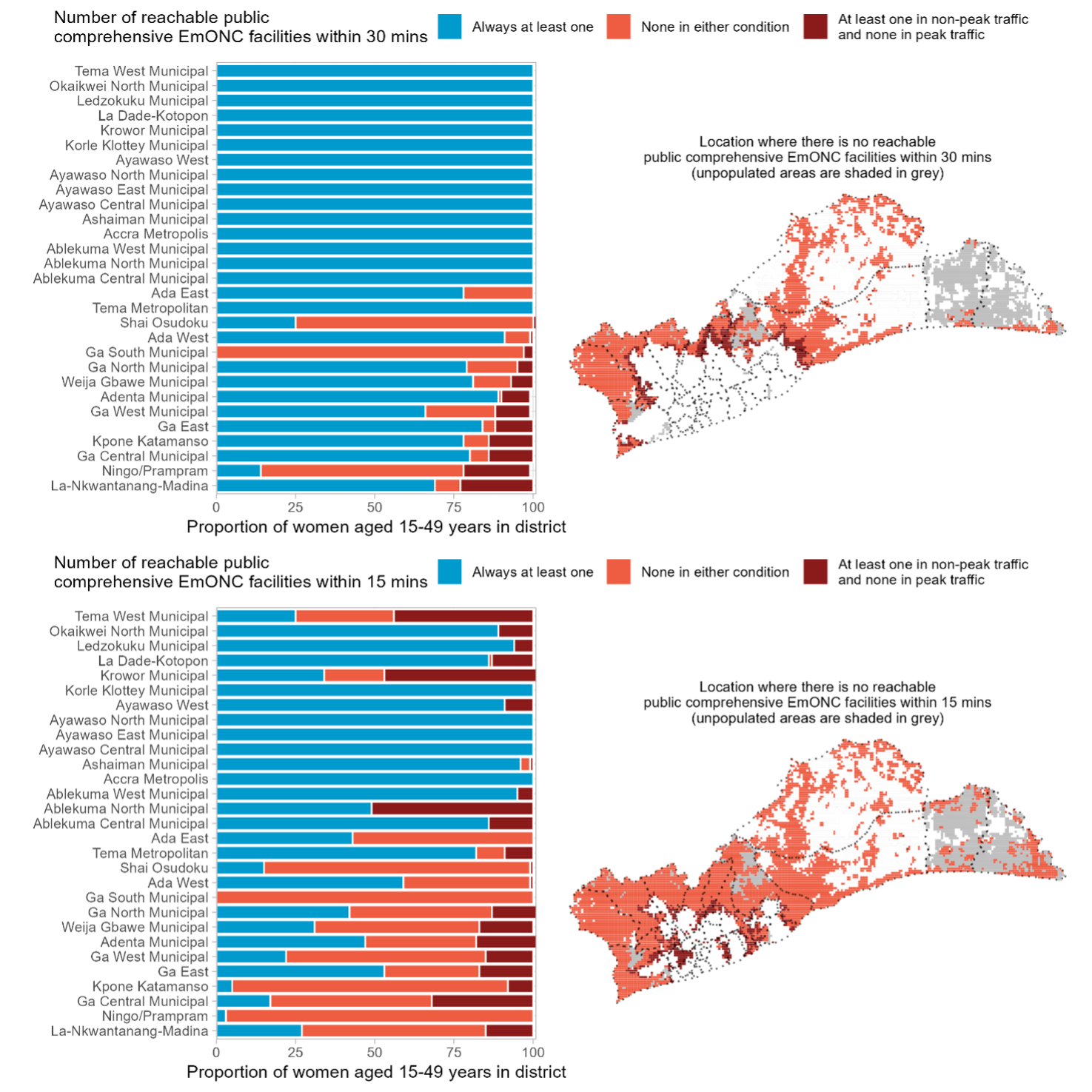
Figure 1. Proportion and location of women with zero reachable public comprehensive EmOC facilities within 30 minutes and 15 minutes in peak/heavy traffic condition in Greater Accra Region
Why it matters beyond Accra
As cities like Accra continue to grow, the gap between where people live and where they can get emergency care will widen unless infrastructure catches up. Our work maps where that gap is widest, so that the next investment in hospital and road upgrade can go where they're needed most. The same patterns are also observed in other cities in the region, including Lagos, Cotonou and Conakry, suggesting that the issues identified are broadly shared in similar settings. Working with colleagues at Google, we have developed a digital dashboard to maximise utility of these geographical insights in informing service planning and policy making.
Travel time is just one part of what determines whether a woman survives an obstetric emergency. Future research should also look at what happens after she arrives: how long she waits to be seen, quality of care and whether referral systems between facilities function when a case needs to be escalated further. For the woman in the back of that car, and for the millions like her, closing that gap is what stands between a safe delivery and a loss that timely care could have prevented.
Follow the Topic
-
Nature Cities
This journal aims to deepen and integrate basic and applied understanding of the character and dynamics of cities, including their roles, impacts and influences — past, present and future.