From Algorithmic Control to Stewardship: A New Framework for Urban Climatic Justice
Published in Earth & Environment

In an era of climate collapse and rapid urbanization, cities are increasingly turning to artificial intelligence (AI) to manage complex challenges. From optimizing traffic flow to rationing water, algorithms are becoming central to urban governance. But what happens when these "smart" systems, often praised for their efficiency, end up deepening existing social and spatial inequalities?
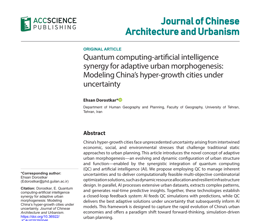
In my recent article, "Algorithmic Stewardship for Urban Climatic Justice," published in City and Built Environment, I argue that the current technocratic approach to "smart cities" is inadequate. Instead, we need a transformative shift towards algorithmic stewardship—a framework that retools urban AI to serve climatic justice rather than prioritise efficiency fetishism.
The Problem: When "Smart" Cities Make Inequality Smarter
Using Tehran as a pivotal case study, the paper reveals how algorithms, despite their technical elegance, can weaponize optimization:
-
Heat-Vulnerability Maps that equate adaptive capacity with property values, effectively erasing the sophisticated thermal knowledge of informal settlements.
-
Water Rationing Algorithms that prioritize supply to high-revenue industrial zones, systematically dehydrating peripheral communities and encoding "hydrological apartheid."
-
Disaster-Response Systems that triage human lives, valuing high-rise commercial districts over informal settlements in flood scenarios—a process I term computational necropolitics.
These aren't mere technical failures; they are design features of systems that optimize within unjust frameworks rather than challenging them.
The Solution: The Three Pillars of Algorithmic Stewardship
Algorithmic stewardship proposes a radical reconfiguration of urban AI, built on three core principles:
-
Generative Transparency: Moving beyond "explainable AI" to make the value judgments within algorithms legible to the public. For example, an air-quality algorithm should not just report an index but reveal which industrial sectors are being sacrificed in cost-benefit calculations, turning a black box into a site for public deliberation.
-
Systemic Accountability: Hardcoding ethics into the system's logic. This means algorithms must be designed with built-in checks for intergenerational equity, ensuring that solutions to today's water crisis don't sacrifice aquifer health for 2070. Accountability means an algorithm must ask itself: "Will this decision displace low-income families? Does it account for the thermal wisdom of street vendors?"
-
Deliberative Polycentrism: Distributing power away from centralized tech hubs. Instead of the city's innovation center having sole control, stewardship advocates for community data cooperatives where local knowledge—like traditional water-sharing patterns—can shape climate models, creating friction against one-size-fits-all techno-solutionism.
Operationalizing Justice: From Principles to Practice
How do we bring this to life? The paper proposes concrete "institutional counter-architectures":
-
Algorithmic Courts of Equity: Public forums where citizens can formally challenge biased climate algorithms and demand their redesign.
-
Ecological APIs: Open data infrastructures that integrate community-generated knowledge, like the toxicity diaries of asthma patients or the dust-storm calendars of local herders, into official city models.
-
Democratic Immunity Zones: Protecting areas of urban life from computational incursion, such as cultural practices around traditional wind-catchers (badgirs) or local assembly control during crises.
A Path Forward
The transition to algorithmic stewardship demands a new research and action agenda focused on:
-
Epistemic Resistance: Valuing subaltern climate knowledges and creating "epistemic asylum zones" in AI training data.
-
Planetary Algorithmic Literacy: Equipping citizens to question computational decisions that affect their survival.
-
Post-Anthropocentric Custodianship: Granting legal representation and rights to non-human entities, like watersheds and tree canopies, in governance frameworks.
Conclusion
The choice is stark. We can continue down the path of computational authoritarianism, where climate adaptation becomes a vehicle for enforcing privilege. Or, we can embrace algorithmic stewardship to ensure that urban AI is a platform for repair and justice. For Tehran, and for all cities facing the climate crucible, this is not an intellectual abstraction—it is a survivability imperative. The future of our cities will be defined by algorithms; stewardship is our chance to ensure those futures remain human.
Read the full research article for free:
Dorostkar, E. Algorithmic stewardship for urban climatic justice. City Built Environ 3, 21 (2025). https://doi.org/10.1007/s44213-025-00065-4

Follow the Topic
-
City and Built Environment
This journal focuses on newer fields related to various forms of urbanization and development, which resolves those related challenges from a world view perspective.

Related Collections
With Collections, you can get published faster and increase your visibility.
Digital Futures for Urban Built Environments
The rapid advancement of digital technologies is fundamentally transforming urban built environments, shaping how we design, construct, and manage cities. This Collection aims to explore the integration of innovative digital tools such as Building Information Modeling (BIM), digital twins, and the Internet of Things (IoT) into the urban fabric. These technologies provide new opportunities for enhancing efficiency, sustainability, and resilience in urban development. As cities face increasing pressures from population growth and climate change, understanding the role of digital futures becomes critical for creating livable urban spaces.
The significance of this research lies in its potential to revolutionize urban planning and management. Recent developments in automation and artificial intelligence have paved the way for smarter cities, enabling real-time data analytics and improved decision-making processes. Advances in big data analytics have also facilitated enhanced citizen engagement and optimized resource allocation. By harnessing these technologies, urban planners and policymakers can create environments that respond dynamically to the needs of their communities.
It may also be helpful to include references to digital fabrication, construction robotics, data interoperability, governance, ethics, and the responsible use of urban data. These areas are increasingly important when considering how digital technologies are implemented across urban planning, construction, infrastructure, and building operation. Continued exploration of digital futures in urban environments may lead to groundbreaking innovations, such as fully autonomous urban systems and integrated smart city frameworks. As research progresses, we can expect the emergence of more resilient urban designs that proactively address challenges such as climate change, public health, and social equity. These advancements could ultimately foster environments that are not only technologically advanced but also inclusive and sustainable.
Topics of interest include, but are not limited to:
- Integrating Building Information Modeling (BIM) in urban planning
- The role of digital twins in urban environments
- Smart city initiatives leveraging the Internet of Things (IoT)
- Automation and artificial intelligence in urban management
- Big data applications for sustainable urban development
- Digital fabrication and robotic construction
- Cyber-physical systems for the built environment
- Data interoperability and integrated digital workflows
- AI-supported design, construction, and building operation
- Ethical, social, and governance implications of urban technologies
- Circular construction and digitally enabled material reuse
This Collection supports and amplifies research related to SDG 9 (Industry, Innovation and Infrastructure), SDG 11 (Sustainable Cities and Communities), SDG 12 (Responsible Consumption and Production) and SDG 13 (Climate Action).
Publishing Model: Open Access
Deadline: Apr 14, 2027
Urban Resilience and Climate-Responsive Design
Urban areas face increasing pressures from climate change, necessitating innovative approaches to enhance resilience and sustainability. This Collection seeks to address the intersection of urban resilience and climate-responsive design, focusing on strategies that empower cities to adapt to environmental challenges. Topics may include the role of green infrastructure, the integration of nature-based solutions, and approaches to disaster risk reduction within urban settings. By fostering interdisciplinary dialogue, we aim to stimulate advancements in the design and planning of urban environments.
Addressing urban resilience is essential as cities are often at the frontline of climate impacts, including extreme weather events, urban heat islands, and rising sea levels. Recent progress has shown promising results in implementing green roofs, permeable pavements, and urban forestry, all of which contribute to mitigating heat and managing stormwater. Furthermore, the recognition of urban areas as dynamic systems underscores the necessity for holistic planning approaches that integrate social, economic, and environmental considerations for long-term sustainability.
As research in this field continues, we may witness the emergence of integrated urban frameworks that harmoniously blend resilience with climate-responsive design. Advancements could lead to the development of smart technologies that monitor urban environments in real time, adaptive design solutions tailored to specific locales, and policies that prioritize equity in climate adaptation efforts. These developments hold the potential to transform urban landscapes into thriving, sustainable communities that are better equipped to face future climate challenges.
In addition, this Collection encourages contributions that adopt integrated systems approaches, including circular economy principles, resource efficiency, and disaster waste management. Such perspectives broaden the scope and attract interdisciplinary research, ensuring that resilience and climate adaptation strategies are embedded within sustainable urban systems.
Topics of interest include, but are not limited to:
- Strategies for enhancing urban resilience
- Climate change adaptation in urban settings
- Nature-based solutions for urban infrastructure
- Urban heat island mitigation techniques
- Circular economy and resource efficiency
- Disaster waste management in urban contexts
This Special Issue supports and amplifies research related to SDG 9 (Industry, Innovation & Infrastructure), SDG 11 (Sustainable Cities and Communities) and SDG 13 (Climate Action).
Publishing Model: Open Access
Deadline: Mar 11, 2027