From an Idea to an Early Warning System
Published in Research Data, Computational Sciences, and Education

Every research paper begins with a question. This one began with a concern.
For years, I watched talented students struggle in silence. Some slowly disappeared from classrooms, others lost confidence despite having immense potential. As educators, we often realized the problem only after it was too late. I kept asking myself:
"What if we could identify academic distress before it became academic failure?"
That simple question eventually became the foundation of this research.
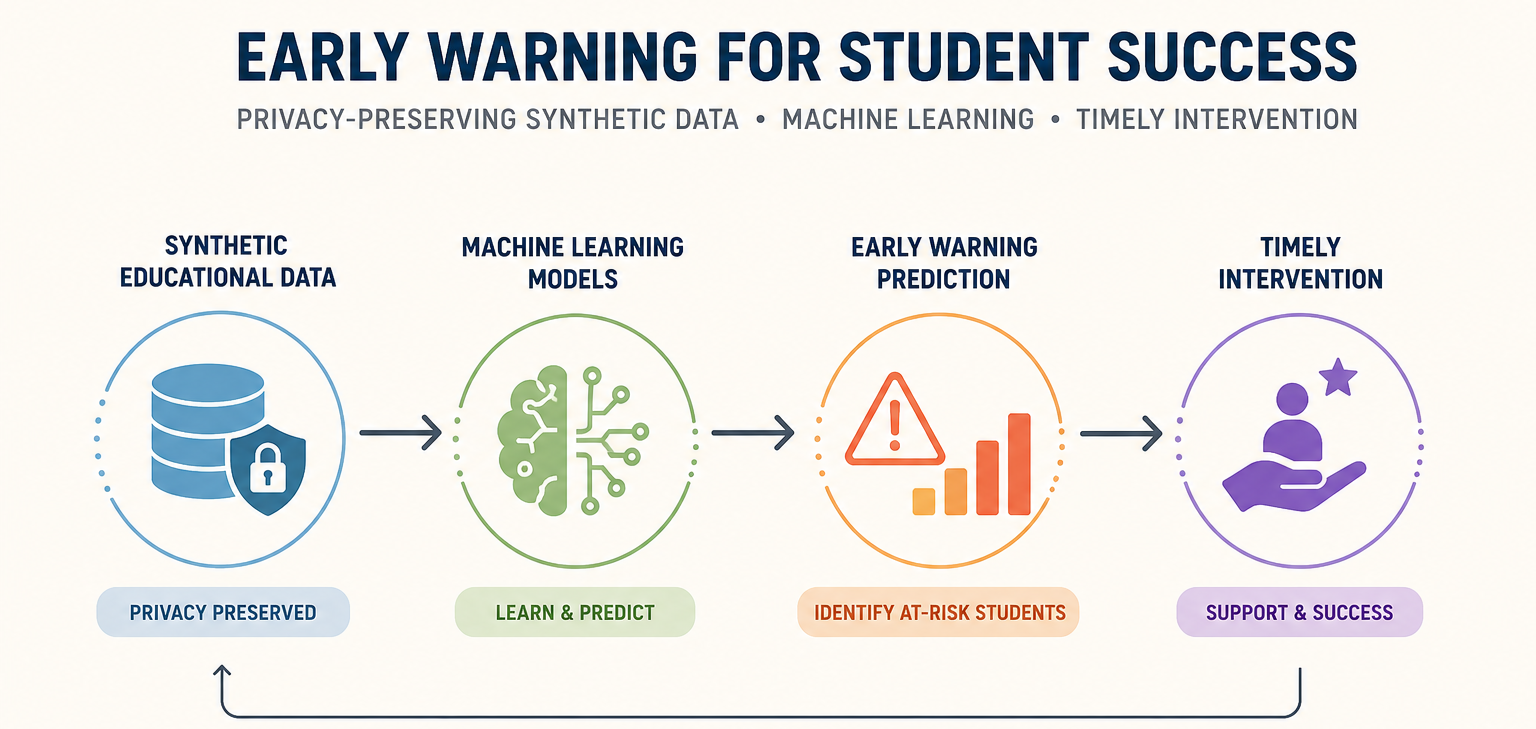
The obvious answer was machine learning. Modern AI can recognize patterns long before humans notice them. Yet, the more I explored educational analytics, the more I encountered the same obstacle faced by researchers across the world access to student data.
Educational institutions rightly protect student records. Privacy regulations safeguard sensitive information, but they also make collaborative research extremely difficult. Without access to diverse, high-quality datasets, many promising ideas remain confined to a single institution.
At that moment I realized that perhaps the problem was not the lack of algorithms.
Perhaps the real challenge was the lack of shareable data.
"Innovation should never require compromising a student's privacy."
That belief completely changed the direction of this project.
Instead of asking how to collect more real data, we asked a different question:
Can we build a realistic educational world that contains no real students at all?
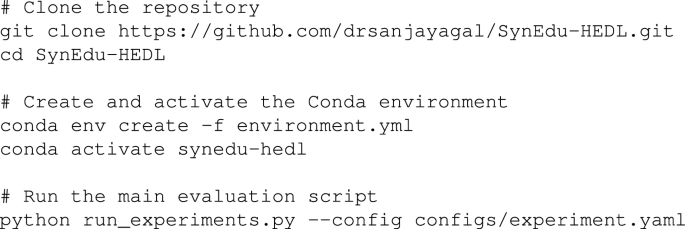
That question gave birth to SynEdu-HEDL, a synthetic educational dataset designed to mirror the complexity of higher education while ensuring that no actual student record is ever exposed. Rather than relying on copied institutional data, the dataset was generated using rule-based simulation and probabilistic modeling, creating thousands of realistic learners, courses, assessments, interactions, and engagement patterns.
Creating the dataset, however, was only the beginning.
The next challenge was understanding how AI could learn from synthetic data without losing relevance in the real world. We explored traditional machine learning models, deep learning architectures, temporal sequence models, graph neural networks, and finally designed a hybrid LSTM-GNN framework capable of understanding both learning behavior over time and relationships between students and courses.
The results surprised even us.
Models trained only on synthetic data could not fully replace real-world learning. However, something much more valuable emerged.
Synthetic data became an exceptional foundation for pre-training.
With only a small fraction of real institutional data, the models rapidly adapted and achieved performance close to systems trained on complete datasets. That insight became the central contribution of this work not that synthetic data replaces reality, but that it dramatically lowers the barrier for building practical early warning systems.
Equally important was the question of fairness.
Predictive models influence real educational decisions. A model that unintentionally disadvantages one group of students is not simply inaccurate—it is unjust. Therefore, fairness evaluation became an integral part of the research rather than an afterthought. Our objective was never merely to maximize accuracy, but to build systems that remain responsible, transparent, and equitable.
Research is rarely a straight path.
There were countless revisions, failed experiments, unexpected findings, and difficult questions raised during peer review. Many assumptions that initially seemed promising had to be abandoned. In retrospect, those moments became the most valuable part of the journey because they forced us to improve the science rather than defend our expectations.
"Good research does not prove that we are right; it teaches us where we were wrong."
This work was never intended to be simply another machine learning paper. It is an invitation to rethink how educational AI can be developed responsibly. If researchers can collaborate without exchanging sensitive student records, institutions of every size—not only those with massive historical databases can participate in advancing educational analytics.
Ultimately, behind every dataset, every algorithm, and every evaluation metric lies a human story.
The purpose of early warning systems is not to predict failure.
It is to create opportunities for timely support, encouragement, and success.
If this research helps even one institution identify struggling students earlier, protect their privacy, and provide interventions before they disengage, then its true impact extends far beyond the pages of a journal.
"Artificial Intelligence should not replace the human side of education; it should strengthen our ability to care for every learner."
Dr. Sanjay Agal
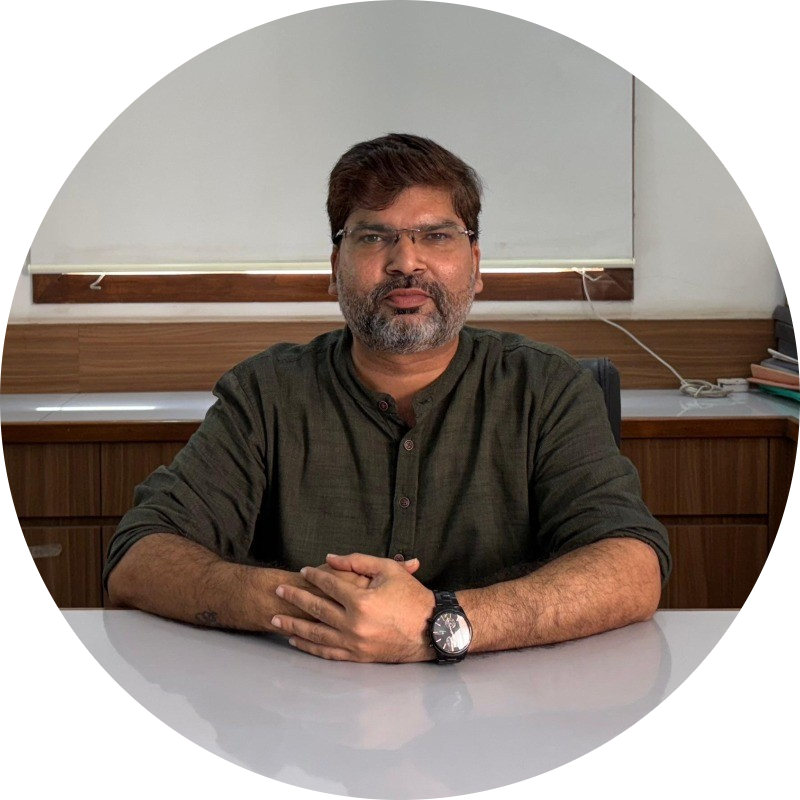
I am Dr. Sanjay Agal, an educator, researcher, and academic leader dedicated to advancing the frontiers of knowledge and shaping the future of engineering education. Currently, I serve as Professor and Head of the Department of Artificial Intelligence and Data Science at Parul University, Vadodara, India. My professional journey also includes serving as the Principal of Dr. V. R. Godhania College of Engineering & Technology, Porbandar an opportunity I was formally endorsed for by Gujarat Technological University (GTU) in 2023.
My career has been guided by a deep commitment to innovation-driven learning and impactful research. Over the years, I have authored sixteen books and published numerous research papers in reputed international journals. I have also secured several patents, reflecting my sustained efforts to bridge theoretical understanding with meaningful real world applications.
With a vision to inspire and empower the next generation of thinkers, innovators, and problem solvers, I strive to foster an environment where curiosity, creativity, and academic excellence thrive. Whether through teaching, research, or academic leadership, my mission remains the same: to contribute to a transformative educational ecosystem that benefits students, faculty, and society at large.
Follow the Topic
-
Scientific Reports
An open access journal publishing original research from across all areas of the natural sciences, psychology, medicine and engineering.

Related Collections
With Collections, you can get published faster and increase your visibility.
Cancer Prevention and Control
Publishing Model: Hybrid
Deadline: Feb 19, 2027
Healthy Aging
Publishing Model: Open Access
Deadline: Dec 31, 2026