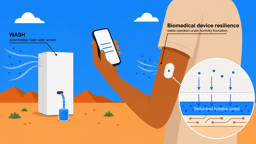

Atmospheric water harvesting (AWH) has drawn growing attention because it offers a very different way to think about water access. Instead of relying only on rivers, groundwater, pipelines, or centralized treatment, it uses the moisture already present in air as a distributed water source. That idea is especially compelling for remote regions, emergency settings, and water-stressed areas where infrastructure is limited or unreliable. But for AWH to matter in practice, it cannot remain a laboratory curiosity. It has to work off grid, in real weather, and at output levels that begin to matter for daily use.
That challenge became the starting point of this study. In our field, AWH is often treated mainly as a materials problem: can we make a sorbent that captures more water from air? That question is important, and it has guided much of our own work. But as we moved toward deployment, we kept running into a different question: what does it actually take for an atmospheric water harvester to work in the field, not just in a controlled test?
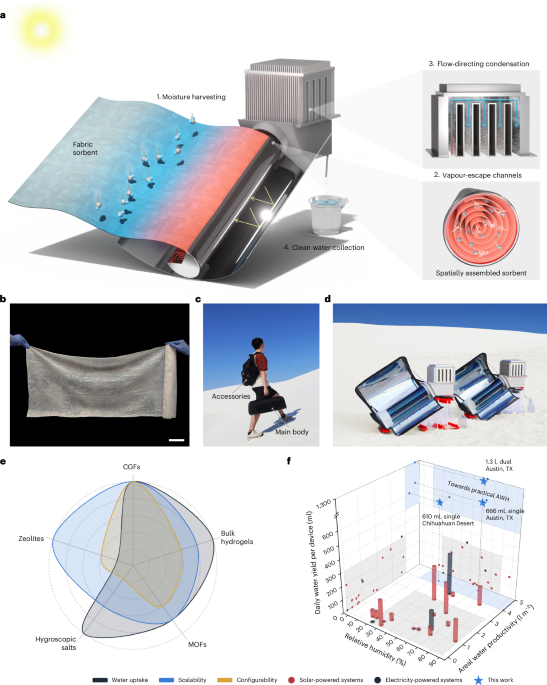
For us, a practical system had to satisfy three conditions at once. It had to be field-portable, solar-powered, and liter-scale. Meeting all three quickly showed us that this was not simply about inventing a higher-performing material. Once a sorbent is packed into a compact device, transport, heat flow, and operation schedule all become just as important. A material that performs beautifully as a thin sample can behave very differently when scaled into a real module.
One important step was recognizing the value of a simple starting point. The foundation of our sorbent is a commercial cotton nonwoven, which we transformed into a hygroscopic gel fabric. What made it powerful was not only its chemistry, but also its form. It was flexible, scalable, and easy to configure. We could roll it into compact cartridges, unroll it for sorption, and still preserve pathways for vapor transport. That became essential once the goal shifted from a benchtop material to a portable device.
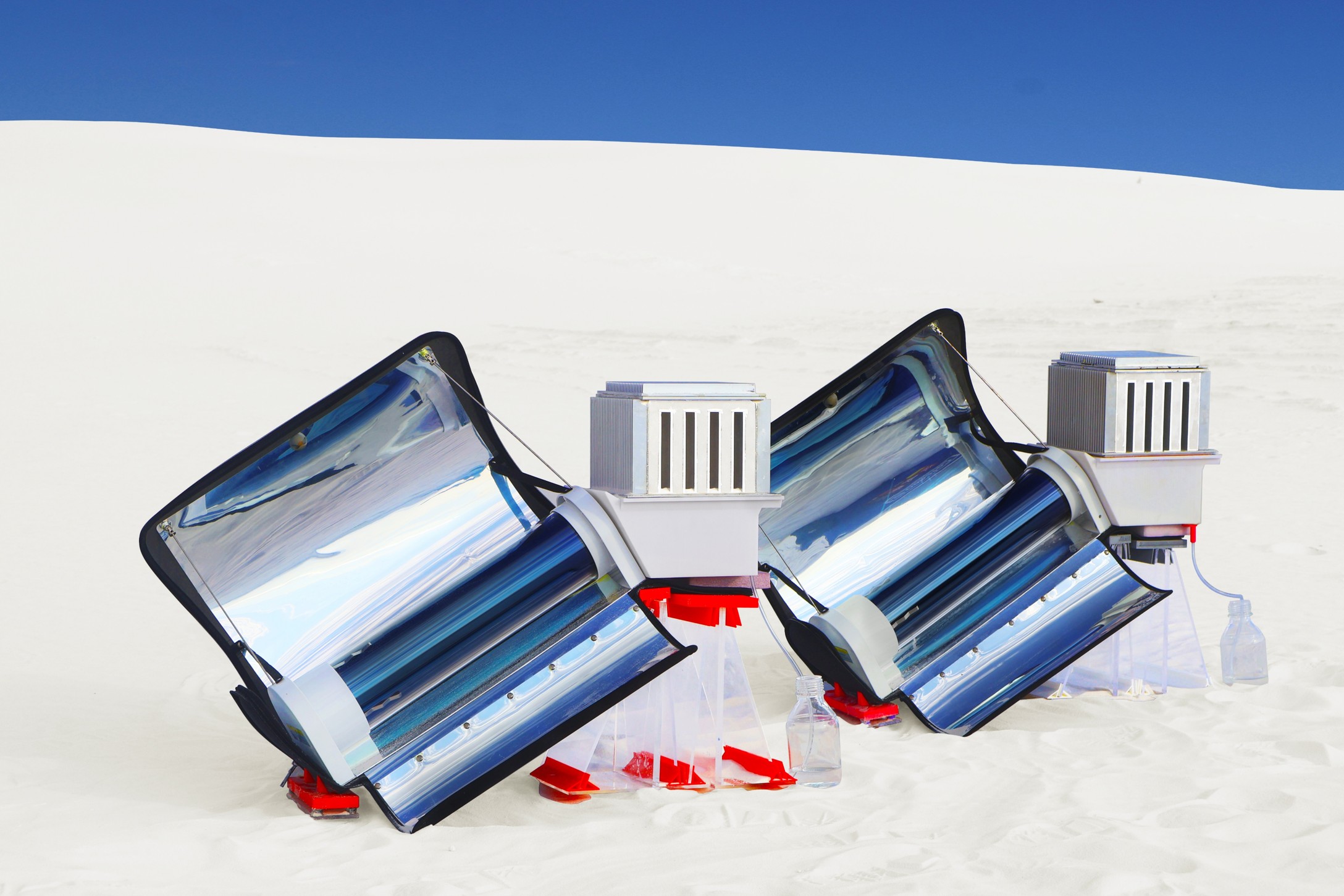
The most memorable part of the project came during field testing in the Chihuahuan Desert. Intuitively, one expects AWH performance to drop sharply in very dry air. At first, our field data seemed to confirm that concern: compared with Austin, the desert device dried out faster and the collection rate dropped earlier in the day. But the deeper lesson was that the problem was not simply lower humidity. The operating window had shifted. In other words, the climate was not just a background condition. It was part of the design problem.
That realization led to one of the most important findings in the paper. In Austin, a dual-batch protocol worked well. In the desert, switching to a triple-batch schedule allowed us to better match the local climate and maintain similarly strong areal productivity: 4.7 L m−2 day−1 in Austin and 4.3 L m−2 day−1 in the Chihuahuan Desert. The system also continued to operate under cloudy conditions, producing 310 mL per module at about 0.4 sun. For us, this was a reminder that practical AWH is not only about what a material can absorb, but about how the whole system is structured and operated.
That is the broader story behind this paper. We did not just develop a sorbent. We designed a material, a cartridge architecture, a device, and an operating strategy together. More broadly, the work reflects a shift in how we think about AWH itself: from pursuing record materials in isolation to building deployable, climate-aware systems that can contribute to decentralized drinking water access where it is needed most.

Follow the Topic
-
Nature Water
This journal publishes research on the evolving relationship between society and water resources on a monthly basis. It covers the natural sciences, engineering, and social sciences, with a particular interest in regards to interdisciplinary research.

What are SDG Topics?
An introduction to Sustainable Development Goals (SDGs) Topics and their role in highlighting sustainable development research.
Continue reading announcementRelated Collections
With Collections, you can get published faster and increase your visibility.
Antibiotic Resistance in the Environment
Publishing Model: Hybrid
Deadline: Apr 24, 2027