From Fear to Framework: Applying Human–AI Co-Agency Across Real-World Sectors
Published in Computational Sciences and Philosophy & Religion
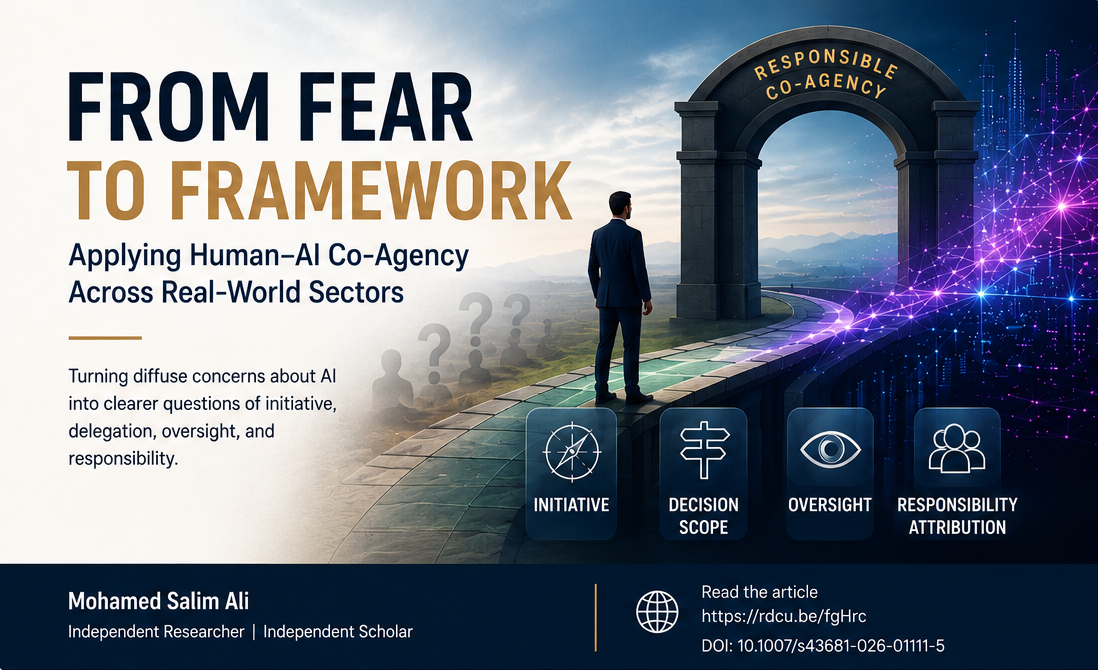

Public discussion about artificial intelligence often begins with concern.
In education, people ask what happens to the classroom when AI systems increasingly support learning, assessment, and student guidance. In government, concern may focus on the opacity of administrative systems and the difficulty of locating responsibility when decisions are increasingly mediated by technology. In work and employment, the debate often centers on displacement, algorithmic management, AI agents, and the changing role of human judgment. In high-stakes institutional settings, the questions become sharper still: where delegation begins, where supervision remains meaningful, and who remains answerable.
These concerns are real, but they are often expressed in broad terms. One difficulty is that concern can remain diffuse unless it is connected to a more precise account of how action, oversight, and responsibility are actually structured.
This is where the framework proposed in my research, From Assistants to Agents: A Relational Framework for Human–AI Co-Agency, may be useful.
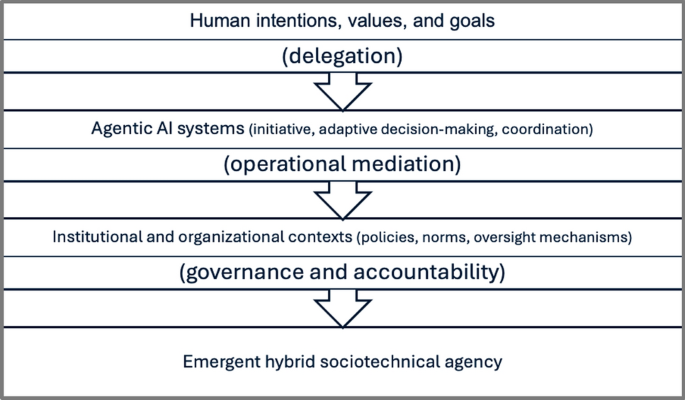
The paper does not attempt to predict the future of any one sector, nor does it claim to resolve the sector-specific policy questions raised by AI adoption. Its contribution is more specific: it proposes a relational framework for analyzing situations in which action is distributed across human actors, AI systems, and institutional structures of delegation, supervision, and responsibility.
The sector examples below are illustrative applications of the framework rather than empirical findings or claims about how these domains will develop.
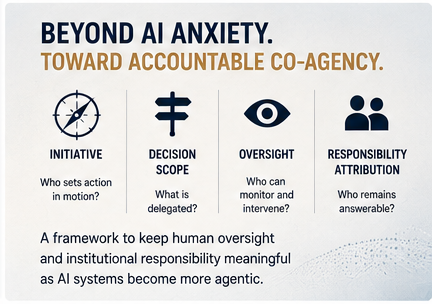
The framework is organized around four dimensions:
- Initiative — who initiates action and sets a process in motion?
- Decision scope — what kinds of decisions are being delegated, and how consequential are they?
- Oversight — who can monitor, review, intervene, or revise?
- Responsibility attribution — who remains answerable when outcomes are contested, harmful, or consequential?
These dimensions can help translate broad institutional concern into clearer governance questions.
Education
In education, the issue is not simply whether AI enters the classroom. The more important question is how pedagogical authority, judgment, and accountability are organized when AI systems become part of learning environments.
If AI systems begin to shape tutoring, feedback, assessment support, learning pathways, or automated grading, the framework helps ask: who is initiating action? What forms of educational judgment are being delegated? Do teachers and institutions retain meaningful oversight? Who remains responsible when system-supported outcomes affect students?
The framework does not answer these questions for educators. It helps make them more visible.
Government and public administration
In government, public concern often centers on opacity and accountability.
When AI systems are embedded in case handling, documentation, service delivery, or decision support, the key issue is whether public processes remain reviewable, contestable, and institutionally accountable.
Here, initiative clarifies when a system moves from support into structuring administrative action. Decision scope clarifies whether delegated functions remain narrow or become more consequential. Oversight asks whether human review is substantive rather than symbolic. Responsibility attribution helps ensure that accountability remains anchored in institutions rather than diffused across technical systems.
Work and employment
In work environments, concern often begins with job displacement. But there is another issue that is equally important: the redistribution of authority.
If AI systems initiate tasks, rank performance, allocate work, or shape organizational workflows, human authority may remain formally present while becoming harder to exercise meaningfully.
The framework helps distinguish visible human involvement from real oversight, and formal responsibility from effective accountability.
Healthcare
Healthcare remains a particularly useful illustration because the stakes of delegation, oversight, and responsibility are immediately visible.
The relevant question is not only whether AI can support diagnosis or treatment-related processes. It is whether clinically significant delegation remains proportionate to meaningful human oversight, and whether accountability remains visible across clinicians, institutions, deployers, AI-enabled clinical assistants or agentic systems, and system designers.
High-stakes institutions
In higher-stakes institutional environments, the framework remains useful as an analytical lens.
The purpose is not to make operational claims, but to clarify where initiative sits, how far delegated decisions extend, where intervention remains possible, and how responsibility is preserved across layered institutional authority.
Across these sectors, the same pattern appears.
Public concern intensifies when initiative is unclear, decision scope expands without visibility, oversight becomes weak or merely formal, and responsibility attribution becomes blurred.
That is why I see the framework not as a response to fear, but as a way to structure it.
The movement from fear to framework is not a movement away from concern. It is a movement toward clarity.
The practical value of human–AI co-agency lies in making delegation more legible, oversight more meaningful, and responsibility more institutionally intelligible as AI systems take on increasingly agentic roles within sociotechnical systems.
The challenge is not machine agency in isolation.
The challenge is whether meaningful human oversight and institutional responsibility can be preserved under conditions of increasingly distributed action.
The challenge is whether human oversight and institutional responsibility remain meaningful under conditions of increasingly distributed action.
Related research
From Assistants to Agents: A Relational Framework for Human–AI Co-Agency
Published in AI and Ethics
Springer Research Communities: https://go.nature.com/4x2XX0R
Published article: https://rdcu.be/fgHrc
DOI: https://doi.org/10.1007/s43681-026-01111-5

Independent researcher focused on AI ethics, philosophy of technology, governance, and sociotechnical systems. I am particularly interested in human–AI co-agency, accountability, and how responsible AI can be made meaningful in real institutional environments for the benefit of humanity.
Follow the Topic
-
AI and Ethics
This journal seeks to promote informed debate and discussion of the ethical, regulatory, and policy implications that arise from the development of AI. It focuses on how AI techniques, tools, and technologies are developing, including consideration of where these developments may lead in the future.

Related Collections
With Collections, you can get published faster and increase your visibility.
AI Ethics for Children and Adolescents
This topical collection invites contributions that critically examine how central concepts and theories of AI ethics function when applied to children and adolescents, and where their limits become visible. While terms such as trust, explainability, informed consent, privacy, bias, justice, and well-being are well established in AI ethics, they are usually developed with adult users and decision-makers in view, which means that in contexts concerning children and adolescents they frequently rest on assumptions that do not hold or at least require critical examination.
Children and adolescents encounter AI systems under conditions of developing autonomy, heightened vulnerability, and dependence on others, which does not mean, however, that they are merely passive objects of protection – rather, they possess emerging forms of agency and a moral right to participation and development. Ethical analysis must therefore go beyond simple transfers of adult-centered frameworks and instead ask how AI ethics concepts must be specified, adapted, or fundamentally reconceived in developmentally appropriate and relational ways, whereby it is likely to emerge that such adaptations are not only relevant for children and adolescents but can also enrich the general debate.
We welcome submissions engaging in conceptual and normative analysis, as well as ethically informed empirical work. Contributions may focus on individual concepts, compare different ethical approaches, or explore concrete application contexts, with particular welcome given to work that makes explicit which assumptions about agency, competence, responsibility, or rationality are embedded in existing AI ethics frameworks and how these assumptions are challenged by childhood and adolescence. Also of interest are contributions addressing the question of how AI systems must be designed to meet the particular needs and rights of children and adolescents, or examining what governance structures are required to ensure child-sensitive AI.
Topics
Topics may include, but are not limited to:
• Trust and trustworthiness of AI systems in childhood and adolescence, including questions of overtrust, emotional attachment, and manipulative design strategies
• Explainability and transparency under conditions of developing cognitive capacities, whereby the danger of "explainability washing" must also be considered
• (Informed) consent, shared decision-making, and participation, including the question of how concepts such as transitional paternalism are to be evaluated ethically
• Privacy, surveillance, and data protection for children and adolescents, particularly in the context of digital phenotyping and other data-intensive applications
• Bias, discrimination, and justice affecting marginalized children, whereby intersectional perspectives should also be taken into account
• AI and the well-being of children and adolescents, including the question of socialization effects of AI
• Autonomy development, vulnerability, and dependence in AI-mediated environments, whereby the role of human relationships in an AI-permeated childhood must also be reflected upon
• Ethical governance and child-sensitive AI design, including the question of democratic participation of children and adolescents in decisions about their technological future.
Please find a detailed call for papers and submission guidelines at https://link.springer.com/journal/43681/updates/27841622.
Publishing Model: Hybrid
Deadline: Nov 30, 2026