Behind the Paper: Why I Wrote From Assistants to Agents
Published in Philosophy & Religion

Explore the Research
From assistants to agents: a relational framework for human–AI co-agency
When we talk about artificial intelligence, much of the debate still oscillates between two familiar images. On one side, AI is treated as a sophisticated tool: something that supports human action but remains external to responsibility. On the other side, AI is sometimes described in near-anthropomorphic terms, as if it were becoming an autonomous actor in its own right. Both views, in different ways, seemed incomplete to me.
What increasingly interested me was a more difficult question: what happens when AI is neither merely assistive nor fully autonomous, but instead operates within structured systems of delegation, supervision, and institutional responsibility? In other words, what happens when action is distributed across humans, artificial systems, and governance structures?
That question became the starting point for my article, From Assistants to Agents: A Relational Framework for Human–AI Co-Agency, now published in AI and Ethics.
The central intuition behind the article is simple: the rise of agentic AI requires us to rethink agency relationally. In many real-world settings, AI does not act in isolation. Its apparent initiative is enabled, bounded, and interpreted through human decisions, institutional goals, technical design, and governance mechanisms. This means that responsibility cannot be understood by looking only at the machine, or only at the individual user. It has to be understood through the structure of the broader sociotechnical system.
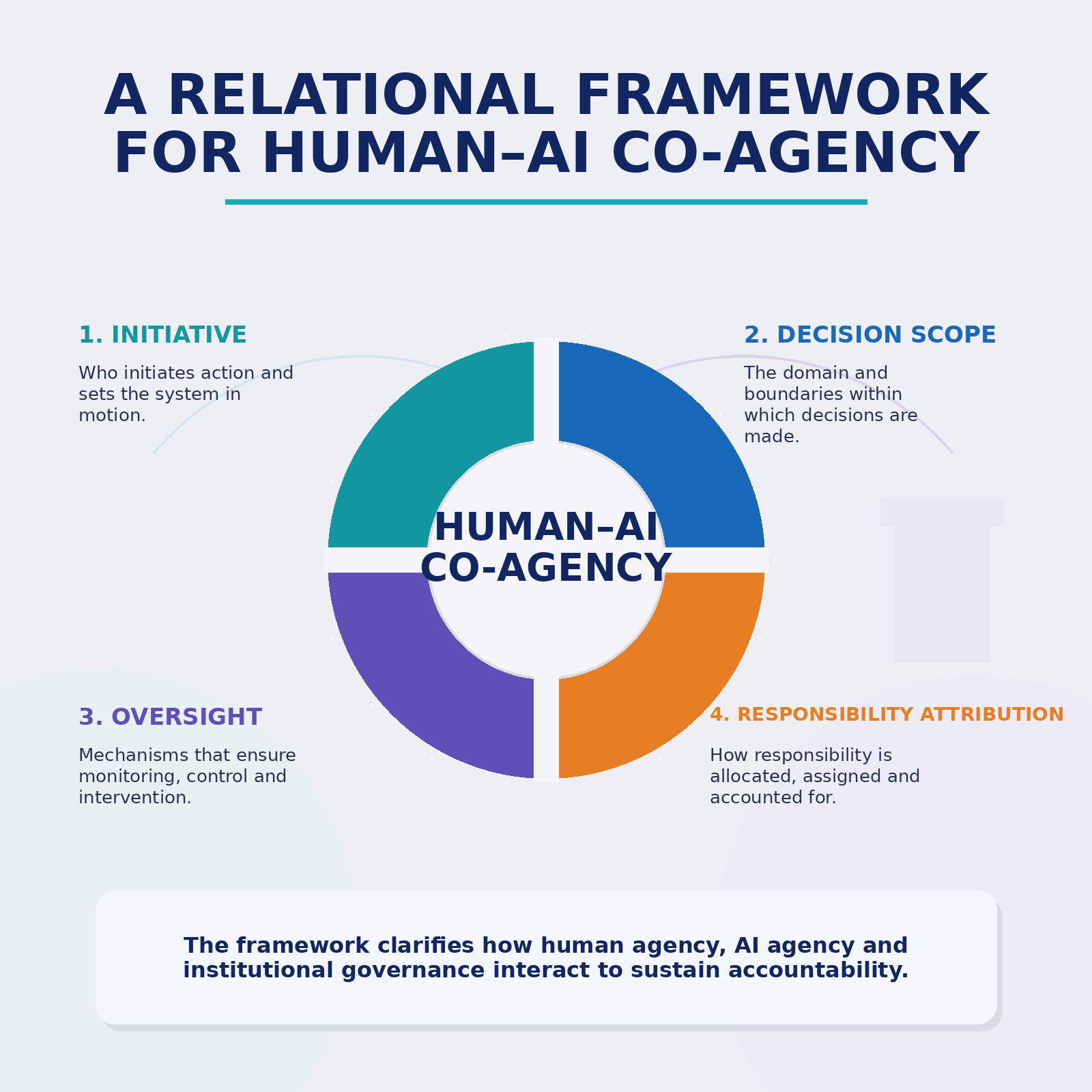
To make that argument more operational, I proposed a four-dimensional framework built around initiative, decision scope, oversight, and responsibility attribution. These dimensions are intended to help clarify where delegation begins, how far it extends, how supervision is preserved, and how accountability should remain anchored even when systems take on greater initiative.
One reason I felt this mattered is that discussions about AI governance often remain either too abstract or too procedural. We speak in large terms about ethics, trust, regulation, and policy, but we often lack a practical conceptual bridge between theory and institutional design. I wanted this work to contribute to that middle layer: not only asking what AI is, but how human–AI arrangements should be evaluated when decisions, actions, and consequences are distributed.
I was also concerned that the vocabulary of “autonomy” can sometimes obscure more than it reveals. The issue is not simply whether a system appears autonomous. The more important question is whether institutions remain capable of structuring delegation responsibly. A system may appear highly capable while still depending on weak governance. Conversely, human accountability can be eroded not because humans disappear, but because roles, boundaries, and responsibility structures become blurred.
In that sense, the challenge posed by agentic AI is not machine agency in isolation. It is the alignment of delegated action with meaningful human oversight and institutional responsibility. More broadly, I hope this work contributes to a more grounded and rigorous conversation about how societies, organizations, and governance systems should respond as AI becomes more agentic.
Read the article
SharedIt: https://rdcu.be/fgHrc
DOI: https://doi.org/10.1007/s43681-026-01111-5

Independent researcher focused on AI ethics, philosophy of technology, governance, and sociotechnical systems. I am particularly interested in human–AI co-agency, accountability, and how responsible AI can be made meaningful in real institutional environments for the benefit of humanity.
Follow the Topic
-
AI and Ethics
This journal seeks to promote informed debate and discussion of the ethical, regulatory, and policy implications that arise from the development of AI. It focuses on how AI techniques, tools, and technologies are developing, including consideration of where these developments may lead in the future.

Related Collections
With Collections, you can get published faster and increase your visibility.
AI Ethics for Children and Adolescents
This topical collection invites contributions that critically examine how central concepts and theories of AI ethics function when applied to children and adolescents, and where their limits become visible. While terms such as trust, explainability, informed consent, privacy, bias, justice, and well-being are well established in AI ethics, they are usually developed with adult users and decision-makers in view, which means that in contexts concerning children and adolescents they frequently rest on assumptions that do not hold or at least require critical examination.
Children and adolescents encounter AI systems under conditions of developing autonomy, heightened vulnerability, and dependence on others, which does not mean, however, that they are merely passive objects of protection – rather, they possess emerging forms of agency and a moral right to participation and development. Ethical analysis must therefore go beyond simple transfers of adult-centered frameworks and instead ask how AI ethics concepts must be specified, adapted, or fundamentally reconceived in developmentally appropriate and relational ways, whereby it is likely to emerge that such adaptations are not only relevant for children and adolescents but can also enrich the general debate.
We welcome submissions engaging in conceptual and normative analysis, as well as ethically informed empirical work. Contributions may focus on individual concepts, compare different ethical approaches, or explore concrete application contexts, with particular welcome given to work that makes explicit which assumptions about agency, competence, responsibility, or rationality are embedded in existing AI ethics frameworks and how these assumptions are challenged by childhood and adolescence. Also of interest are contributions addressing the question of how AI systems must be designed to meet the particular needs and rights of children and adolescents, or examining what governance structures are required to ensure child-sensitive AI.
Topics
Topics may include, but are not limited to:
• Trust and trustworthiness of AI systems in childhood and adolescence, including questions of overtrust, emotional attachment, and manipulative design strategies
• Explainability and transparency under conditions of developing cognitive capacities, whereby the danger of "explainability washing" must also be considered
• (Informed) consent, shared decision-making, and participation, including the question of how concepts such as transitional paternalism are to be evaluated ethically
• Privacy, surveillance, and data protection for children and adolescents, particularly in the context of digital phenotyping and other data-intensive applications
• Bias, discrimination, and justice affecting marginalized children, whereby intersectional perspectives should also be taken into account
• AI and the well-being of children and adolescents, including the question of socialization effects of AI
• Autonomy development, vulnerability, and dependence in AI-mediated environments, whereby the role of human relationships in an AI-permeated childhood must also be reflected upon
• Ethical governance and child-sensitive AI design, including the question of democratic participation of children and adolescents in decisions about their technological future.
Please find a detailed call for papers and submission guidelines at https://link.springer.com/journal/43681/updates/27841622.
Publishing Model: Hybrid
Deadline: Nov 30, 2026