From intracellular biomolecule delivery to prophylactic cancer immunotherapy: a nine-year research journey
Published in Bioengineering & Biotechnology, Materials, and Biomedical Research
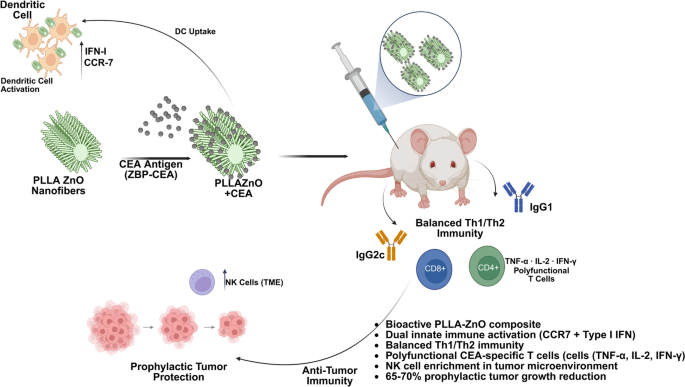

I am pleased to share the newest and most comprehensive article from our continuing research on the PLLA–ZnO nanowire platform for nanovaccines.
FEATURED NEW ARTICLE
“PLLA–ZnO nanowire nano-vaccine orchestrates balanced Th1/Th2 immunity and confers prophylactic antitumor protection."
Cancer Nanotechnology, 2026
https://doi.org/10.1186/s12645-026-00429-3
This study extends our previous therapeutic findings into a prophylactic tumor model while providing a broader mechanistic understanding of the immune response.
The PLLA–ZnO/CEA nanovaccine achieved efficient antigen loading and 96.2% dendritic-cell uptake, induced strong Type I interferon production and increased CCR7 expression, and generated balanced IgG1/IgG2c humoral immunity. It also stimulated antigen-responsive CD4+ and CD8+ T-cell responses involving IFN-γ, TNF-α, and IL-2.
In a prophylactic MC38/CEA mouse model, vaccination reduced tumor burden by 65–70%. It also expanded splenic CD8+ T cells and increased tumor-infiltrating NK cells, demonstrating systemic and tumor-microenvironment remodeling.
This publication represents the latest stage of a research journey that began in 2017:
- Intracellular biomolecule delivery (Nanoscale, 2017)
We demonstrated that the three-dimensional organization of ZnO nanowires controls their interaction with cells. Vertical and fan-shaped nanowires efficiently delivered non-covalently associated peptides, while fan-shaped nanowires also enabled intracellular DNA delivery and gene expression through cellular uptake and transient membrane penetration.
https://doi.org/10.1039/C7NR05219G
- Translation into intellectual property (Korean patent)
“Delivery of biomacromolecules employing clusters of nanowires”
The patent family covers vertical and radial ZnO nanowire structures, ZnO-binding peptides, and the delivery of proteins, DNA, RNA, drugs, and vaccine antigens.
KR20190027346A / KR102689812B1
https://patents.google.com/patent/KR102689812B1/en
- Therapeutic cancer vaccination (Nanoscale, 2019)
We translated the delivery concept into a cancer-vaccine platform, demonstrating dendritic-cell activation, tumor-specific cellular immunity, reduced systemic regulatory T cells, enhanced tumor-infiltrating T cells, and suppression of established tumors.
https://doi.org/10.1039/C8NR08704K
- ZnO vaccine mechanisms (Pharmaceutics, 2019)
This review examined ZnO nanocomposites as antigen carriers and immune adjuvants, including nano–bio interactions, immunological mechanisms, and safety considerations.
https://doi.org/10.3390/pharmaceutics11100493
- Materials engineering (Advanced Functional Materials, 2021)
This study expanded the materials-science foundation by examining ZnO nano-spicule formation on PLA, structure-dependent wettability, and antibacterial functionality.
https://doi.org/10.1002/adfm.202100844
- Tumor-microenvironment modulation (Bioactive Materials, 2024)
Our review examined how multifunctional nanocomposites can overcome immunosuppression and remodel the tumor microenvironment to enhance cancer immunotherapy.
https://doi.org/10.1016/j.bioactmat.2023.08.022
Together, these studies trace the evolution of one scientific concept—from understanding the nanowire–cell interface and delivering biomacromolecules to therapeutic tumor control, tumor-microenvironment modulation, mechanistic immune characterization, and prophylactic antitumor activity.
I am deeply grateful to all the mentors, collaborators, and co-authors who contributed to this research journey.

Follow the Topic
-
Cancer Nanotechnology
This is a peer-reviewed, open access journal aiming to disseminate cutting-edge research and promote emerging trends in the use of nanostructures and the induction of nanoscale processes for the prevention, diagnosis, treatment of cancer.