Functionalized Wood: A Green Nanoengineering Platform for Sustainable Technologies
Published in Bioengineering & Biotechnology and Materials
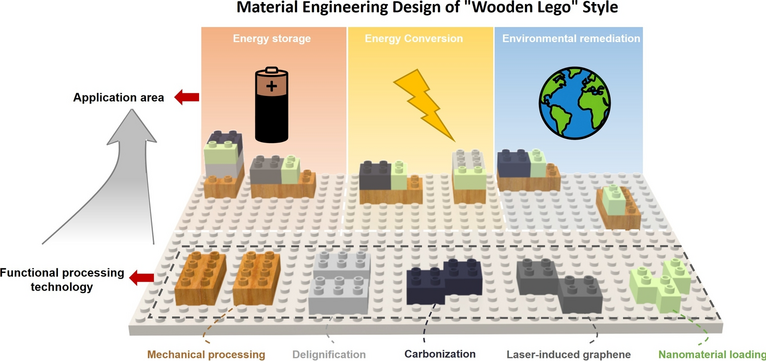

As industrialization intensifies and carbon imbalances grow, the demand for renewable, multifunctional materials has never been more urgent. Now, researchers from Soochow University and Xidian University, led by Professor Haibo Huang, Professor Zhen Wen, and Professor Yunlei Zhou, have presented a comprehensive review on functionalized wood as a versatile nanoengineering platform for sustainable technologies. This work offers valuable insights into transforming natural wood into high-performance, programmable materials for next-generation energy and environmental applications.
Why Functionalized Wood Matters
- Structural Versatility: The intrinsic hierarchical, anisotropic, and porous architecture of wood provides a structurally programmable scaffold that supports subsequent nanoengineering strategies, enabling multiscale property modulation.
- Sustainability: As a renewable, bio-based material, wood offers an eco-friendly alternative to synthetic materials, promoting closed-loop life cycle management and reducing environmental impact.
- Multifunctionality: Through targeted functionalization, wood can be engineered for diverse applications including energy storage, water treatment, and renewable power generation.
Innovative Design and Features
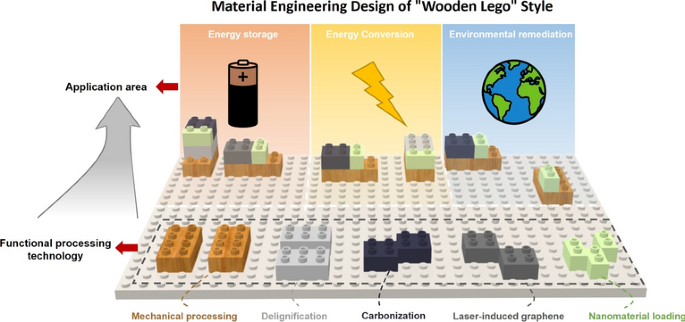
- Wood-Specific Nanoengineering Strategies: The review covers thermal carbonization, laser-induced graphene formation, targeted delignification, nanomaterial integration, and mechanical processing—systematically categorized to enable tunable structures and properties across multiple length scales.
- Functional Materials Integration: The selection of functional materials is crucial for achieving desired properties. Carbon-based materials, metal oxides, conductive polymers, and single-atom catalysts are discussed as key components for functionalized wood systems.
- Modular "Lego-like" Assembly: These functionalization strategies can be flexibly combined in a modular manner, allowing wood to be reconfigured and optimized for diverse application scenarios.
Applications and Future Outlook
- Energy Storage: Functionalized wood enables sustainable solutions in metal-ion batteries, Zn–air systems, and supercapacitors, delivering improved electrical conductivity, catalytic activity, and cycling stability.
- Water Treatment: Engineered wood structures facilitate efficient adsorption, photothermal filtration, and catalytic degradation for removing heavy metals, dyes, and organic contaminants.
- Energy Conversion: Wood-based platforms support solar-thermal evaporation, ionic thermoelectrics, hydrovoltaics, and triboelectric nanogenerators for renewable power generation.
- Challenges and Opportunities: The review highlights challenges in scalable fabrication, material integration, and long-term environmental stability. Future research will focus on developing standardized manufacturing protocols and exploring new hybrid architectures to fully realize the potential of functionalized wood in sustainable technologies.
This comprehensive review provides a roadmap for the development and application of functionalized wood as a green nanoengineering platform. It highlights the importance of interdisciplinary research in materials science, chemistry, and environmental science to drive innovation in this field. Stay tuned for more groundbreaking work from Professor Haibo Huang, Professor Zhen Wen, and Professor Yunlei Zhou at Soochow University and Xidian University!

Editor of Nano-Micro Letters, which is an Open-Access, peer-reviewed journal reported papers that have at least one dimension ranging from a few sub-nanometers to a few hundreds of micrometers. The journal is published by Springer Nature and indexed by SCI, EI, SCOPUS, Pubmed, etc. The 2025 JCR Impact Factor is 38.5. The 2025 CiteScore is 58.9.
Follow the Topic
-
Nano-Micro Letters
Nano-Micro Letters is a peer-reviewed, international, interdisciplinary and open-access journal that focus on science, experiments, engineering, technologies and applications of nano- or microscale structure and system in physics, chemistry, biology, material science, and pharmacy.