Enhanced Spin‑Engineering Photothermoelectric–Enzymatic Catalysis System via Lattice Mismatch‑Induced Jahn–Teller Distortion for Tumor Therapy
Published in Bioengineering & Biotechnology, Cancer, and Chemistry
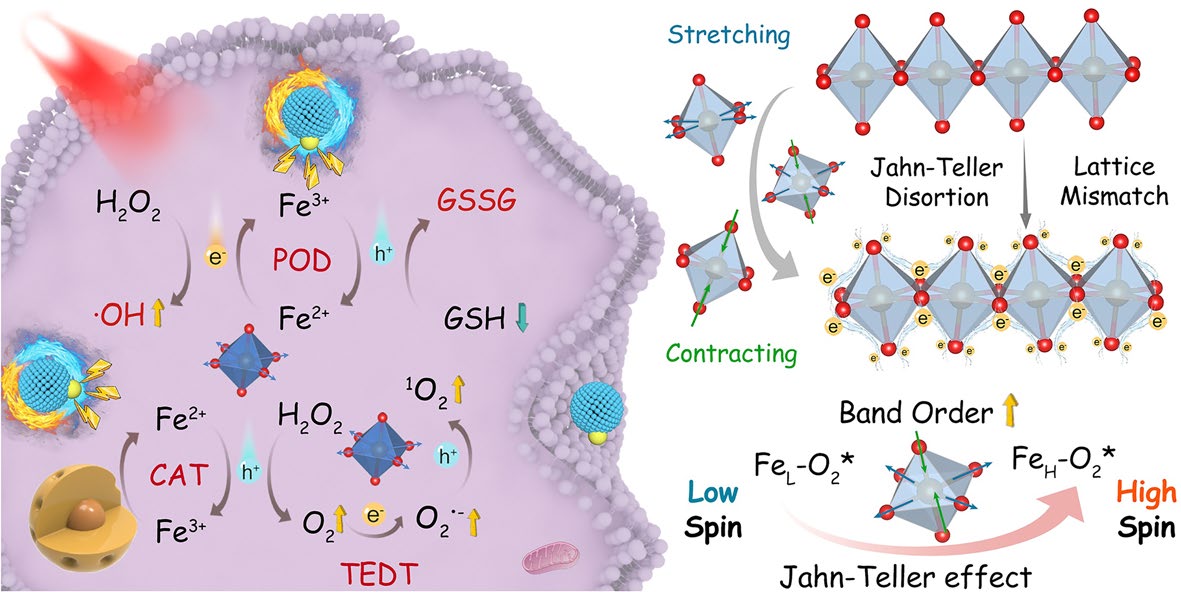
Introduction: The Challenges of Conventional Catalytic Therapy
In the rapidly evolving field of nanomedicine, chemodynamic therapy (CDT) and enzyme-mimicking catalysis have emerged as powerful tools for targeted tumor destruction. However, the efficiency of these oxygen-dependent and reactive oxygen species (ROS)-generating treatments is often throttled by two major hurdles: the rapid recombination of electron-hole pairs and the persistent hypoxic (oxygen-poor) environment within tumors.
To break these bottlenecks, a collaborative research team from Harbin Engineering University and international partners has published a study in Nano-Micro Letters. They introduced a sophisticated Fe3O4-Ag2S p-n heterojunction system that utilizes "spin-engineering" to boost catalytic performance, providing a new roadmap for synergistic photothermoelectric-enzymatic tumor therapy.
The Current Benchmark: Beyond Simple Heterostructures
Traditional heterojunctions focus primarily on charge separation through internal electric fields. While effective, they often overlook the potential of optimizing the electronic "spin state" of the active catalytic sites. The researchers recognized that the electronic configuration of Fe3+ ions—specifically their d-orbital splitting—plays a decisive role in how efficiently they can catalyze the decomposition of H2O2 into toxic hydroxyl radicals (•OH).
By engineering a lattice mismatch between Fe3O4 and Ag2S, the team aimed to induce a structural phenomenon known as Jahn-Teller (J-T) distortion, which "retunes" the electronic states for maximum therapeutic impact.
The Synergetic Approach: Jahn-Teller Distortion and Thermoelectric Effects
The researchers integrated advanced physical concepts with bio-catalysis to create a multi-responsive system:
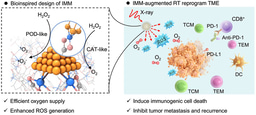
- Jahn-Teller Distortion: The lattice mismatch at the Fe3O4-Ag2S interface triggers a structural asymmetry that modifies the d-orbital splitting of Fe3+. This "spin-engineering" optimizes the binding energy of intermediates, significantly enhancing peroxidase-like (POD) and catalase-like (CAT) activities.
- Photothermal-Driven Thermoelectricity: Under NIR-II laser irradiation, the heterojunction generates a localized temperature gradient. This gradient induces a thermoelectric potential that acts as a continuous driving force for charge separation, further boosting the production of ROS even in the complex tumor microenvironment.
Roadmap to Enhanced Therapy: Stepwise Validation
The research team validated the efficacy of the Fe3O4-Ag2S system through a three-step experimental and theoretical approach:
- Step 1: Density Functional Theory (DFT) Calculations: Theoretical models confirmed that the J-T distortion successfully reduced the energy barrier for ROS generation by optimizing the spin state of iron sites.
- Step 2: Multi-Enzyme Mimicry: In vitro tests showed that the nanozyme system could simultaneously mimic POD, CAT, and oxidase (OXD) functions, allowing it to generate oxygen (to alleviate hypoxia) and ROS (to kill cancer cells) concurrently.
- Step 3: Synergistic In Vivo Eradication: In tumor-bearing mouse models, the combination of NIR-II photothermal effects and enhanced catalytic activity led to the complete suppression of tumor growth with minimal side effects on healthy tissues.
Real-World Impact: Precision Medicine and "Green" Catalysis
The Fe3O4-Ag2S system represents a leap forward in "smart" nanomedicine:
- Oxygen-Self-Sufficient Therapy: By converting endogenous H2O2 into O2, the system overcomes the hypoxia that typically makes tumors resistant to treatment.
- Spin-State Precision: This work provides a rare example of how atomic-level spin manipulation can be translated into macro-scale therapeutic outcomes.
- Bimodal Imaging Guidance: The unique magnetic and optical properties of the heterojunction allow for real-time monitoring of the treatment via MRI and thermal imaging.
Conclusion and Future Outlook
The integration of lattice-mismatch engineering with photothermoelectric effects marks a significant advance in spin-polarized catalysis for biomedicine. By demonstrating that Jahn-Teller distortion can be a "powerful design tool" for nanozymes, the researchers have provided a manual for the next generation of high-efficiency catalytic therapies.
As this spin-engineering strategy is applied to other heterojunction systems, the dream of precisely controlled, highly efficient, and low-toxicity cancer treatment is moving closer to clinical reality.

Editor of Nano-Micro Letters, which is an Open-Access, peer-reviewed journal reported papers that have at least one dimension ranging from a few sub-nanometers to a few hundreds of micrometers. The journal is published by Springer Nature and indexed by SCI, EI, SCOPUS, Pubmed, etc. The 2025 JCR Impact Factor is 38.5. The 2025 CiteScore is 58.9.
Follow the Topic
-
Nano-Micro Letters
Nano-Micro Letters is a peer-reviewed, international, interdisciplinary and open-access journal that focus on science, experiments, engineering, technologies and applications of nano- or microscale structure and system in physics, chemistry, biology, material science, and pharmacy.