Harnessing the Power from Ambient Moisture with Hygroscopic Materials
Published in Bioengineering & Biotechnology and Materials
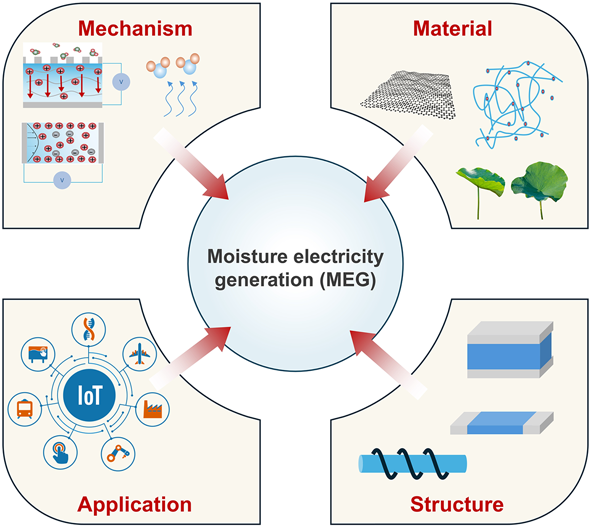
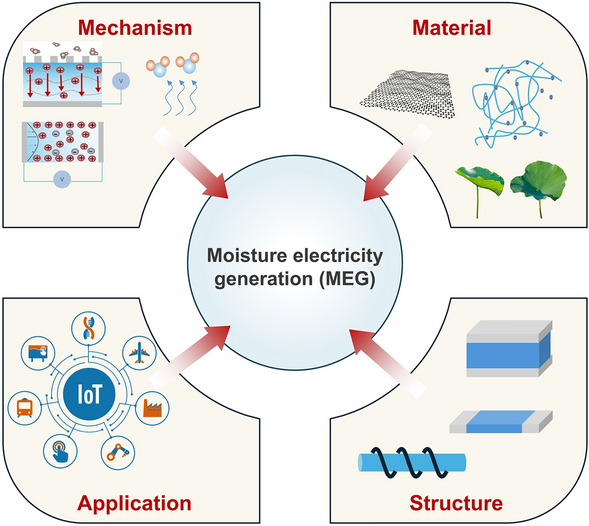

Moisture electricity generation (MEG) has emerged as a sustainable and versatile energy-harvesting technology capable of converting ubiquitous environmental moisture into electrical energy, which holds great promise for renewable energy and constructing self-powered electronics. In this review, we begin by outlining the fundamental mechanisms—ion diffusion, electric double layer formation, and streaming potential—that govern charge transport for MEG in moist environments. A comprehensive survey of material innovations follows, highlighting breakthroughs in carbon-based materials, conductive polymers, hydrogels, and bio-inspired systems that enhance MEG performance, scalability, and biocompatibility. We then explore a range of device architectures, from planar and layered systems to flexible, miniaturized, and textile-integrated designs, engineered for both energy conversion and sensor integration. Key challenges are analyzed, along with strategies for overcoming them. We conclude with a forward-looking perspective on future directions, including hybrid energy systems, AI-assisted material design, and real-world deployment. This review presents a timely and comprehensive overview of MEG technologies and their trajectory toward practical and sustainable energy solutions.

Editor of Nano-Micro Letters, which is an Open-Access, peer-reviewed journal reported papers that have at least one dimension ranging from a few sub-nanometers to a few hundreds of micrometers. The journal is published by Springer Nature and indexed by SCI, EI, SCOPUS, Pubmed, etc. The 2025 JCR Impact Factor is 38.5. The 2025 CiteScore is 58.9.
Follow the Topic
-
Nano-Micro Letters
Nano-Micro Letters is a peer-reviewed, international, interdisciplinary and open-access journal that focus on science, experiments, engineering, technologies and applications of nano- or microscale structure and system in physics, chemistry, biology, material science, and pharmacy.