Highly Conductive and Stable Naphthalenediimide‑Based Organic Salt Cathode for Robust Lithium‑Ion Batteries
Published in Materials

Introduction: The Rise of Sustainable Organic Photovoltaics
As the global push for carbon neutrality intensifies, the development of sustainable, cobalt-free, and environmentally friendly energy storage systems has become a top priority. Organic lithium salts have emerged as promising cathode candidates for next-generation lithium-ion batteries (LIBs) due to their high theoretical capacity, synthetic simplicity, and recyclability.
However, despite their potential, organic cathodes face two persistent "Achilles' heels": high solubility in liquid electrolytes (leading to rapid capacity decay) and poor intrinsic electrical conductivity. A significant study published in Nano-Micro Letters by a research team from Soochow University and Nanjing University of Posts and Telecommunications introduces a high-aromaticity design strategy to overcome these hurdles, pushing organic batteries toward practical longevity.
The Current Benchmark: Tackling the Dissolution Dilemma
The primary bottleneck for organic small-molecule cathodes is the "shuttle effect"—where active materials dissolve into the electrolyte during cycling, causing irreversible loss of capacity. While polymerizing organic molecules or using solid-state electrolytes are common fixes, these often compromise the material’s energy density or ionic conductivity.
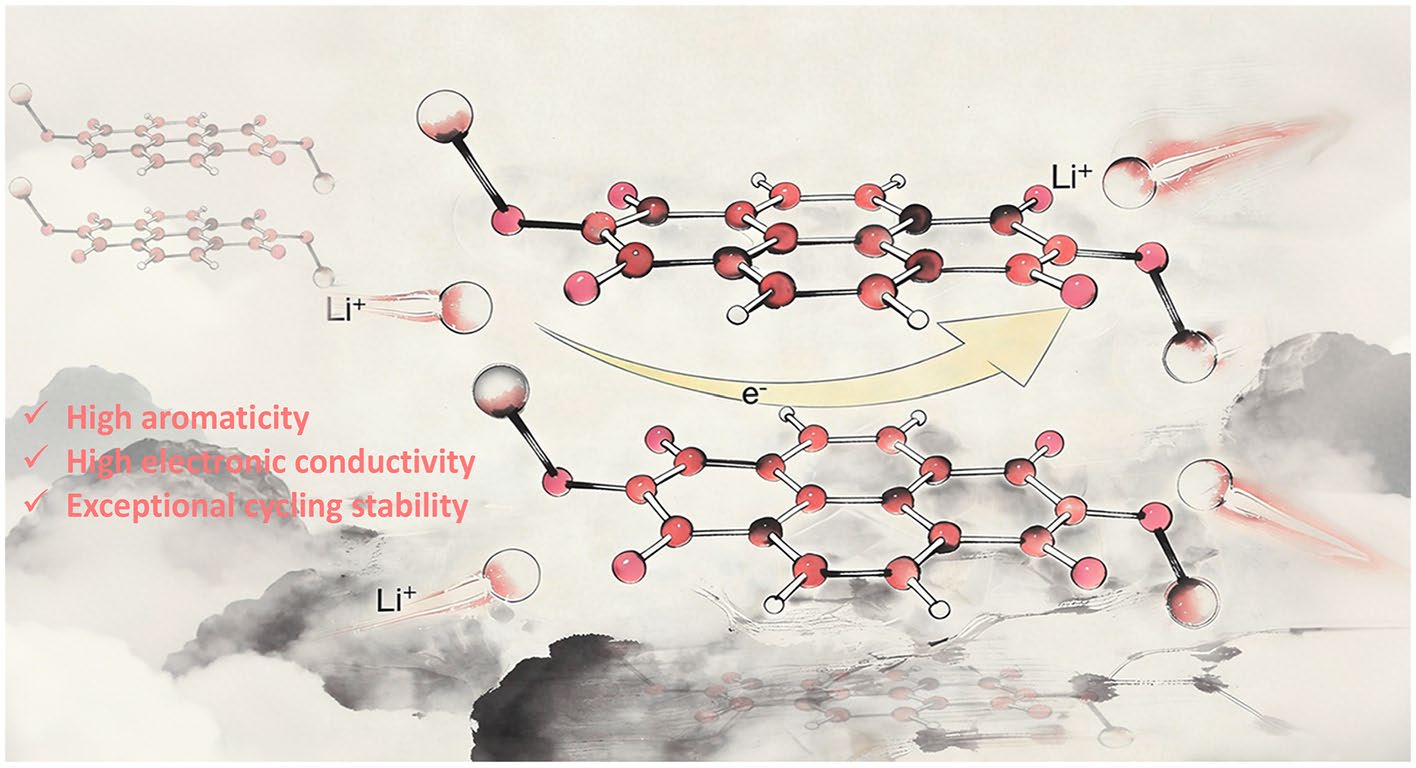
The researchers turned their attention to naphthalenediimide (NDI) derivatives. By synthesizing a specific lithium salt, NDI-OLi, they aimed to leverage strong intermolecular interactions and a stable π-conjugated structure to "lock" the active material in the solid state while maintaining rapid charge transfer.
The Synergetic Approach: π-Conjugation and Fast Reaction Kinetics
The team integrated advanced spectroscopic characterization with theoretical modeling to understand the NDI-OLi's superior performance:
- Stable π-Conjugated Geometry: The high aromaticity of the NDI-OLi structure creates a delocalized electronic environment. This not only reduces the molecule's solubility in organic solvents but also provides a "highway" for electron transport, addressing the low conductivity typical of organic materials.
- Efficient Carbonyl Utilization: Through in-situ Raman spectroscopy and Density Functional Theory (DFT) calculations, the team proved that the lithium ions couple efficiently with the carbonyl (C=O) active sites. This ensures that the theoretical energy storage capacity is fully realized during the redox process.
Roadmap to Robust Performance: Stepwise Validation
The study demonstrates the material's excellence through a series of rigorous benchmarks:
- Step 1: Superior Rate Capability: Thanks to its high electronic conductivity, the NDI-OLi cathode maintains exceptional performance even at high current densities, proving its suitability for fast-charging applications.
- Step 2: Exceptional Cyclability: In long-term testing, the battery retained 85% of its initial capacity after 5,000 cycles. This level of stability is among the highest reported for organic lithium salt cathodes to date.
- Step 3: Structural Integrity: Post-cycling analysis confirmed that the NDI-OLi electrode maintains its morphology and crystalline structure, resisting the structural pulverization that plagues many other organic electrodes.
Real-World Impact: Toward Green Energy Storage
The implications of this research extend to the broader goal of "green" battery technology. Unlike conventional inorganic cathodes that rely on expensive and toxic transition metals like cobalt and nickel, NDI-OLi is:
- Metal-Free and Sustainable: Derived from abundant organic precursors.
- Mechanically Robust: Capable of being integrated into flexible or large-scale energy storage systems without losing performance.
- Economically Viable: The synthetic simplicity of organic salts offers a clear path toward low-cost industrial production.
Conclusion and Future Outlook
The development of the NDI-OLi cathode marks a significant advance in the design of high-performance organic batteries. By strategically engineering the π-conjugated structure to balance conductivity and stability, the researchers have provided a manual for creating organic electrodes that can finally compete with their inorganic counterparts.
As the industry seeks more sustainable alternatives to traditional LIBs, this high-aromaticity organic salt approach stands out as a cornerstone for the next generation of robust, long-lived, and eco-friendly energy storage solutions.

Editor of Nano-Micro Letters, which is an Open-Access, peer-reviewed journal reported papers that have at least one dimension ranging from a few sub-nanometers to a few hundreds of micrometers. The journal is published by Springer Nature and indexed by SCI, EI, SCOPUS, Pubmed, etc. The 2024 JCR Impact Factor is 36.3. The 2024 CiteScore is 53.1.
Follow the Topic
-
Nano-Micro Letters
Nano-Micro Letters is a peer-reviewed, international, interdisciplinary and open-access journal that focus on science, experiments, engineering, technologies and applications of nano- or microscale structure and system in physics, chemistry, biology, material science, and pharmacy.




Please sign in or register for FREE
If you are a registered user on Research Communities by Springer Nature, please sign in