How a long-term tree of life project revealed a hidden biodiversity hotspot in Central China
Published in Ecology & Evolution

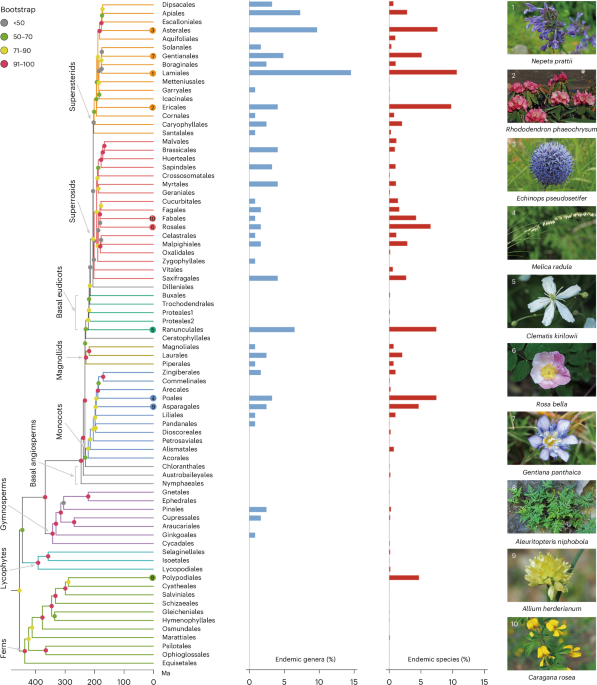

Global biodiversity hotspots, defined by exceptional plant endemism and severe habitat loss, represent some of the most important priorities for conservation. To qualify, regions must host at least 1,500 endemic vascular plant species and retain less than 30% of their original natural vegetation. To date, 36 such hotspots have been recognized worldwide, attracting substantial international attention and conservation investment.
China is one of the world’s richest countries for plant diversity, harbouring more than 30,000 vascular plant species, with about half being endemic. Yet this extraordinary diversity is under intense pressure from habitat loss, land-use change and other human activities. The Kunming-Montreal Global Biodiversity Framework, with its “30×30” target of protecting at least 30% of Earth’s land and seas by 2030, has made the identification of conservation priorities more urgent than ever before.
Building a tree of life for plants in China
Our team has worked for many years to identify conservation priorities through a long-term effort to build a comprehensive tree of life for China’s vascular plants. With each round of sampling, sequencing and data integration, we have sought to make this phylogenetic framework more complete and increasingly informative. Our goal has never been simply to produce a large tree. Rather, we aim to understand how China’s extraordinary plant diversity has formed, how endemism has accumulated across time and space, and how evolutionary knowledge can inform conservation priorities.
Before this study, we had already reconstructed two earlier versions of the tree of life for China’s vascular plants. The first version, published in 2016, covered ~93% of genera and ~20% of species. Based on this framework, we showed in Nature that southeastern China acts as a “museum” preserving ancient lineages, whereas northwestern China functions as a “cradle” of rapid diversification in younger clades. We also identified key conservation hotspots from a phylogenetic perspective (https://communities.springernature.com/posts/evolutionary-history-of-the-angiosperm-flora-of-china).
The second version of the tree of life, published in 2020, expanded coverage to 96% of genera and 42% of species. This allowed us to identify 42 priority conservation areas to inform China’s National Park system, and to reveal spatial patterns of extinction risk and the geographic heterogeneity of their underlying drivers. These findings highlighted that phylogenetic diversity represents a critical, yet often overlooked, dimension of biodiversity.
The third and most recent update of the tree of life, published in Nature Ecology & Evolution, includes 3,029 genera and 16,585 species, representing 99% of genera and 53% of species native to China. The key motivation for this study, however, came from an earlier continental-scale comparison by our team. In that work, Central China stood out for its unexpectedly high phylogenetic diversity, even when compared with the North American Coastal Plain, the 36th recognized global biodiversity hotspot. Although this signal initially emerged at the genus level, it prompted us to assemble species-level data to test whether Central China represents a major but overlooked conservation priority.
Fieldwork: searching for the missing pieces
Expanding both genus- and species-level sampling required extensive targeted fieldwork. Many unsampled taxa are rare, highly localized, inconspicuous, or restricted to regions that are difficult to access. Over several years, our team carried out fieldwork in multiple under-collected parts of China, such as Xinjiang, Gansu, Yunnan, and Hainan. We crossed deserts, climbed unstable slopes, and searched through tropical forests, often looking for tiny herbs that could easily be missed even by trained botanists.
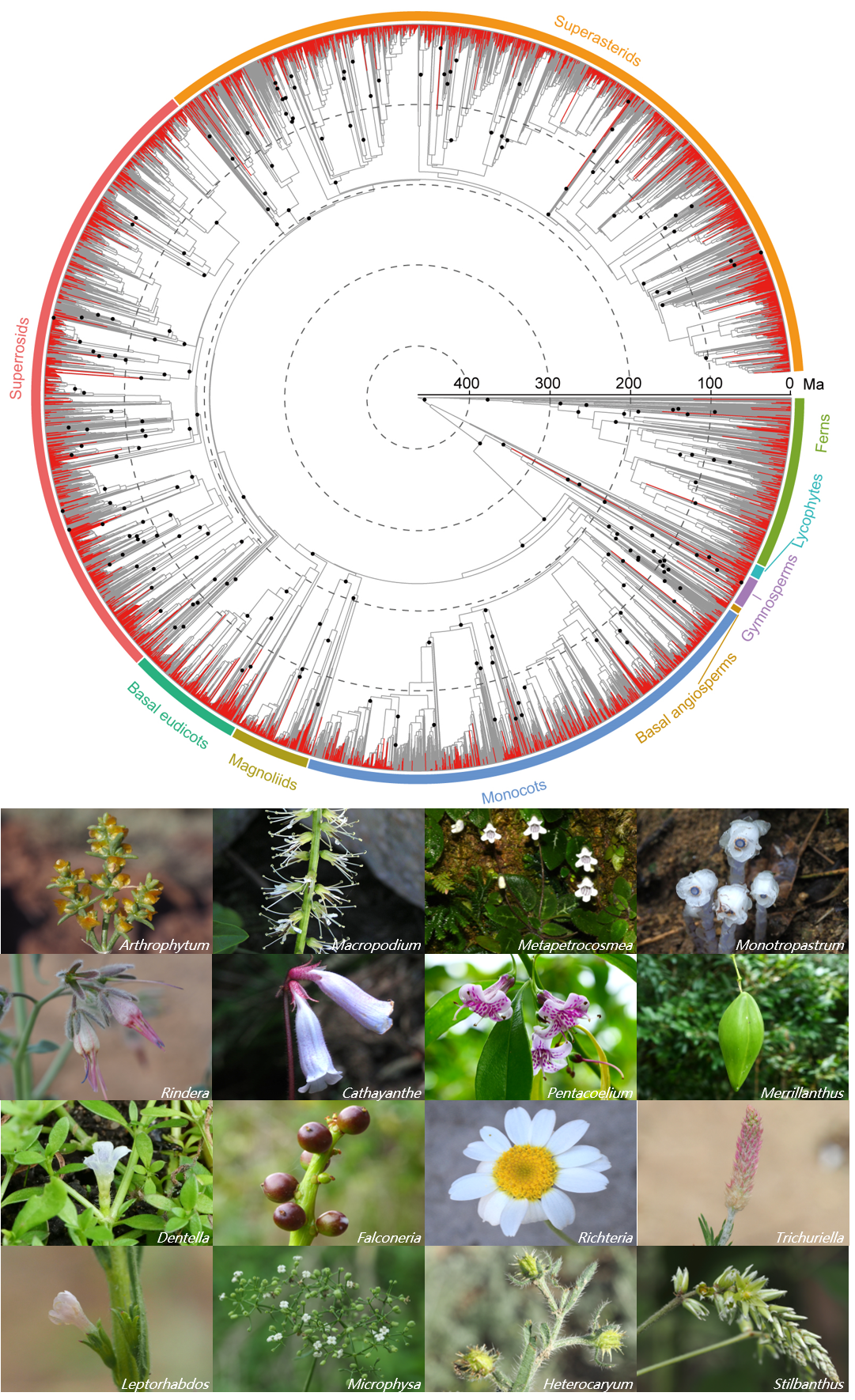
Fig. 1 Tree of life for Chinese vascular plants alongside photographs of selected newly sampled representative genera. Photo credit: Yalei Feng, Limin Lu, Bing Liu, and Langxing Yuan.
Two field experiences remain especially vivid.
The first took place in the summer of 2020, in the dry-hot valley of the Bailongjiang River in Gansu. We were searching for Baolia, a monotypic genus endemic to China. The plants are extremely small and grow on steep, gravelly slopes. After an entire day scanning the stony hillside without success, we were close to giving up. Then, at the final site near sunset, we found fewer than ten individuals. The excitement in that moment was difficult to describe. After hours of uncertainty, encountering this tiny endemic genus felt like discovering a missing piece of a much larger puzzle.
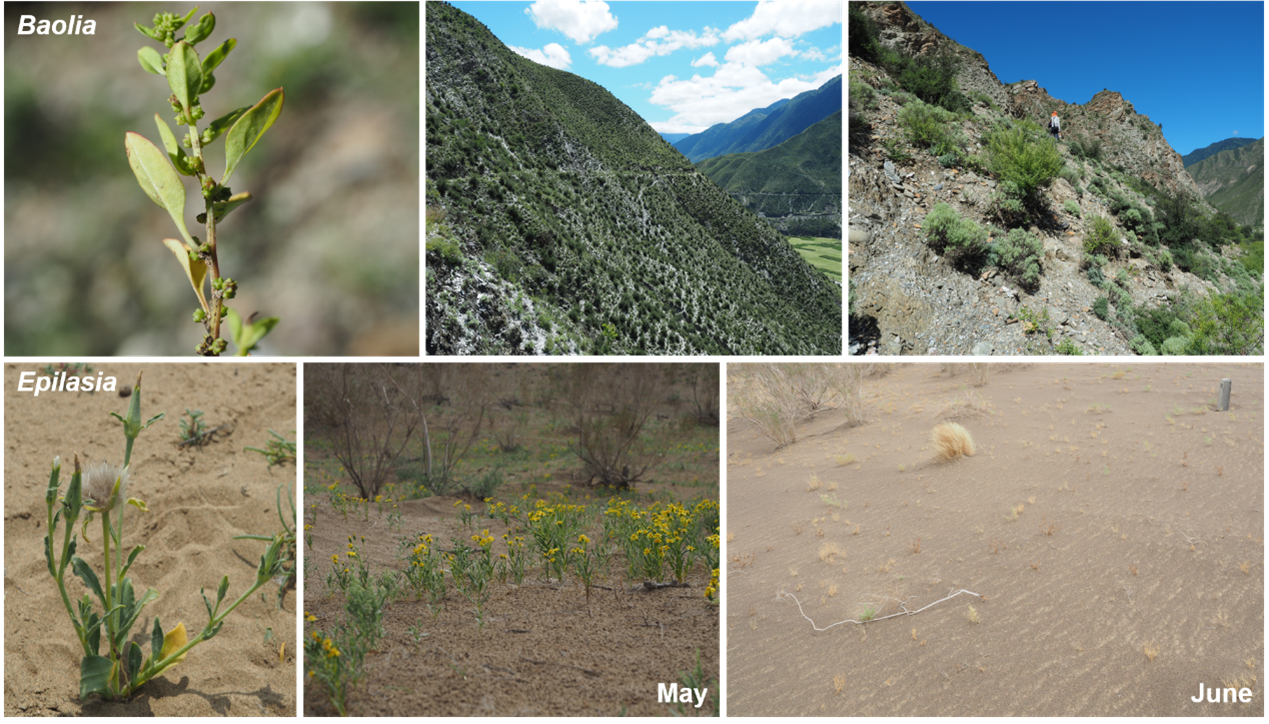
Fig. 2 Collection of photographs from fieldwork. The upper panel shows the morphology and habitat of Baolia, highlighting the challenges of sampling on steep, unstable slopes in a hot, dry river valley. The lower panel illustrates the fruiting morphology of Epilasia and the pronounced seasonal contrast at the same locality between May and June, with lush vegetation in May transitioning to a nearly barren landscape in June. Photo credit: Yalei Feng.
The second moment came in 2021, in the Gurbantünggüt Desert of Xinjiang, where we were looking for Epilasia, an ephemeral early-spring desert plant. These species complete their flowering and fruiting within a very short window, usually from April to May. Fortunately, we arrived in mid-May just in time to collect material at the end of the fruiting season. When we returned in late June, the landscape had completely changed, with almost no visible trace of life remaining. The early-summer heat and shifting sands had erased nearly everything. This striking contrast left a lasting impression on us: some lineages persist within such narrow spatial and temporal windows that missing them by just a few weeks may mean missing them entirely.
A hidden hotspot in Central China emerges
These efforts, together with large-scale data compilation, allowed us to reconstruct the most comprehensive dated phylogeny of China’s vascular plants to date. This provided the foundation to examine the spatial and temporal dynamics of Chinese plant endemism at an unprecedented scale.
Our results revealed that centres of taxonomic endemism and phylogenetic endemism do not fully overlap. In other words, conserving species-rich areas alone is not sufficient. Some regions are important because they contain many narrowly distributed species that arose recently; others are critical because they preserve deep, irreplaceable branches of evolutionary history.
Notably, by overlaying the endemism centres with existing global biodiversity hotspots, we identified Central China, an area of approximately 1.54 million km2, as a major conservation gap. This region supports over 14,000 vascular plant species and serves as a key centre for insect and vertebrate diversity. Despite retaining only about 7% of its original vegetation, it harbours at least 2,024 endemic vascular plant species, fully meeting the criteria for global biodiversity hotspot designation.
What makes Central China remarkable is that it appears to function both as a cradle and a museum of diversity within East Asia’s subtropical evergreen broad-leaved forests. It hosts recently diversified lineages while also preserving ancient relicts. Despite this, it has received far less international attention than many already recognized hotspots.
Looking ahead
This discovery opens an important next chapter. We hope to work more closely with international conservation organizations to support the formal recognition of Central China as a global biodiversity hotspot. At the same time, much work remains. Finer-scale assessments of diversity, endemism, threat exposure, and conservation gaps are still needed. And of course, the tree of life is never truly complete. We will continue updating both phylogenetic and distribution data to provide a long-term foundation for research in biogeography, macroevolution and biodiversity conservation.
Follow the Topic
-
Nature Ecology & Evolution
This journal is interested in the full spectrum of ecological and evolutionary biology, encompassing approaches at the molecular, organismal, population, community and ecosystem levels, as well as relevant parts of the social sciences.

Related Collections
With Collections, you can get published faster and increase your visibility.
Biodiversity and ecosystem functioning of global peatlands
Publishing Model: Hybrid
Deadline: Jan 31, 2027
Understanding species redistributions under global climate change
Publishing Model: Hybrid
Deadline: Dec 31, 2026
