How a Scholarship Funding Setback Led to an Unexpected Publication
Published in Sustainability and Education



A Hopeful Beginning
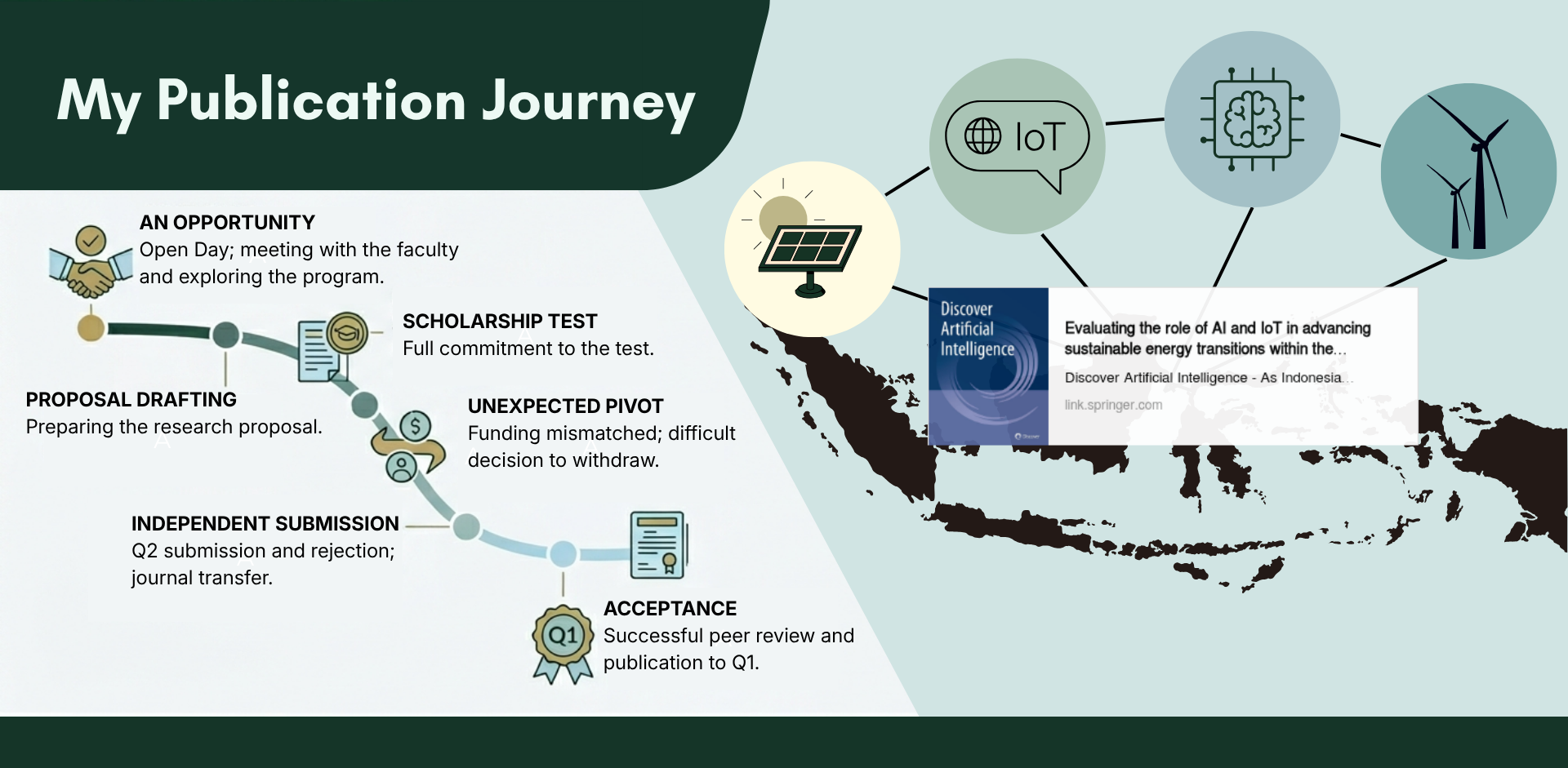
The foundation of this paper began not as a journal submission, but as a research proposal for a Master degree program in sustainability. When I first inquired about the program after graduating with my bachelor's degree, full funding was not an option. However, a few months later in October, the university marketing team reached out to let me know a full-scholarship track had opened up. I was eager to try.
During the university open day, I had an incredibly encouraging conversation with one of the faculty professors. I shared my background with him, explaining that I had previously published a paper as a first author in a Q3 Scopus journal and had spent 1 year working in the green building sector. He was genuinely delighted to find an applicant interested in the demanding research track of their mixed-course program. This alignment felt especially meaningful because the university maintained a strict graduation requirement for students to publish in a Q1 journal.
During conversations with other candidates at the open day, I noticed many were content with accepting standard 30% or 50% partial grants without sitting for further examinations. Realizing that a partial scholarship would not be financially viable for me, I knew my only path forward was to aim for the 100% full-funding track. I chose to take the formal scholarship test instead. I put my absolute best effort into the examination with the hope of making my future studies financially feasible. Simultaneously, I also began drafting my research proposal.
An Unexpected Pivot
Unfortunately, administrative logistics can sometimes take unexpected turns. When the initial email notification arrived, it was for a 50% partial grant. Knowing this was not a suitable path for me, I politely informed the senior marketing representative that I would not be able to proceed with enrollment. The next day, I received a follow-up email clarifying that due to a miscommunication, the offer was actually a 50% scholarship for the 1st year only, which was half of what was offered the previous day.
It was a deeply disheartening moment. It is tough to navigate a process where you feel a strong mutual connection with the faculty, only to have the practical and financial framework shift so suddenly. The abrupt change in terms after such a welcoming open day experience felt incredibly confusing. Realizing the numbers simply did not work, I made the difficult decision to walk away and withdraw my application entirely.
Testing the Work Independently
With my application withdrawn, the research proposal sat idle in my file. I still believed in the core ideas regarding sustainable energy transitions, so I decided to reshape the framework into a full manuscript. I submitted it to a Q2 Scopus-indexed journal to see if the ideas could stand on their own merit within the global scientific community.
Then came the next twist in the rollercoaster ride: the Q2 journal declined the paper.
However, the editor kindly threw me a lifeline by suggesting a journal transfer. Looking through the publisher transfer options, I noticed several high-tier Q1 journals on the list. Because the transfer included a conditional APC waiver to one of the options, I figured there was no harm in trying. I remember thinking that if it got rejected again, I would still learn a lot from the peer review feedback for my next academic application.
I chose a Q1 journal, submitted the manuscript through the transfer network, and let it go. To my complete surprise, after a rigorous round of peer review and careful revisions, the reviewers and editors accepted the paper.
Lessons Learned Along the Way
It is a strange, humbling feeling to realize that I ended up meeting the exact Q1 publication milestone required by that program, just through a completely different door.
For fellow early-career researchers who might be facing funding hurdles or sudden changes in plans, my experience taught me that an apparent roadblock is often just a redirection. If a door closes due to administrative or financial mismatches, it does not mean your ideas lack value.
Academic paths are rarely linear. By staying open to unexpected opportunities and focusing on the research itself, we can often find a community ready to welcome our work, even if it is not the one we originally anticipated.

Follow the Topic
-
Discover Artificial Intelligence
This is a transdisciplinary, international journal that publishes papers on all aspects of the theory, the methodology and the applications of artificial intelligence (AI).
What are SDG Topics?
An introduction to Sustainable Development Goals (SDGs) Topics and their role in highlighting sustainable development research.
Continue reading announcementRelated Collections
With Collections, you can get published faster and increase your visibility.
Transforming Education through Artificial Intelligence: Opportunities, Challenges, and Future Directions
Artificial Intelligence (AI) is rapidly changing the educational field by enabling personalized learning, intelligent tutoring systems, automated assessments, learning analytics, and administrative automation.
This collection invites original research, systematic reviews, and visionary perspectives on the transformative impact of AI in education. It aims to explore how AI technologies can enhance equity, inclusion, and efficiency in educational settings across different contexts, including higher education, K-12, vocational training, and lifelong learning. This collection will address technical, pedagogical, ethical, and policy aspects, fostering interdisciplinary perspectives and evidence-based insights.
This Collection supports and amplifies research related to SDG 4 and SDG 9.
Keywords: Artificial Intelligence, AI in Education, Educational Technology, Data Analytics, AI Ethics
Publishing Model: Open Access
Deadline: Nov 30, 2026
Advanced AI Methods for Personalized Healthcare
The advancement of Artificial Intelligence (AI) technologies, especially Reinforcement Learning (RL) and Deep Learning (DL), is transforming healthcare, enabling innovative solutions for patient monitoring, diagnostics, and personalized treatment. These technologies facilitate the effective use of healthcare data and intelligent analytics, enhancing clinical decision-making and improving patient outcomes. AI is revolutionizing how healthcare is delivered, making it more proactive, efficient, and accessible. This Collection explores new methods and applications of AI for healthcare such as personalized healthcare. Contributions in this Collection showcase novel frameworks, case studies, and interdisciplinary approaches that drive the future of personalized healthcare, fostering innovations that bridge technology and patient care.
In this context, we are inviting original research articles, reviews, and perspective papers addressing (but not limited to) the following themes:
- Personalized medicine
- IRL for dynamic treatment regimes
- Wireless sensor networks for patient monitoring
- Identification and prevention of critical condition
- Monitoring systems within the medical devices contest
- Methodologies and tools for the rapid integration of WSNs, IoT and AI in health monitoring
- Behavior analysis of patients
- Personalized health-promoting interventions
- Ambient assisted living and active assisted living
- AI security and privacy models for healthcare applications
- AI methods for rehabilitation
Publishing Model: Open Access
Deadline: Feb 27, 2027

