How methane is produced in mangrove ecosystems?
Published in Microbiology

Mangroves are important constituents of the coastal wetlands. They could store atmospheric CO2 as organic matter, so-called “blue carbon”, inhabiting approximately 0.5% of the coast and contributing 10–15% to the global carbon storage. However, mangrove sediment carbon does not remain stored in perpetuity. Some of organic matter are transformed to CH4 and returned to the atmosphere, which has the potential to partially offset blue carbon storage in mangrove sediments. Most pristine mangroves showed low CH4 efflux rate, while mangroves with human disturbances showed significantly higher CH4 efflux rate. Futian Mangrove Nature Reserve (FT) is located in the urban hinterland of Shenzhen Special Economic Zone, China (Figure 1). FT is a restricted area since establish of Futian Natural Reserve in 1980s. It is dominated by native, true mangrove flora and is one of the largest mangrove habitats along the southeastern coast of mainland China. It has been reported that methane emission rates in FT range from 242 μmol m−2 day−1 to 124 mmol m−2 day−1.
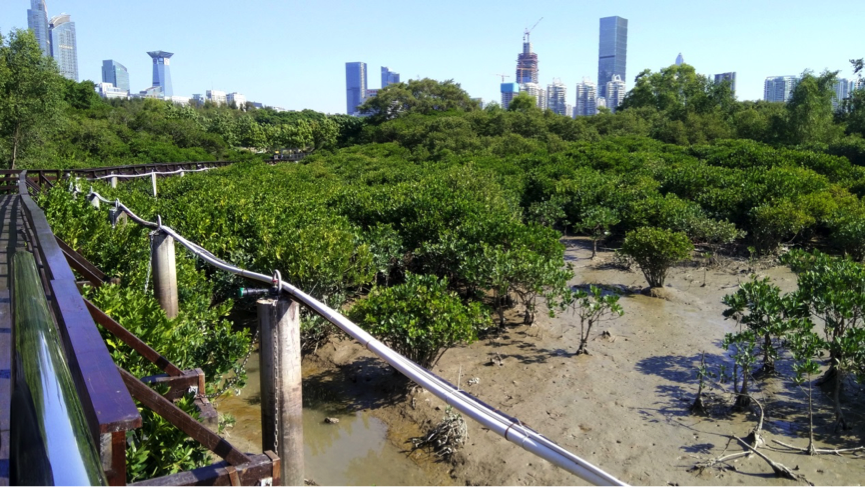
Methane is the second most important greenhouse gas after CO2. Methanogenesis is conducted by methanogens that thrive in strictly anoxic habitats. Methanogens are considered to play important roles in the global carbon cycle and climate change. Methanogens from the phylum Euryarchaeota are currently classified into one class (Methanofastidiosa) and seven orders (Methanococcales, Methanopyrales, Methanobacteriales, Methanomicrobiales, Methanocellales, Methanosarcinales, and Methanomassiliicoccales).
How methane is produced in FT mangrove ecosystems. Previous studies using 16S rRNA gene and genes encoding the methyl-coenzyme M reductase alpha subunit (mcrA) demonstrated that multiple methanogens are widely spread across mangrove sediments. However, the metabolic activity and relative contributions to methane production of diverse methanogens in mangroves remain unclear.
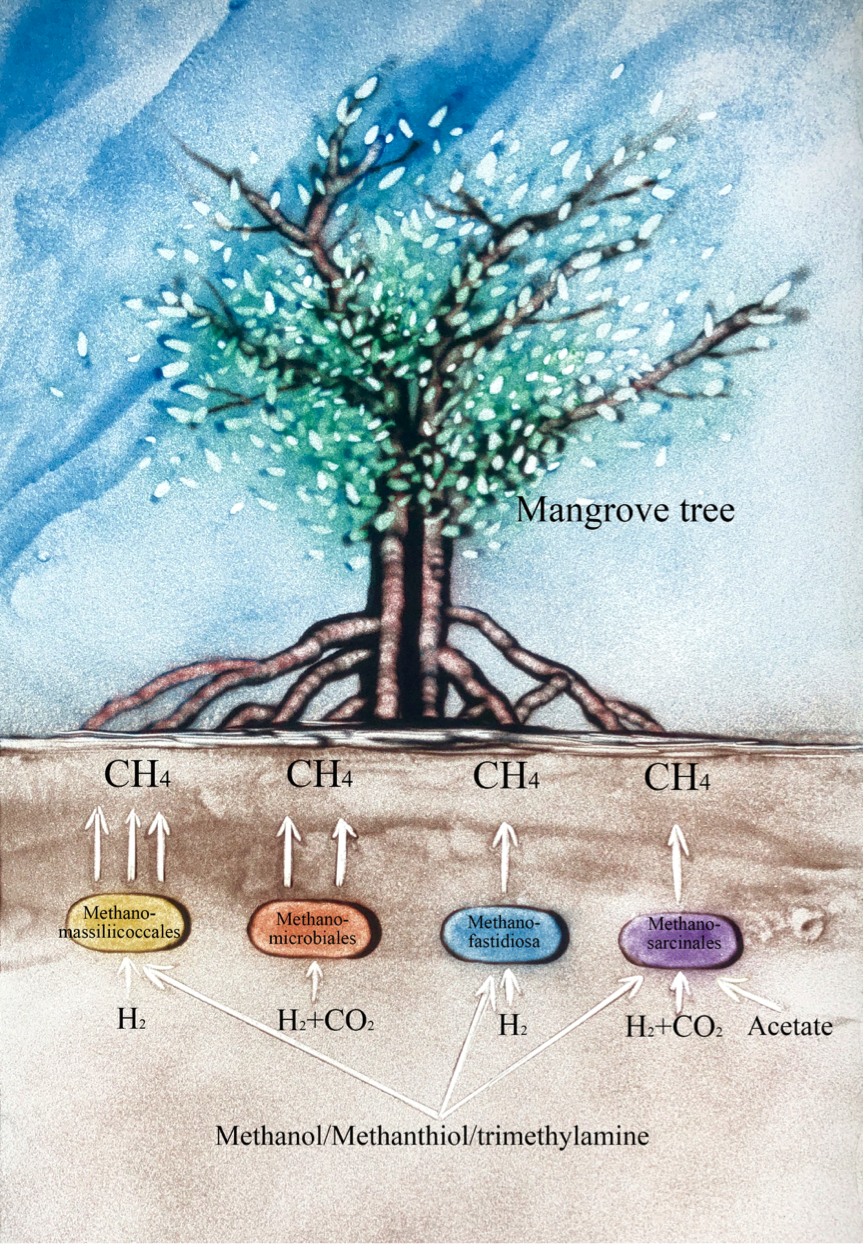
We combined metagenomic and metatranscriptomic analyses to investigate the metabolic activity and relative contributions of diverse methanogens to methane production in a vertical sediment profile in mangrove ecosystem. We found that Methanomassiliicoccales, Methanofastidiosa, Methanosarcinales and Methanomicrobiales were the four dominant methanogens in FT mangroves. Methanomicrobiales were the most abundant methanogens and Methanomassiliicoccales were the most active methanogens in the analyzed sediment profile. Methanomicrobiales are hydrogenotrophs that utilize H2 and CO2 to produce methane. Methanomicrobiales could consume H2 and cooperate with syntrophic microbes to degrade short-chain fatty acids. Methanomassiliicoccales are methylotrophic methanogens using H2 reduce methyl-compounds for methane production. Methyl-compounds such as trimethylamine (TMA) contribute 35-90% of the methane production in coastal sediments, which could explain why methylotrophic methanogens play an important role in methane production in mangroves. The presented findings imply that Methanomicrobiales and Methanomassiliicoccales play a vital role in methane production in mangroves (Figure 2).
To see the full story, check out the publications in Microbiome. Paper link: https://microbiomejournal.biomedcentral.com/articles/10.1186/s40168-020-00876-z
Follow the Topic
-
Microbiome
This journal hopes to integrate researchers with common scientific objectives across a broad cross-section of sub-disciplines within microbial ecology. It covers studies of microbiomes colonizing humans, animals, plants or the environment, both built and natural or manipulated, as in agriculture.

Related Collections
With Collections, you can get published faster and increase your visibility.
Oncobiome
This collection of papers delves into the burgeoning field of oncobiome research, exploring the intricate relationship between cancer and the microbiome. The oncobiome encompasses the diverse microbial communities residing in and on the human body, which influence cancer development, progression, and treatment responses. By examining these interactions, our aim is to unravel the complex mechanisms through which the microbiome impacts oncogenesis and therapeutic outcomes.
This compilation highlights cutting-edge research, offering insights into potential diagnostic markers and novel therapeutic strategies, thereby advancing our understanding of cancer biology and paving the way for innovative, microbiome-targeted cancer treatments.
This is a cross-journal collection between:
Experimental Hematology and Oncology
Articles will undergo the standard peer-review process of the journal to which they are submitted and are subject to either the BMC editorial policies or those of BJC Reports. Articles will be added to the Collection as they are published. The Editors have no competing interests with the submissions which they handle through the peer review process. The peer review of any submissions for which the Editors have competing interests is handled by another Editorial Board Member who has no competing interests.
Publishing Model: Open Access
Deadline: Ongoing
The Apple Microbiome
Microbiome and Environmental Microbiome are calling for submissions to our Collection on the Apple Microbiome.
With world apple production estimated at 84 million tons, the microbiome of the apple has significant implications for agriculture, food security, and human health. Understanding the complex interactions between apple plants and their associated microbial communities can lead to improved crop management strategies, enhanced fruit quality and longevity, and sustainable agricultural practices. Recent advances have highlighted the role of specific bacteria and fungi in promoting plant health and resilience against specific pathogens. Moreover, detailed profiling of these microbial communities, revealing their diversity and functional potential facilitate exciting future developments, such as the identification of beneficial microbial consortia for biocontrol and the formulation of tailored probiotic treatments for both plants and humans. By advancing our collective understanding in this area, we can work towards a more sustainable and resilient agricultural system.
Topics of interest include but are not limited to:
-Microbial diversity and function associated with apples
-Effects of soil health and rhizosphere interactions on apple production
-Impact of climate change on the apple microbiome
-Role of the apple microbiome in fruit quality
-Microbiome-driven strategies for disease resistance
This collection is open for submissions from all authors on the condition that the manuscript falls within both the scope of the collection and the journal it is submitted to.
All submissions in this collection undergo the relevant journal’s standard peer review process. Similarly, all manuscripts authored by a Guest Editor(s) will be handled by the Editor-in-Chief of the relevant journal. As an open access publication, participating journals levy an article processing fee (Microbiome, Environmental Microbiome). We recognize that many key stakeholders may not have access to such resources and are committed to supporting participation in this issue wherever resources are a barrier. For more information about what support may be available, please visit OA funding and support, or email OAfundingpolicy@springernature.com or the Editor-in-Chief of the journal where the article is being submitted.
Publishing Model: Open Access
Deadline: Sep 30, 2026