How Space Technology Is Helping India's Smallholder Farmers




When we think about India's agricultural strength, we often imagine vast green fields stretching across the countryside, feeding more than a billion people and contributing significantly to the nation's economy. Yet, hidden within this landscape is a challenge that receives far less attention: most Indian farmers cultivate very small and fragmented pieces of land.
Today, majority of India's farmers belong to the small and marginal category. Their fields are often divided into multiple tiny plots scattered across villages and landscapes. While these farmers form the backbone of India's food system, their fragmented landholdings make it difficult to monitor crop health, assess risks, provide insurance support, and implement modern agricultural technologies. In many cases, these small plots are so tiny that they become nearly invisible in conventional agricultural databases and monitoring systems.
This realization became the starting point of our research.
As researchers working at the intersection of disaster management, geospatial science, and agricultural sustainability, we repeatedly encountered a fundamental question: How can we protect farmers from climate risks if we cannot accurately identify and monitor the fields they cultivate?
The challenge is particularly important in a country like India, where agriculture remains highly vulnerable to floods, droughts, heat waves, pest outbreaks, and changing rainfall patterns. Climate change is increasing the frequency and intensity of these hazards, placing unprecedented pressure on farming communities. Smallholder farmers are often the first to experience these impacts and the last to receive timely support.
At the same time, we are living in an era where satellites orbit the Earth every day, drones can capture centimetre-level imagery, and artificial intelligence can analyze millions of data points within seconds. The question was no longer whether technology exists, but whether it can be effectively used to serve India's fragmented agricultural landscape.
This motivation led us to undertake a comprehensive review of Earth Observation (EO) technologies for agricultural risk management in India's small and fragmented croplands.
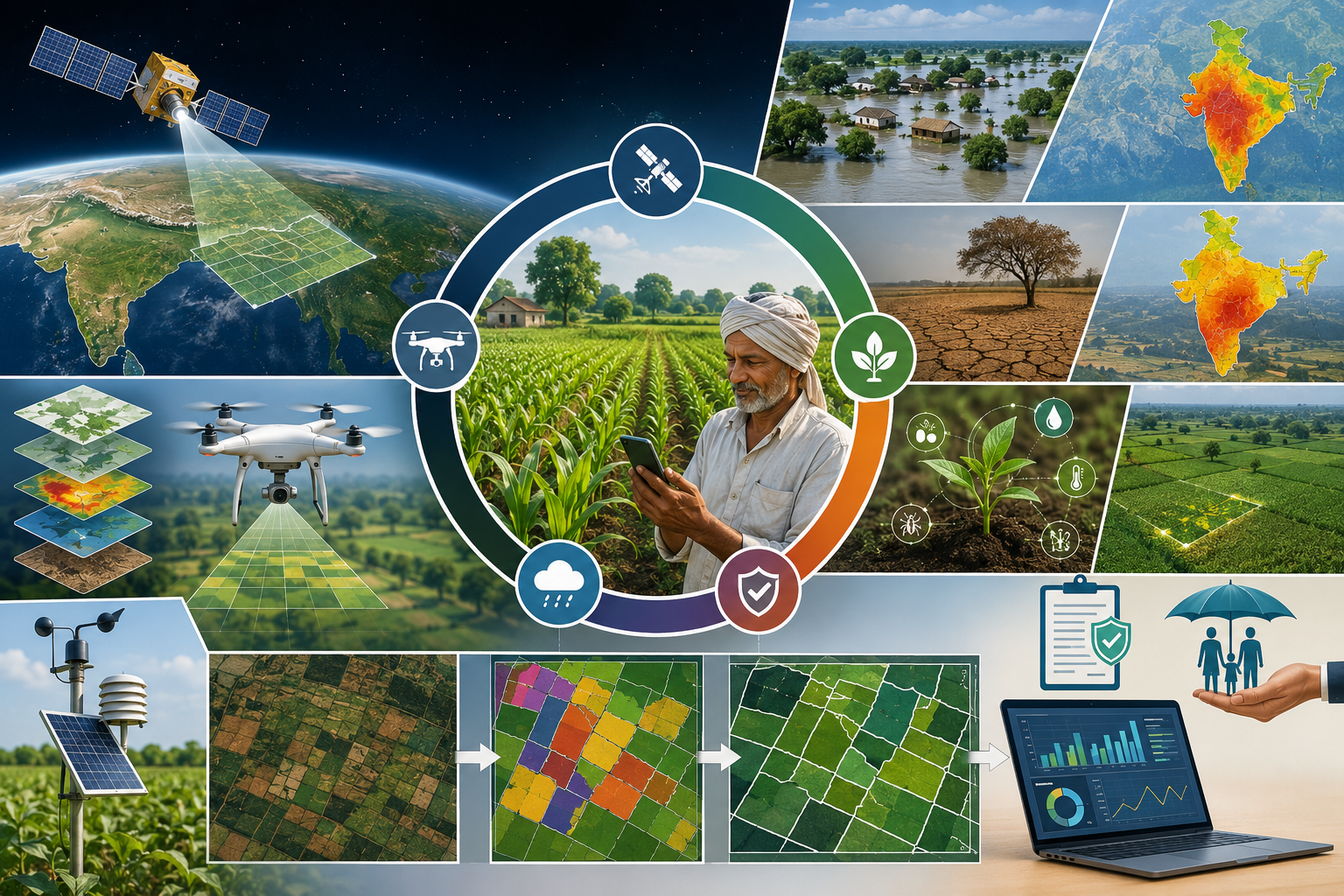
Earth Observation refers to the use of satellites, drones, aircraft, and ground-based sensors to collect information about the Earth's surface. Every day, these technologies capture enormous amounts of data about vegetation, soil moisture, crop conditions, water availability, and environmental changes. However, the challenge lies in translating this information into practical solutions for small farmers.
During our investigation, we examined decades of scientific research from India and across the world. We explored how different sensing platforms—from satellites such as Landsat and Sentinel, SAR, to advanced drones and hyperspectral sensors—can help identify individual agricultural plots, monitor crop conditions, and assess risks.
One of the most fascinating discoveries was how plants communicate their health status through light.
Healthy crops reflect and absorb sunlight differently than stressed crops. Sensors mounted on satellites can detect these subtle differences in reflected light, often long before visible symptoms appear to the human eye. By analyzing specific wavelengths, scientists can estimate crop health, water stress, nutrient conditions, and even predict yields.
For smallholder farmers, this capability has enormous implications.
Imagine a farmer receiving an early warning that a section of their field is experiencing water stress. Imagine crop insurance companies being able to verify disaster-related crop damage within days instead of months. Imagine government agencies identifying drought-affected villages in near real time and delivering assistance before losses become catastrophic.
These possibilities are no longer science fiction. Many of the technologies already exist.
However, our review also revealed important challenges.
India's agricultural landscape is incredibly diverse. A field in Punjab looks very different from a terraced farm in Uttarakhand, a shifting cultivation plot in Northeast India, or a rain-fed farm in the Deccan Plateau. Small fields often have irregular shapes, mixed cropping patterns, and poorly defined boundaries. Traditional satellite imagery sometimes struggles to distinguish these tiny plots accurately.
Fortunately, recent advances in artificial intelligence are changing the situation dramatically.
Modern machine learning and deep learning techniques can now analyze satellite images with unprecedented accuracy. Technologies such as object-based image analysis, convolutional neural networks, and emerging GeoAI frameworks can automatically detect field boundaries, classify crops, and monitor agricultural conditions over large areas. These tools are helping researchers move from simply observing agricultural landscapes to understanding them in detail.
Another important insight from our work is that no single technology can solve the problem alone.
Satellites provide broad coverage over entire regions. Drones deliver extremely detailed local information. Radar sensors can see through clouds during the monsoon season. Ground-based observations provide valuable validation. The future lies in combining these multiple sources of information into integrated systems that offer both accuracy and scalability.
Beyond agricultural productivity, this work has broader implications for disaster risk reduction and national resilience.
Accurate mapping of small landholdings can improve flood exposure assessments, drought monitoring, crop insurance implementation, food security planning, and climate adaptation strategies. In regions such as the Ganga-Brahmaputra-Meghna basin, where farmers face recurring floods, erosion, and climate variability, detailed geospatial information can support more effective risk management and evidence-based decision-making.
Ultimately, this paper is about visibility.
For decades, millions of smallholder farmers have contributed immensely to India's food security while remaining under-represented in technological systems and policy frameworks. Earth Observation technologies offer an opportunity to change that reality.
By making small farms visible, we can make them measurable. By making them measurable, we can manage risks more effectively. And by managing risks more effectively, we can build a more resilient agricultural future.
The story behind this research is therefore not merely about satellites, sensors, or algorithms. It is about ensuring that the farmer cultivating a one-acre plot receives the same technological attention as large agricultural enterprises. It is about using science to bridge the gap between innovation and inclusion.
As climate risks continue to grow, the ability to see every field—and every farmer—may become one of the most important tools for securing India's agricultural future.
Follow the Topic
-
Discover Applied Sciences
This is a multi-disciplinary, peer-reviewed journal for the disciplines of Applied Life Sciences, Chemistry, Earth and Environmental Sciences, Engineering, Materials Science and Physics, fostering sound scientific discovery to solve practical problems.

Related Collections
With Collections, you can get published faster and increase your visibility.
Engineering: Machine Learning, AI, and Deep Learning Applications in Microwave Engineering: Devices and Communication
This Topical Collection is dedicated to highlighting the application of Machine Learning (ML), Artificial Intelligence (AI) and Deep Learning (DL) in the field of Microwave Engineering: Devices and Communication. It will concentrate on AI/ML/DL approaches in Microwave Engineering, which includes new breakthroughs, design and performance techniques of various Microwave Devices like Antennas, Filters, Couplers etc. Starting with single/multiband antennas, this topical collection will showcase the application of AI/ML/DL in the design and/or performance features of wideband to super wideband antennas including Multiple-Input-Multiple-Output (MIMO) antenna structures suited for wireless communication.
It will also focus on the use of AI/ML/DL in various aspects of Terrestrial and/or Satellite-based Microwave Communication: Processes, Algorithms and Protocols.
Publishing Model: Open Access
Deadline: Dec 31, 2026
Engineering: Technological Advancement in Wireless Sensor Networks and Its Scope in Industry 4.0 IoT
This Topical Collection is dedicated to highlighting the cutting-edge methods and latest research in the field of smart sensing, primarily in terms of exploring the latest machine learning analytics to extract information from the consequent sensory data, and investigating potential risk and countermeasures to ensure the security and privacy of sensing devices in WSN based Internet of Things/ Industrial Internet of things (IoT/IIoT). It allows researchers in WSN and IoT community to demonstrate their new ideas which may potentially reshape the future of IoT/IIoT. While sensing data have been traditionally processed within a powerful remote cloud server, the recent emergence of edge computing with these communication technologies makes it feasible to perform AI processing at the edges. Edge processing is aimed at overcoming the slower and more expensive method of sending the data to the cloud. The benefits of the parallel development of cloud-edge technologies in wireless sensor networks and communications are manifold. The progress in the development of these technologies has opened several new opportunities in multi-domain applications, such as smart cities, transportation, intelligent manufacturing, and e-Health.
Publishing Model: Open Access
Deadline: Sep 30, 2026