How to Grow Urinary Stone and Gouty Crystals on Glass Slide: Exploring Morphologies, Disease Insights, and Herbal Inhibition Strategies
Published in Chemistry, Research Data, and Biomedical Research
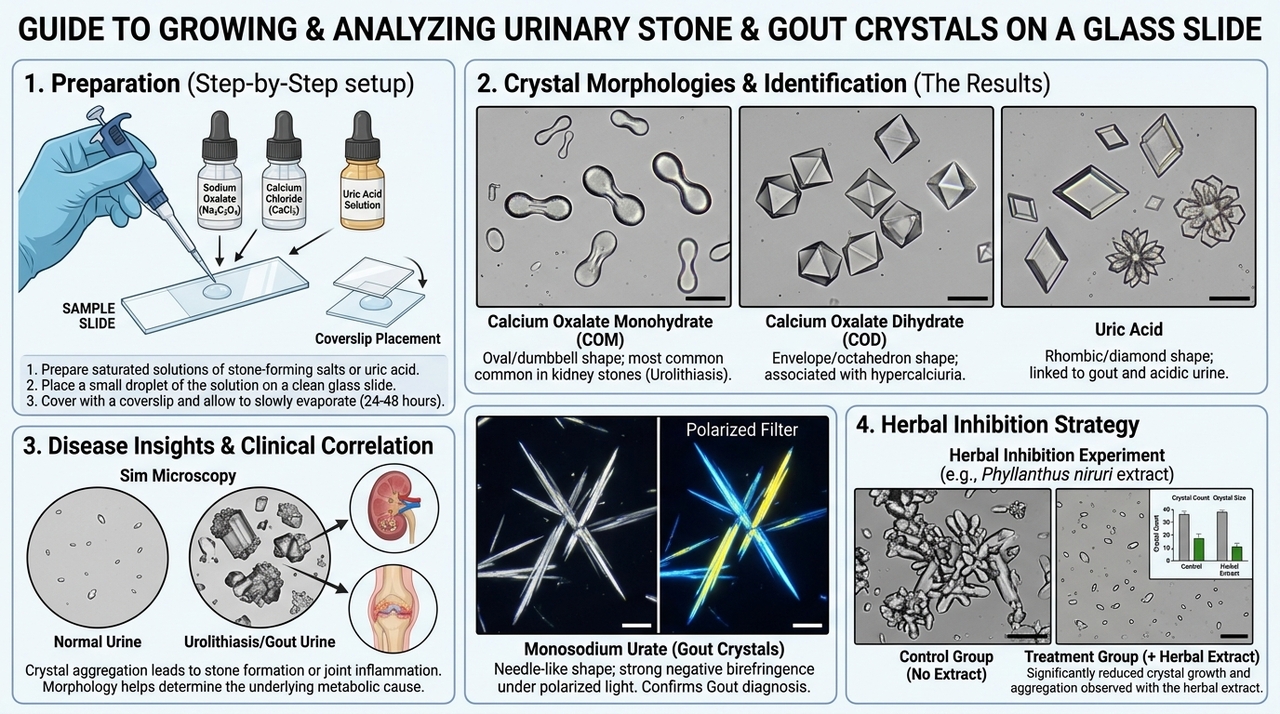


Growing Stones on Glass Slides: What Urinary Crystals Taught Me about Disease, Curiosity, and Low-Cost Science
Some research ideas arrive with grand funding proposals and sophisticated instruments. Others begin with a simple question asked in a modest laboratory. For me, this journey started with a glass slide, a beaker, and a question that many patients silently live with every day: Why do stones form in the body—and can nature help stop them?
Urolithiasis (kidney stone disease) and gout may sound unrelated at first, but they share a common enemy: crystals. These tiny, sharp structures—whether calcium oxalate, brushite, or urate—can cause immense pain and long-term complications. Watching patients struggle with recurrent stones or gout flare-ups made me realize how urgent it is to understand these crystals not just clinically, but fundamentally.
That realization led me to one of the most visually fascinating and intellectually rewarding projects of my research life: growing disease-related crystals on a simple glass slide.
Why Crystals?
Crystals are at the heart of both kidney stones and gout. In kidney stone disease, compounds like calcium oxalate and calcium phosphate slowly assemble into hard masses inside the urinary tract. In gout, needle-shaped urate crystals deposit in joints, triggering inflammation so severe that even light touch becomes unbearable.
As a researcher, I wanted to see what was happening—to move beyond textbook diagrams and into real structures. Growing these crystals in vitro (outside the body) offered a powerful and surprisingly affordable way to do exactly that.
The Beauty of Simple Experiments
One of the most exciting aspects of this work was how accessible it was. Using glass slides, basic reagents, and controlled conditions, we were able to grow crystals that closely resemble those found in patients.
I still remember the first time I looked through the microscope and saw well-formed calcium oxalate crystals spreading across the slide. What struck me was not just their beauty, but their order. Disease suddenly looked structured, predictable—and therefore, potentially controllable.
Each crystal type told its own story. Some formed dense, compact shapes; others grew like branching trees. These differences are not just aesthetic—they reflect how stones behave in the body, how fast they grow, and how damaging they can become.
Learning from Shape and Structure
Studying crystal morphology—their size, shape, and growth pattern—gave us insights that numbers alone could not. For example, tightly packed crystals suggest stronger aggregation, which often translates to harder, more painful stones. Long, needle-like crystals explain why gout is so intensely painful.
These visual cues helped bridge the gap between chemistry and clinical symptoms. It was one of those moments in research where theory and reality finally shake hands.
When Plants Enter the Picture
My background in pharmacognosy naturally pushed the project in a new direction. If crystals are the problem, could plant-based remedies interfere with their growth?
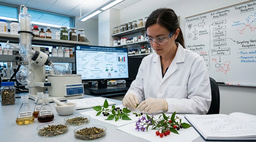
Traditional medicine has long claimed that certain herbs help dissolve stones or relieve gout. Instead of accepting or rejecting these claims outright, we tested them—by adding plant infusions to the crystal growth system.
What followed was one of the most satisfying moments of the study.
Some plant extracts didn’t just slow crystal growth—they visibly altered crystal shape. Others reduced crystal size or prevented proper aggregation. Watching crystals struggle to form in the presence of herbal infusions felt like witnessing nature defend itself.
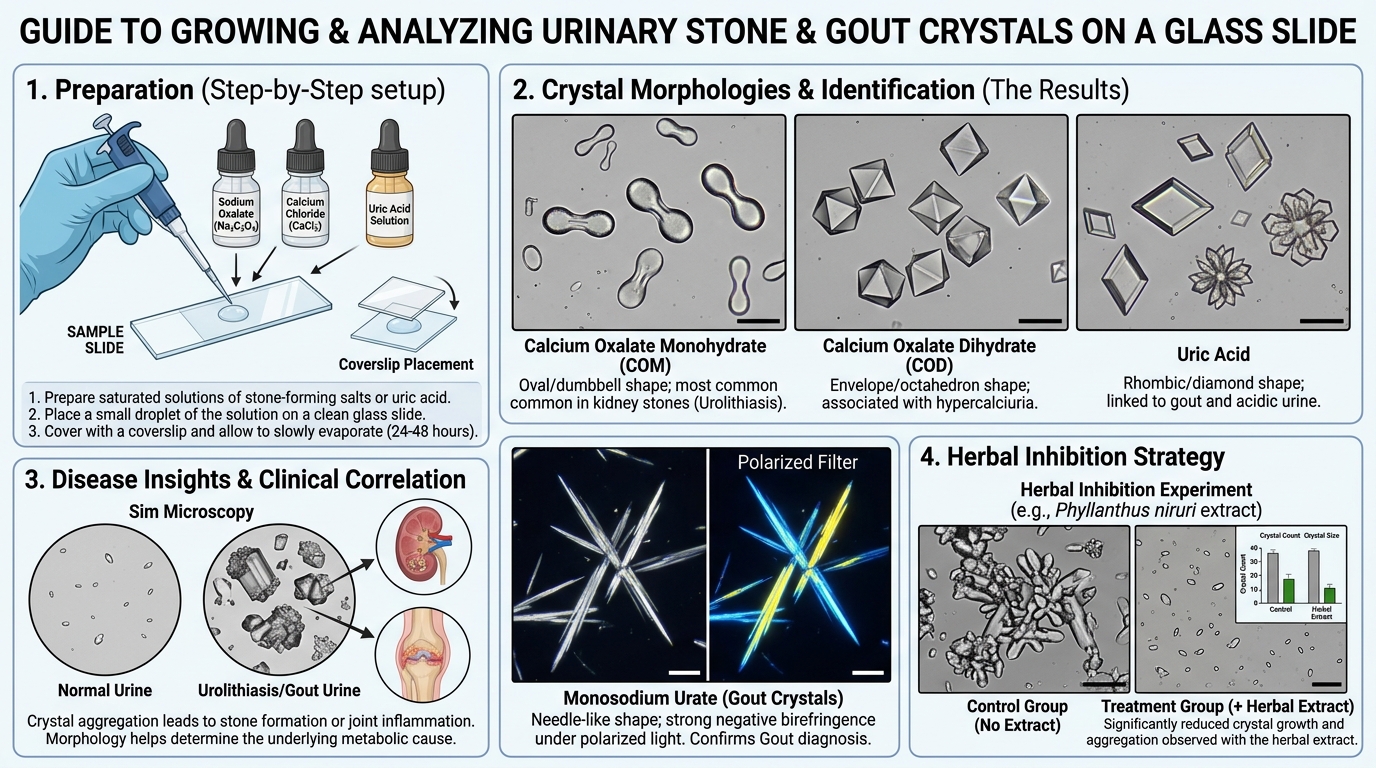
Why This Matters Beyond the Lab
This model is powerful because it is simple. In many parts of the world, especially in resource-limited settings, expensive analytical tools are not always available. A glass-slide crystal growth method offers a low-cost, reproducible way to study stone disease and screen potential inhibitors.
For students, this method is also a teaching tool. It transforms abstract disease concepts into something visible and tangible. For researchers, it opens doors to rapid screening of herbal formulations before moving to more complex models.
And for patients, it represents hope—that affordable, plant-based strategies might one day complement conventional treatments.
Personal Lessons from Crystal Research
This project taught me that impactful research does not always require complex technology. Sometimes, it requires patience, curiosity, and the willingness to observe closely.
I also learned to appreciate interdisciplinary thinking. This work sits at the intersection of chemistry, pathology, pharmacology, and traditional medicine. Each discipline alone tells part of the story; together, they reveal the bigger picture.
Most importantly, it reminded me why I chose research in the first place. Not for publications alone, but for understanding—understanding disease mechanisms deeply enough to imagine better solutions.
Looking Ahead
This work is only a beginning. Future studies need to identify which compounds in plant infusions are responsible for crystal inhibition and how they function at the molecular level. Translating these findings into clinical applications will take time, collaboration, and rigorous testing.
But every large journey begins with a small step—or in this case, a glass slide.
A Final Reflection
Growing disease-related crystals outside the body may sound technical, but for me, it was profoundly human. Every crystal represented pain someone has felt. Every inhibited structure hinted at relief someone might one day experience.
If there is one thing I hope fellow researchers take from this work, it’s this: never underestimate simple models, and never ignore traditional knowledge. When curiosity meets careful experimentation, even a humble glass slide can illuminate complex diseases.
And sometimes, the smallest crystals can teach the biggest lessons.
.jpeg)

Salman Ahmed (ORCID: 0000-0003-2033-0181) holds a B.Pharm. degree from the University of Karachi, Pakistan, and a PhD and M.Phil. in Pharmacognosy from the same institution. He has gained valuable experience in the pharmaceutical industry, having worked at Helix Pharma, Pharm Evo (Pvt.) Ltd., and Searle Pakistan Ltd. Currently, he holds the position of Assistant Professor in the Department of Pharmacognosy at the Faculty of Pharmacy, University of Karachi, Pakistan.
Salman Ahmed has made significant contributions to the field with a decade-long career dedicated to teaching Pharmacognosy, also known as Natural Products Sciences. He has authored 125 research papers with an impact factor of 100 with 2297 citations, a h-index of 24, and an i10-index of 59. He has secured multiple research grants in Pharmacognosy (2021, 2018, 2016, and 2014) to study plants traditionally used for analgesic, anti-inflammatory, diuretic, and antidiarrheal purposes and their effects on digestive enzymes. Additionally, he has authored seven books and presented 16 posters at national and international conferences. Salman Ahmed's expertise is acknowledged by various esteemed journals published by Elsevier, Springer Nature, Wiley, MDPI, Hindawi, and Dove Medical Press Limited, as he serves as an invited reviewer for these publishers.
Scientific Achievements (2011–2015): He pioneered a cost-effective copper sulfate-induced chick emesis model for evaluating natural antiemetics. His research explores antiemetic, analgesic, and anti-inflammatory properties in Pakistani plants, herbs, and spices, reporting fixed oil's analgesic effects and discovering Bergenin as an antiemetic. He authored two state-of-the-art reviews on natural antiemetics, "Antiemetic effects of bioactive natural products" and "Natural antiemetics- an overview". He was awarded Nishan-e-Zafar by the University of Karachi in 2014.
Scientific Achievements (2016–2024): Dr Salman Ahmed pioneered glass slide models to grow Whewellite, Brushite, and Urate crystals for the evaluation of antiurolithiatic and anti-gout drugs, presenting key findings at international conferences such as MMDR-7, STEP-5, ISNPC-14, and ISNPF-2. His book “How to Grow Urinary Stone and Gouty Crystals on Glass Slide” provides detailed methodologies for replicating crystal growth in vitro and discusses the implications for understanding crystal morphologies, disease mechanisms and developing herbal treatment strategies.
Dr Ahmed's research highlights the antiurolithiatic potential of pentacyclic triterpenes and polyphenols. These compounds inhibit calcium oxalate crystallization, reduce oxidative stress, and modulate inflammation. They also promote nephroprotection, diuresis, and ACE inhibition, advancing natural therapeutics for kidney stone prevention.
His contributions include “Glossary of Globally Used Herbs and Animals for Urolithiasis” (2024), a comprehensive book exploring medicinal plants covering botanical families from A to Z and animal-based remedies covering their historical use, mechanism of action, and therapeutic spectrum against Whewellite, Brushite, and Urate crystals separately. His research on antiurolithiatic formulations compiles mono- and polyherbal remedies from diverse regions, including Appalachia, Canada, India, and the Middle East. His work provides critical data for future phytochemical, pharmacological, and toxicological studies, aiding in the discovery of safer, more effective treatments for kidney stones.
Additionally, he explores the anticancer potential of marine peptides against breast, ovarian, cervical, malignant melanoma, prostate, neuroblastoma, glioblastoma, leukemia and lymphoma, advancing natural therapeutics for cancer treatment.


Please sign in or register for FREE
If you are a registered user on Research Communities by Springer Nature, please sign in