Hydrated Network Interphase with Dynamic Negatively Charged Microregion Enables Ultra‑Stable Aqueous Zinc‑Ion Batteries
Published in Materials
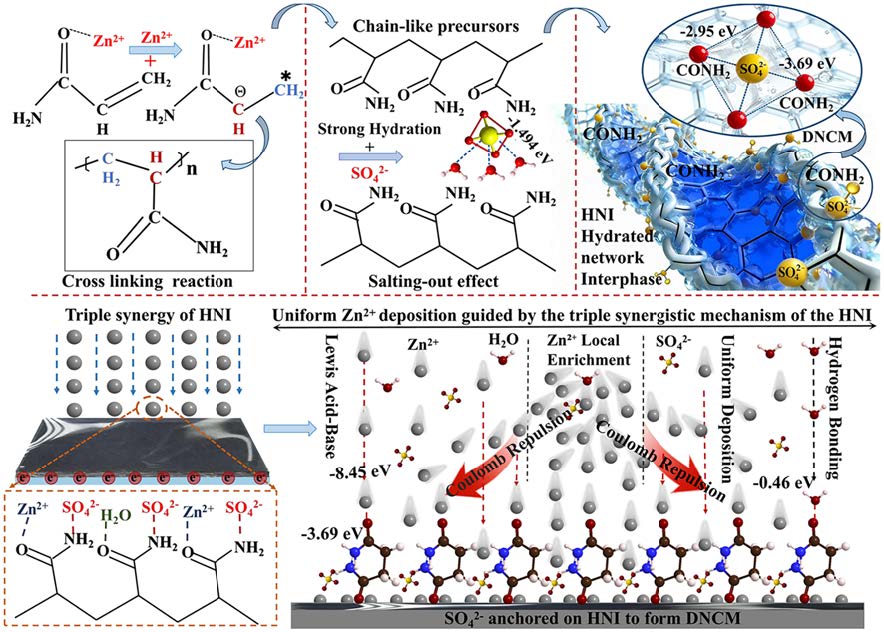

As the global transition toward clean energy accelerates, aqueous zinc-ion batteries (AZIBs) have emerged as promising candidates for grid-scale energy storage due to their inherent safety, environmental benignity, and cost-effectiveness. However, the practical deployment of AZIBs remains severely hindered by interfacial instability at the Zn anode—manifesting as uncontrolled dendrite growth, corrosion, and hydrogen evolution reactions. Now, researchers from Hubei University, led by Professor Hao Wang and Professor Houzhao Wan, along with their team including Yin Yang, Xiaofang Wang, Xin Chen, Jia Yao, Daigan Wang, Luyang Ge, Fei Wang, Lin Lv, and Li Tao, have presented a breakthrough monomer-induced in situ interface engineering strategy that fundamentally redefines Zn deposition behavior.
Why This Interphase Matters
Conventional strategies for stabilizing Zn anodes—such as pre-formed polymer coatings, artificial interfacial layers, and hydrogel electrolytes—often suffer from complex fabrication, poor interfacial contact, and insufficient ionic conductivity. The novel hydrated network interphase (HNI) overcomes these limitations by leveraging a unique electrochemically triggered, in situ formation mechanism. Rather than relying on ex situ coatings, this approach uses the battery's own electrochemical cycling to construct a dynamic, self-renewing protective layer directly at the electrode–electrolyte interface, ensuring seamless integration and sustained functionality.
Innovative Design and Mechanism
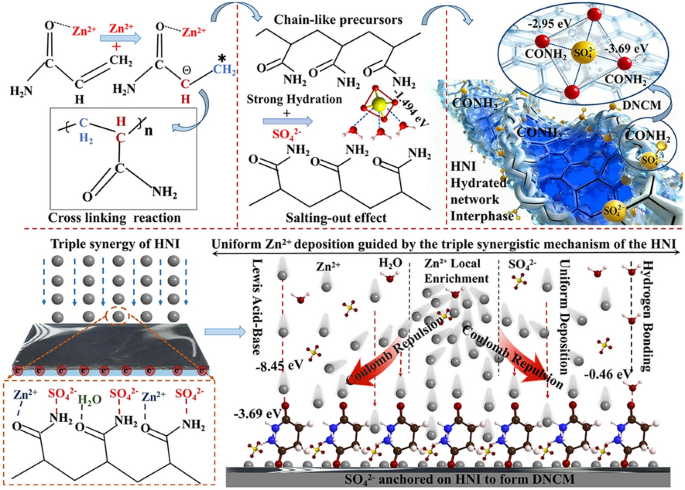
The HNI is constructed through a sophisticated synergistic triggering process. Acrylamide (AM) monomers, featuring superior zincophilicity over water molecules (adsorption energy of −0.828 eV vs. −0.325 eV on Zn (002)), preferentially adsorb onto the Zn anode surface, creating a localized high-concentration region. During electrochemical cycling, this enriched layer undergoes in situ polymerization driven by the concerted effects of Zn2+ cross-linking (which reduces polymerization energy barriers and generates radical intermediates) and SO42- salting-out (which triggers chain contraction and network assembly via dehydration). The resulting HNI is enriched with dynamic negatively charged microregions (DNCM) formed by electrostatically anchored SO42- within the polymer network.
This architecture enables triple synergistic regulation of Zn deposition: (1) Lewis acid–base coordination (C=O···Zn2+, binding energy −8.45 eV) provides fixed nucleation sites for directional Zn2+ deposition; (2) DNCM homogenizes Zn2+ flux via long-range Coulombic repulsion, preventing concentration polarization and ensuring uniform ion distribution; and (3) a dense hydrogen-bonding network (C=O···H–O–H, −0.46 eV) effectively confines free water molecules, suppressing hydrogen evolution reactions and parasitic side reactions.
Outstanding Performance
Symmetric Cells: Zn//Zn symmetric cells with the HNI-modified anode achieve extraordinary cycling stability: 8650 h (over 360 days) at 1 mA cm-2/0.5 mAh cm-2, 6700 h at 1 mA cm-2/1 mAh cm-2, 2740 h at 5 mA cm-2, and 1600 h at 10 mA cm-2—representing improvements of approximately 90×, 20×, and 45× over bare Zn anodes, respectively. The nucleation overpotential decreases from 42.8 mV to 36.5 mV, and the critical current density for dendrite suppression is dramatically enhanced.
Asymmetric Cells: Zn//Ti asymmetric cells deliver a high average Coulombic efficiency of 99.71% at 5 mA cm-2 for over 1150 cycles, with Zn//Cu cells achieving 99.68% CE over 2000 cycles at 1 mA cm-2.
Full Cells: Zn//I₂ full cells exhibit remarkable performance metrics: a high specific capacity of 356.27 mAh g-1 at 1 A g-1 with 89.15% capacity retention after 12,000 cycles. Rate capability tests demonstrate stable charge/discharge platforms from 0.1 to 10 A g-1, with capacities of 539.89 mAh g-1 at 0.1 A g-1 and 231.75 mAh g-1 even at 10 A g-1.
Applications and Future Outlook
This work establishes a transformative paradigm for in situ interfacial engineering in aqueous battery systems. By harnessing electrochemically driven ion enrichment to trigger precise monomer polymerization and assembly, the HNI strategy eliminates the need for complex pre-treatment while achieving dynamic self-renewal during operation. The triple synergistic mechanism—combining guided nucleation, flux homogenization, and interfacial stabilization—offers a universal design principle for next-generation aqueous metal batteries. This research opens promising avenues for developing ultra-stable, high-performance energy storage systems combining long cycle life, high safety, and practical scalability for grid-level applications.
Stay tuned for more groundbreaking research from this team at Hubei University!

Editor of Nano-Micro Letters, which is an Open-Access, peer-reviewed journal reported papers that have at least one dimension ranging from a few sub-nanometers to a few hundreds of micrometers. The journal is published by Springer Nature and indexed by SCI, EI, SCOPUS, Pubmed, etc. The 2025 JCR Impact Factor is 38.5. The 2025 CiteScore is 58.9.
Follow the Topic
-
Nano-Micro Letters
Nano-Micro Letters is a peer-reviewed, international, interdisciplinary and open-access journal that focus on science, experiments, engineering, technologies and applications of nano- or microscale structure and system in physics, chemistry, biology, material science, and pharmacy.





Please sign in or register for FREE
If you are a registered user on Research Communities by Springer Nature, please sign in