

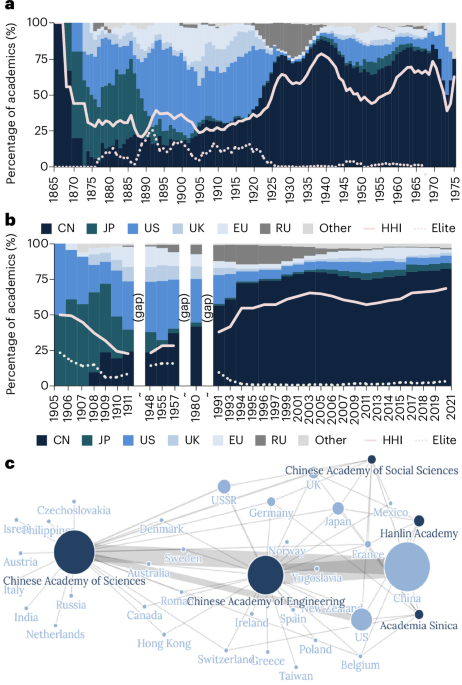

Researchers from Nanyang Technological University (NTU) in Singapore have co-authored a paper in Nature Human Behaviour, titled "Indigenization and inclusion in Chinese academia." This study, published on December 23, 2025, dissects the career trajectories of over 3,500 members of China's prestigious Chinese Academy of Sciences (CAS) and Chinese Academy of Engineering (CAE) spanning more than a century from 1905 to 2023. This paper reveals shifts in China's scientific and academic elite, highlighting a move toward self-reliance amid globalization.
The work shows how China, now the world's second-largest producer of scientific papers, is reshaping its collaborations with foreign powers. For Singapore-based academics and institutions like NTU, this analysis is particularly relevant, offering insights into sustaining partnerships in a changing landscape.
Historical Context: From Reform to Research Powerhouse
China's scientific ascent began accelerating post-1978 economic reforms under Deng Xiaoping, which opened doors to international exchanges. In the 1980s and 1990s, thousands of Chinese scholars pursued advanced degrees at elite Western universities, particularly in the United States (e.g., MIT, Harvard) and United Kingdom (e.g., Oxford, Cambridge). Many returned as "returnee scholars" or "haigui" (sea turtles), bringing cutting-edge knowledge and fostering co-authored publications.
This era saw peak collaboration: U.S.-China co-publications surged, peaking around 2018 before geopolitical tensions prompted declines. Domestically, initiatives like the Thousand Talents Plan (launched 2008) lured top overseas talent back, bolstering institutions like Tsinghua and Peking Universities. By 2023, China accounted for 22% of global research output, per Scopus data, but the NTU study probes deeper into elite academy memberships.
Methodology: A Century-Long Dataset of Elite Careers
The researchers compiled a comprehensive dataset from public biographies of 3,534 CAS and CAE members, tracking education, career mobility, and regional origins. Using quantitative analysis, they measured proportions of foreign-educated elites over time, regional representation, and foreign member elections. This longitudinal approach—unique in scale—allows robust conclusions on indigenization, defined as prioritizing domestically trained scholars in leadership roles.
Data sources: Official academy websites, university profiles, and historical records.
Key metrics: Highest degree origin, career stations (domestic vs. abroad), election years.
Time frame: 1905–2023, capturing pre-1949 Republican era to modern Xi Jinping policies.
Such rigorous methods exemplify NTU's strength in empirical social science research on Asia.
Core Finding: Declining Foreign-Educated Representation
Despite globalization, foreign-educated scholars' share in CAS/CAE plummeted. By 2023, over 82% held highest degrees from Chinese universities, up from earlier decades. The proportion from elite U.S./U.K. institutions peaked in the 1980s and has declined steadily, reflecting policies favoring domestic training.
Elite returnees face mixed outcomes: while advancing in mid-tier universities, they are underrepresented in top academies compared to pure domestic scholars. University leadership now predominantly features domestically educated academicians, signaling undervaluation of foreign credentials.
Positive Shifts: Regional Inclusion and Diversity
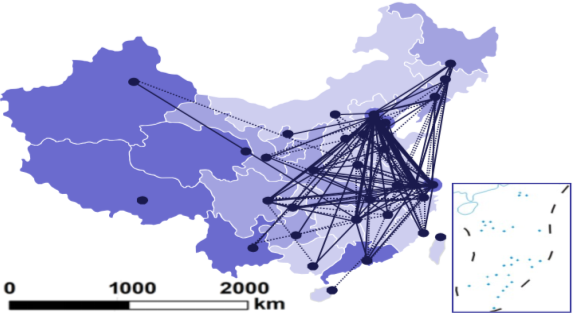
Indigenization brings inclusion: underrepresented provinces like Guizhou and Yunnan see rising academy representation, balancing Beijing/Shanghai dominance. Women and ethnic minorities gain ground, though gaps persist. This democratizes elite science, fostering broader talent pools.
Foreign memberships evolve too: U.S. share dropped from 88% (1994) to 21% (2023), while Belt and Road Initiative (BRI) partners from developing nations increase, aligning with China's global south outreach.

Historian of Education; Digital Social Scientist
Follow the Topic
-
Nature Human Behaviour
Drawing from a broad spectrum of social, biological, health, and physical science disciplines, this journal publishes research of outstanding significance into any aspect of individual or collective human behaviour.
Related Collections
With Collections, you can get published faster and increase your visibility.
Digital Media and Mental Health
Publishing Model: Hybrid
Deadline: Oct 30, 2026
Basic Psychological Needs and Well-Being
Publishing Model: Hybrid
Deadline: Nov 27, 2026




Please sign in or register for FREE
If you are a registered user on Research Communities by Springer Nature, please sign in