Hydrogel Electrolytes for Zinc-Ion Batteries: Materials Design, Functional Strategies, and Future Perspectives
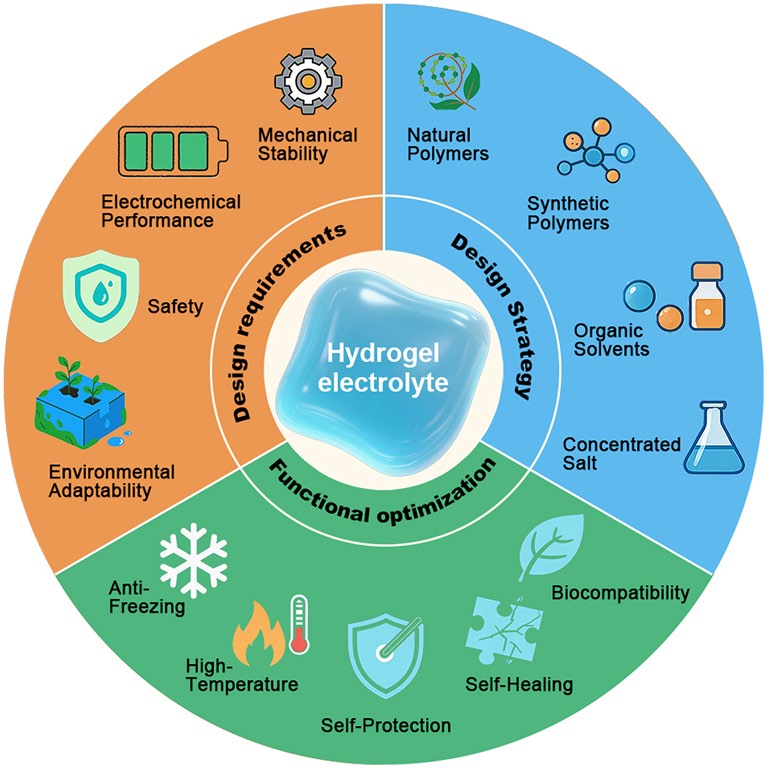


With the escalating demand for safe, sustainable, and high-performance energy storage systems, hydrogel electrolytes have emerged as promising alternatives to conventional liquid electrolytes in zinc-ion batteries. By integrating the high ionic conductivity of liquid electrolytes with the mechanical robustness of solid frameworks, hydrogel electrolytes offer distinct advantages in suppressing zinc dendrite formation, enhancing interfacial stability, and enabling reliable operation under extreme environmental conditions. This review systematically summarizes the fundamental characteristics and design criteria of hydrogel electrolytes, including mechanical flexibility, ionic transport capabilities, and environmental adaptability. It further explores various compositional design strategies involving natural polymers, synthetic polymers, and composite systems, as well as the incorporation of electrolyte salts and functional additives. In addition, recent advances in functional optimization, such as anti-freezing properties, self-healing abilities, thermal responsiveness, and biocompatibility, are comprehensively discussed. Finally, the review outlines the current challenges and proposes potential directions for future research.

Editor of Nano-Micro Letters, which is an Open-Access, peer-reviewed journal reported papers that have at least one dimension ranging from a few sub-nanometers to a few hundreds of micrometers. The journal is published by Springer Nature and indexed by SCI, EI, SCOPUS, Pubmed, etc. The 2025 JCR Impact Factor is 38.5. The 2025 CiteScore is 58.9.
Follow the Topic
-
Nano-Micro Letters
Nano-Micro Letters is a peer-reviewed, international, interdisciplinary and open-access journal that focus on science, experiments, engineering, technologies and applications of nano- or microscale structure and system in physics, chemistry, biology, material science, and pharmacy.