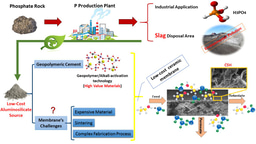
Over the past decade, I’ve worked in both innovative research using waste valorization and process engineering focused on Detailed Engineering. This combination helps me connect what happens in the lab with what actually works in the field, something that is valuable for both academia and EPC Companies/ petrochemical industries.
Recently, I was invited to review a pilot‑scale study that tried to measure the total porosity of catalysts and cements using Mercury Intrusion Porosimetry (MIP). The idea was promising, but several important scientific and engineering points were missing, points that matter when you want reliable results for design, material selection, or industrial performance:
- MIP has clear limits based on ASTM standards
- Open porosity and total porosity are not the same
- MIP only works within certain pore‑size ranges
- Two ASTM standards overlap, and each has its own restrictions
With 9+ yrs. of research experience and 5+ yrs. in EPC/chemical process engineering, I’ve learned how standards like ASME, ASTM, and API guide both scientific testing and engineering design. These standards are not just paperwork, they protect the accuracy of calculations, the safety of equipment, and the reliability of materials.
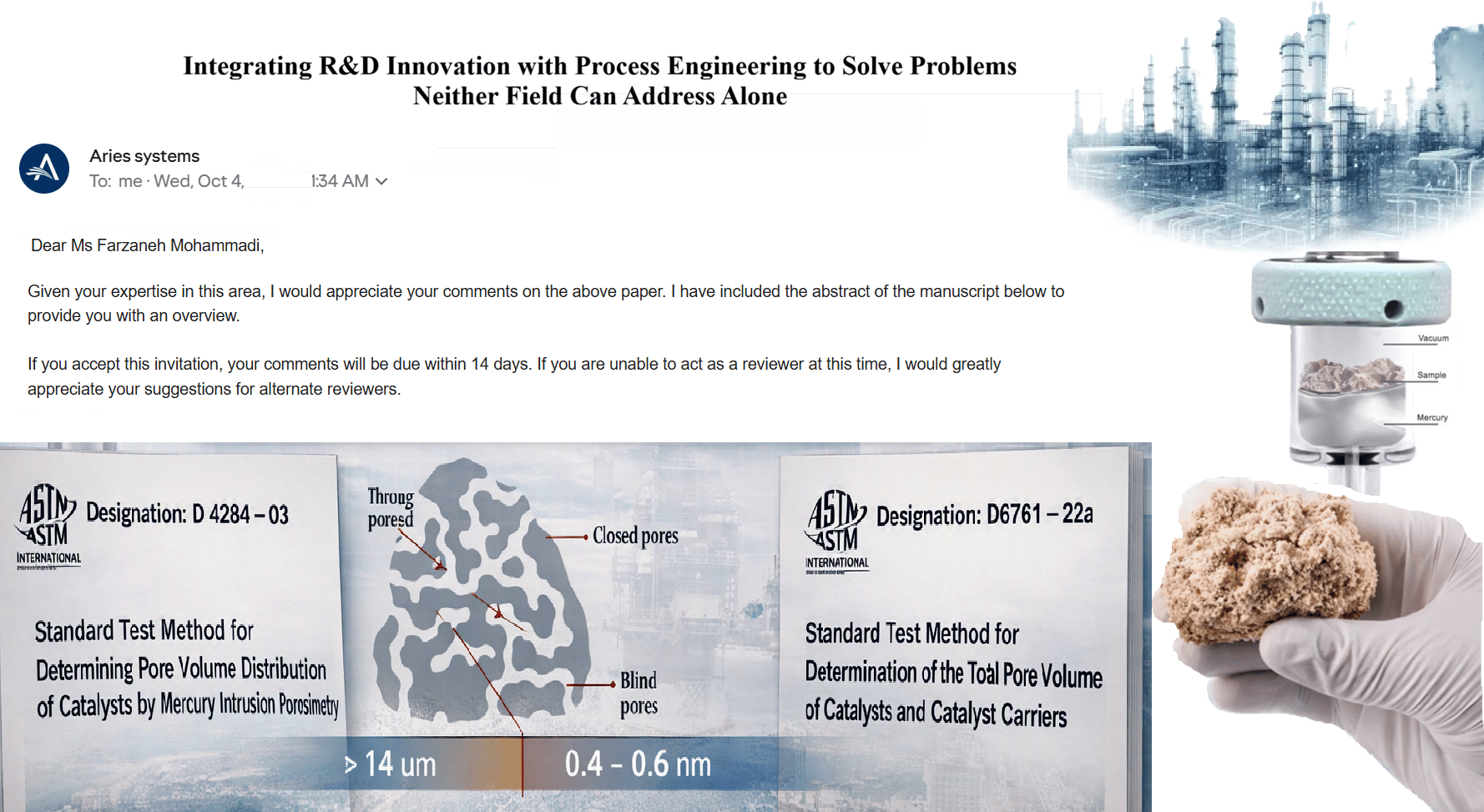
In this specific review case, I used ASTM D4284‑03 and ASTM D6761‑22a to check the method. These standards define standard test method to determine pore volume distribution of catalysts by mercury intrusion porosimetry and standard test method to calculate the total pore volume of catalysts and catalyst carriers, respectively. According to ASTM D6761‑22a, measuring total pore volume requires two techniques together:
- MIP only detects pores open to the exterior of a particle.
- For pore‑volume distribution (ASTM D4284‑03), measurable pore diameters are 100 to 0.003 μm. (3nm).
- For total pore volume (ASTM D6761‑22a), mercury‑accessible pores are ≥14 μm at ambient pressure, and helium‑accessible pores are around 0.4 nm because helium cannot enter pores smaller than this range.
The ASTM D6761‑22a clearly states:
“the volume of pores having pore diameter between approximately 14 μm and 0.4 nm.” (ASTM D6761‑22a, Section 1.1)
This means the “accessible pores” in this standard cover 14 microns down to 0.4 nm, but only when both methods are combined. As a result, MIP alone cannot measure total porosity. It only measures open pores within its own range, while helium covers part of the very small pores. Closed pores remain unmeasured.
This is exactly why combining R&D + Process Engineering is powerful. When you understand both the scientific limits and the engineering impact, you can turn research results into accurate designs, better materials, and solutions that actually work in industry.
To comply with blind review requirements, the date of review and the manuscript title were erased.

Farzaneh Mohammadi is a R&D process engineer with 10+yrs of experience in sustainable ceramic membrane synthesis via geopolymers & alkali activation. Her background is in the synthesis & characterization of ceramic & polymer membranes. Since 2015, her research has focused on the sustainable valorization of by-products for fabricating low-cost ceramic membranes. Her research results have been published as research papers & patents in scientific societies. In 2023, she joined the Elsevier Reviewer Hub as a reviewer, receiving an invitation from the journal of the European Ceramic Society. As a professional R&D process engineer & technical manager, she has worked on water & wastewater treatment projects in the representation of Atech Innovations GmbH Co.