IrMn‑Cluster‑Based Artificial Metalloenzymes with Radiosensitized Systemic Antitumor Responses to Prevent Malignant Tumor Metastasis and Recurrence
Published in Bioengineering & Biotechnology and Cell & Molecular Biology
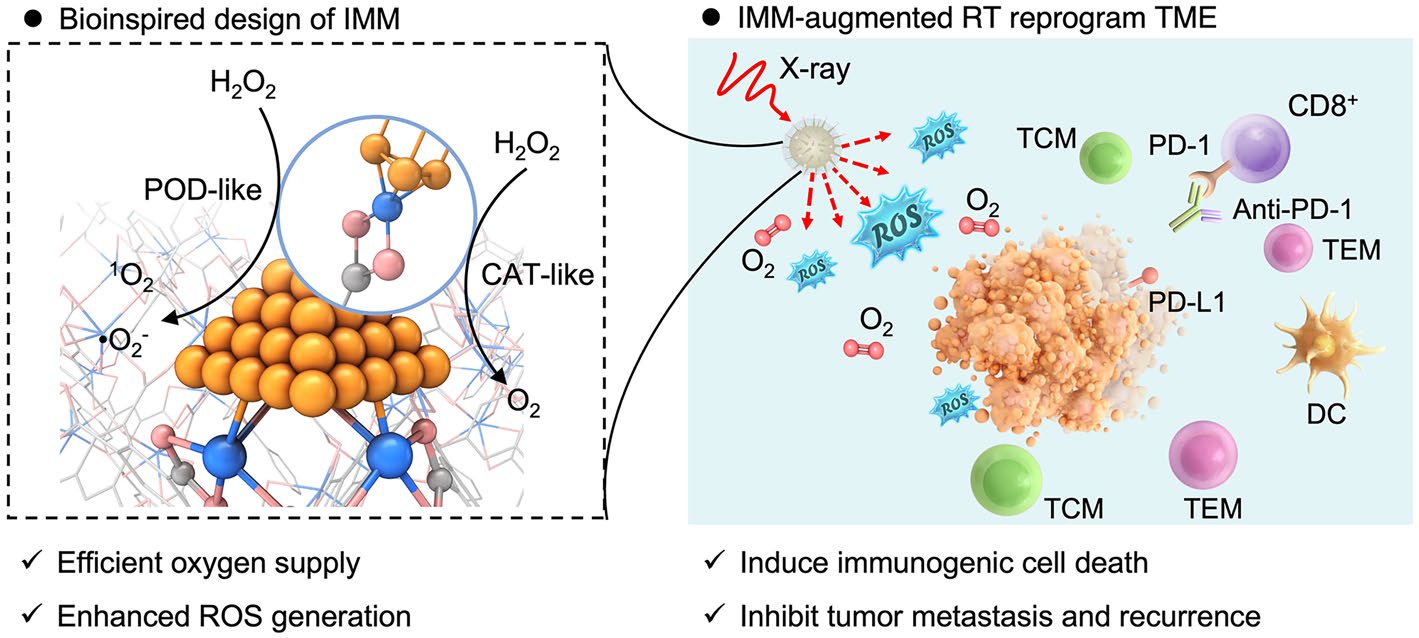

Radiotherapy (RT) remains a cornerstone of cancer treatment, but its therapeutic efficacy is often limited by tumor hypoxia, radiation resistance, and insufficient systemic antitumor immunity. In particular, hypoxic tumor microenvironments can reduce radiation-induced DNA damage, while localized radiotherapy alone is generally insufficient to control distant metastases or prevent tumor recurrence. Developing radiosensitizing agents that can simultaneously enhance reactive oxygen species (ROS) generation, relieve tumor hypoxia, and activate systemic immune responses therefore represents an important challenge in cancer therapy.
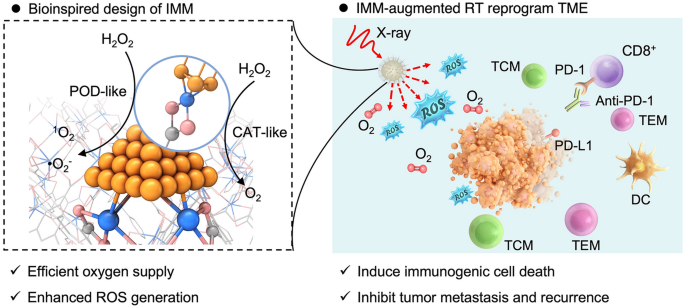
In a recent study published in Nano-Micro Letters, Ruidan Li, Qinlong Wen and co-workers, led by Professor Chong Cheng and Professor Xingchen Peng, report the de novo design of an IrMn-cluster-based artificial metalloenzyme (IMM) that integrates enzyme-mimetic catalysis, radiosensitization, and immune modulation into a single therapeutic platform. Inspired by natural manganese-containing peroxidase and catalase, the researchers constructed IrMn clusters coordinated with Mn-organic ligands to create electron-rich catalytic centers capable of simultaneously promoting ROS and O2 generation.
Bioinspired Construction of Electron-Rich IrMn Catalytic Centers
The key concept of this work is the use of Mn-organic ligands to electronically regulate Ir clusters. The resulting IMM adopts a spiky nanostructure, with ultrasmall Ir nanoclusters of approximately 1.5 nm uniformly distributed on the surface of the Mn-organic framework. Spectroscopic and theoretical analyses reveal strong electronic interactions between the organic framework and Ir centers, with approximately 0.51 |e| electron transfer from the ligand to Ir. This electron redistribution increases the electron density of the Ir catalytic centers and facilitates multielectron redox reactions involving oxygen-containing intermediates.
XANES and EXAFS analyses further confirm the local coordination environment of the Ir centers, revealing Ir–O, Ir–Ir, and Ir–Mn coordination structures. Together with DFT calculations, these results establish a structure–electronic configuration relationship in which the Mn-organic ligands modulate the electronic state of Ir and thereby enhance its catalytic activity.
Dual Enzyme-Mimetic Activity for ROS and O₂ Generation
The engineered IMM exhibits two complementary catalytic functions: ROS generation and O2 evolution. Under tumor-microenvironment-mimicking conditions, IMM rapidly decomposes H₂O₂ and generates oxygen, reaching an O2 concentration of 44.54 mg L-1 within 100 s at 10 μg mL-1 IMM. Its peroxidase-like activity is also substantially enhanced compared with conventional Ir/C, with a maximum reaction velocity of 2.37 μM s-1 and a turnover number of 134.7 × 10⁻³ s-1.
Importantly, X-ray irradiation further amplifies ROS production. The generated ROS include •O2⁻ and 1O2, while in situ FTIR measurements identify *OOH and *OH as key reaction intermediates. DFT calculations indicate that ligand-induced electronic modulation weakens the adsorption of *OOH from −1.67 eV on Ir/C to −1.59 eV on IMM, facilitating intermediate desorption and accelerating catalytic turnover.
Thus, IMM functions as a catalytic platform that converts the H2O2-rich tumor microenvironment into both oxygen and highly reactive oxygen species, providing two complementary mechanisms for overcoming tumor hypoxia and enhancing radiation-induced oxidative damage.
Enhancing Radiotherapy by Relieving Hypoxia and Blocking DNA Repair
The biological consequences of this catalytic activity were subsequently investigated under hypoxic conditions. In CT26 tumor cells, the combination of IMM and X-ray irradiation produced the highest apoptosis rate, reaching 43.17% ± 1.33%, while also strongly suppressing tumor-cell proliferation and migration.
The enhanced therapeutic effect originates from the synergistic generation of ROS and O2. IMM-generated O₂ alleviates tumor hypoxia, while ROS directly damage cellular components and amplify the oxidative stress induced by irradiation. Consistently, IMM treatment substantially reduces HIF-1α expression under hypoxic conditions, indicating effective hypoxia reversal. At the same time, RT+IMM treatment produces pronounced γ-H2AX signals and maintains elevated DNA double-strand breaks, demonstrating that IMM not only increases radiation-induced DNA damage but also suppresses DNA damage repair.
From Local Tumor Killing to Systemic Antitumor Immunity
Beyond direct tumor-cell killing, IMM-augmented RT induces immunogenic cell death (ICD). The combined treatment promotes the release of damage-associated molecular patterns (DAMPs), including ATP and HMGB1, together with increased surface exposure of calreticulin. These signals can facilitate antigen presentation and stimulate adaptive antitumor immunity.
In vivo studies further demonstrate that IMM-augmented RT remodels the tumor microenvironment. The treatment promotes tumor-vessel normalization, alleviates hypoxia, and enhances the recruitment and activation of immune cells. In particular, increased CD8⁺ T-cell activation and dendritic-cell abundance suggest that IMM can help transform an immunosuppressive tumor microenvironment into one that is more favorable for antitumor immune responses.
Synergy with Anti-PD-1 Therapy Generates Antitumor Memory
A particularly important feature of this work is that the therapeutic effect of IMM extends beyond the irradiated tumor. When IMM-augmented RT was combined with anti-PD-1 therapy, the treatment enhanced systemic antitumor responses and suppressed both primary and distant tumor lesions. The treatment also increased CD8⁺ T-cell activation as well as populations of central memory T cells (TCMs) and effector memory T cells (TEMs), providing evidence for the establishment of sustained antitumor immune memory. This combination therefore establishes a therapeutic cascade:
IMM → ROS/O2 generation → hypoxia relief + DNA damage → immunogenic cell death → immune activation → anti-PD-1-enhanced systemic immunity → antitumor memory.
Such a strategy moves radiotherapy beyond localized tumor destruction toward a systemic therapeutic response capable of targeting distant lesions and reducing the risk of recurrence.
Suppressing Radioresistant Tumors and Lung Metastasis
The therapeutic potential of IMM was further validated in more clinically relevant models. In a humanized patient-derived xenograft (PDX) model generated from recurrent head and neck tumors after radiotherapy, IMM-augmented RT significantly suppressed tumor growth, whereas RT alone showed limited therapeutic efficacy. These findings indicate that IMM can enhance the radiosensitivity of radioresistant tumors.
In a spontaneous lung-metastasis breast cancer model, IMM-augmented RT produced sustained tumor suppression for 30 days after treatment. Bioluminescence imaging showed complete tumor regression in the IMM-augmented RT group, while CT imaging and H&E staining revealed no detectable lung metastases in treated mice, in contrast to metastatic lesions observed in the control and RT groups.
Toward Systemic and Durable Cancer Therapy
Overall, this study presents an IrMn-cluster-based artificial metalloenzyme that integrates catalytic therapy, radiotherapy, and immunotherapy. By transferring electron density from Mn-organic ligands to Ir clusters, IMM creates highly active catalytic centers capable of efficient ROS and O2 generation. This catalytic activity simultaneously alleviates tumor hypoxia, enhances radiation-induced DNA damage, and inhibits DNA repair, resulting in potent tumor-cell apoptosis.
More importantly, IMM-augmented RT promotes immunogenic cell death and remodels the tumor microenvironment, while its combination with anti-PD-1 therapy activates systemic antitumor immunity and establishes long-lasting immune memory. The efficacy of this strategy has been demonstrated in radioresistant PDX and spontaneous lung-metastasis models, highlighting its potential for treating aggressive tumors and preventing metastatic progression and recurrence.
This work provides a promising bioinspired nanomedicine platform that transforms radiotherapy from a primarily local treatment into a coordinated strategy integrating radiosensitization, hypoxia modulation, tumor immune activation, and long-term antitumor memory, offering new opportunities for the treatment of malignant and radioresistant tumors.

Editor of Nano-Micro Letters, which is an Open-Access, peer-reviewed journal reported papers that have at least one dimension ranging from a few sub-nanometers to a few hundreds of micrometers. The journal is published by Springer Nature and indexed by SCI, EI, SCOPUS, Pubmed, etc. The 2025 JCR Impact Factor is 38.5. The 2025 CiteScore is 58.9.
Follow the Topic
-
Nano-Micro Letters
Nano-Micro Letters is a peer-reviewed, international, interdisciplinary and open-access journal that focus on science, experiments, engineering, technologies and applications of nano- or microscale structure and system in physics, chemistry, biology, material science, and pharmacy.