Is it really true that students from low socioeconomic status (SES) are less creative than high-SES ones?
Published in Neuroscience, Behavioural Sciences & Psychology, and Education



Explore the Research
 Nature
Reading ability conflates SES creativity gaps - npj Science of Learning
npj Science of Learning - Reading ability conflates SES creativity gaps
Are high-SES individuals more creative than low-SES ones? While numerous studies find positive correlations between SES and creative performance, there are plausible mechanisms that might lead the exact opposite to hold.
On the one hand, wealth might provide cognitive freedom, freeing people from immediate survival concerns and allowing them to think more imaginatively and beyond conventional constraints. On the other hand, more creative individuals may feel unfulfilled by the repetitive tasks typical in many educational and workplace settings – with potential detrimental effects to their productivity, learning, and employability, particularly within societies that undervalue creative skills. Moreover, limited resources can push individuals to think creatively out of necessity, developing resourceful ways to meet basic needs.
Determining which effect dominates (if any) is an empirical question, widely debated in both academic research and public discourse.
PISA 2022 Creative Thinking Assessment
In 2022, the Program for International Student Assessment (PISA) framework, which assesses 15-year-olds in over 60 countries, evaluated for the first time students’ abilities to generate diverse and original ideas, as well as to assess and refine ideas across various contexts, using open-ended tasks focused on communication and problem-solving.
The OECD report on PISA creativity scores documents a sizable socioeconomic status (SES) gap, both across and within countries. At face value, these correlations support the theory that creativity is positively correlated with wealth.
However, performing well on the PISA creativity assessment – a standard assessment, based on open-ended questions – also requires strong reading and writing skills. Since low-SES students (often disadvantaged by multiple oppressions) often have lower proficiency in these areas, the observed SES gap in creativity scores may, at least in part, reflect underlying disparities in reading and writing ability.
This paper (with Lêticia Lopes and Sachin Allums) reports the results of three studies that address this challenge, conducted with different samples of 6-12th graders in Brazilian schools.
Measuring creativity
The studies focus on divergent thinking, a core component of creative thinking: the ability to generate a variety of creative possibilities and novel associations. In Studies 1 and 2, we conducted multiple trials of the Alternative Uses Task (AUT) and one trial of the Divergent Association Task (DAT). In Study 3, we replicated two items from the PISA 2022 Creative Thinking Assessment.
In the AUT, participants have to come up with as many creative and unusual uses for an everyday object (e.g., tire, pants, shoe, table, or bottle). The AUT is typically scored on different dimensions: fluency (the number of distinct uses), flexibility (the number of categories to which alternative uses correspond), and originality (responses’ statistical infrequency) – each deemed as a key indicator of creative potential. We restrict attention to fluency, the most common and transparent dimension used in the literature; Supplementary Materials replicate all analyses using originality instead of fluency.
In the DAT, participants have to come up with 10 nouns as semantically different as possible from one another. For example, ‘dog’ and ‘cat’ are very close in meaning, and thus, including both of them would result in a low DAT score. By contrast, ‘dog’ and ‘guitar’ would score much higher since they have very different meanings and uses. A scoring algorithm extracts the semantic difference between the different nouns.
The first PISA item targeted the ability to generate diverse ideas, emphasizing students’ ability to think flexibly: they had to created three distinct titles based on a surreal image, featuring a large-scale book alongside various elements of the countryside, such as a field, tree, and wooden bench. The second item targeted the ability to generate creative ideas, focusing on the novelty and usefulness of an idea: students had to caption a comic strip featuring a dialogue between the sun and the earth.
Measuring SES
The analyses proxy for SES by comparing students living in households with at most one full bathroom (low-SES) to those with two or more (high-SES). This is considered a reliable proxy for SES in contexts where direct measures of income or wealth are unavailable or impractical. Since children were the ones filling out the survey or reporting on socioeconomic status with no caregivers present, we decided to use full bathrooms as a proxy for SES.
Measuring reading ability
We measured students’ reading ability through the Rapid Online Assessment of Reading (ROAR), a digital assessment that measures reading fluency and comprehension. Concretely, we assessed participants’ reading fluency and comprehension using the ROAR Sentence Reading Efficiency (ROAR-SRE) task, previously validated for Brazil. In the task, participants rate sentences as true or false as quickly and accurately as they can, within 180 seconds. Sentences were carefully validated for Brazilian Portuguese and screened for contextual suitability, requiring minimal background knowledge and using simple vocabulary and syntactic structures
SES gaps in creativity or reading ability?
Study 1 first documents SES gaps in standard creativity measures and investigates the extent to which reading ability mediates these gaps. In May-Jul/2025, the study enrolled 523 students across 8 middle schools (grades 6-9) in the municipality of Rio de Janeiro, Brazil. Recruited students participated in computer-based reading and creativity assessments, covering conventional divergent thinking tasks.
Figure 1 documents a sizable and statistically significant SES creativity gap based on the summary measure of conventional creativity measures (the AUT and the DAT).
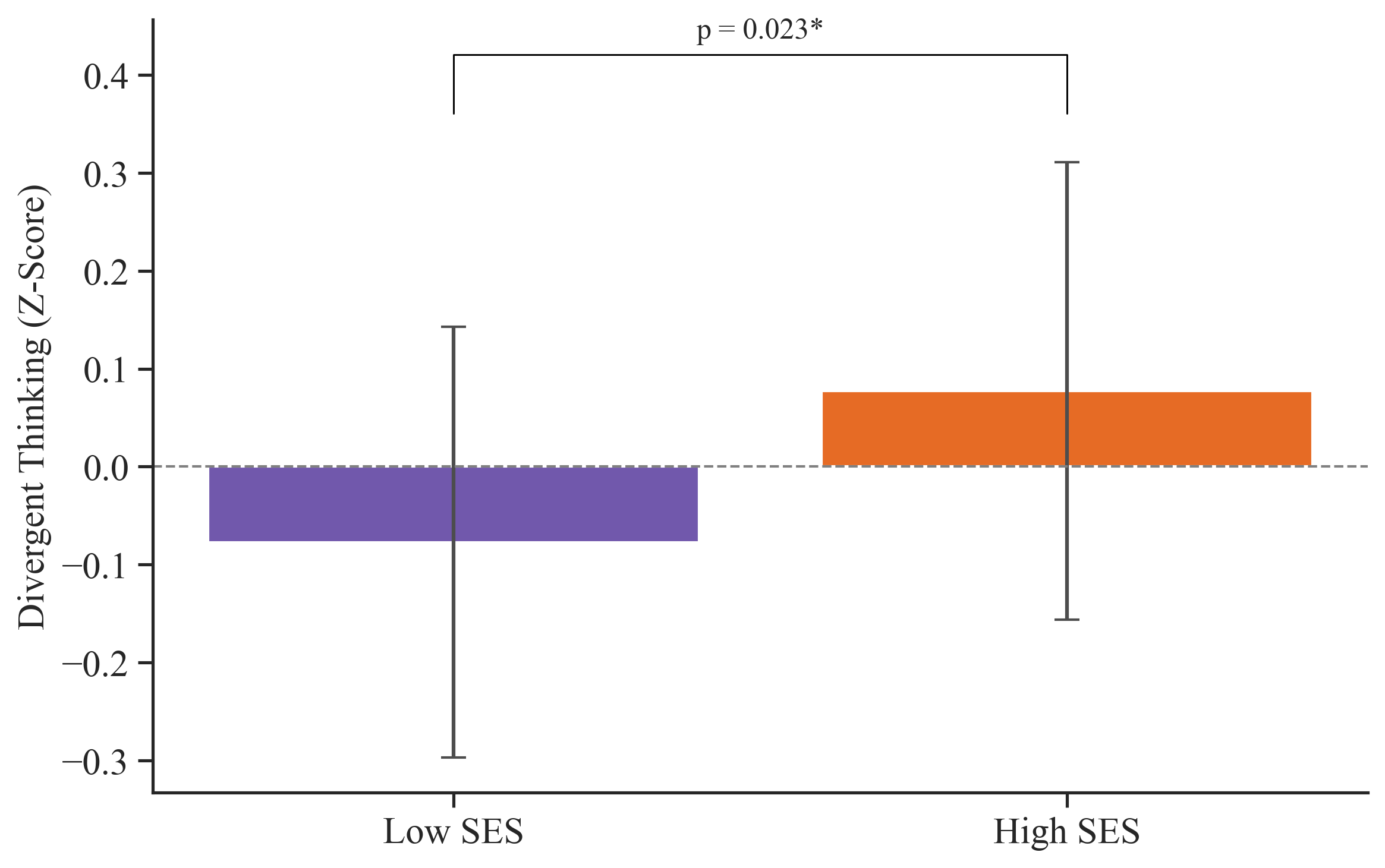
Figure 2 documents that, however, this gap at least partly conflates differences in reading ability across low- and high-SES participants. Leveraging high-quality reading ability data from ROAR-SRE, we document that while the SES creativity gap among proficient students is of similar magnitude, albeit imprecisely estimated, such gap is 1/3 lower among those who do not read at grade-5 level and no longer statistically significant.
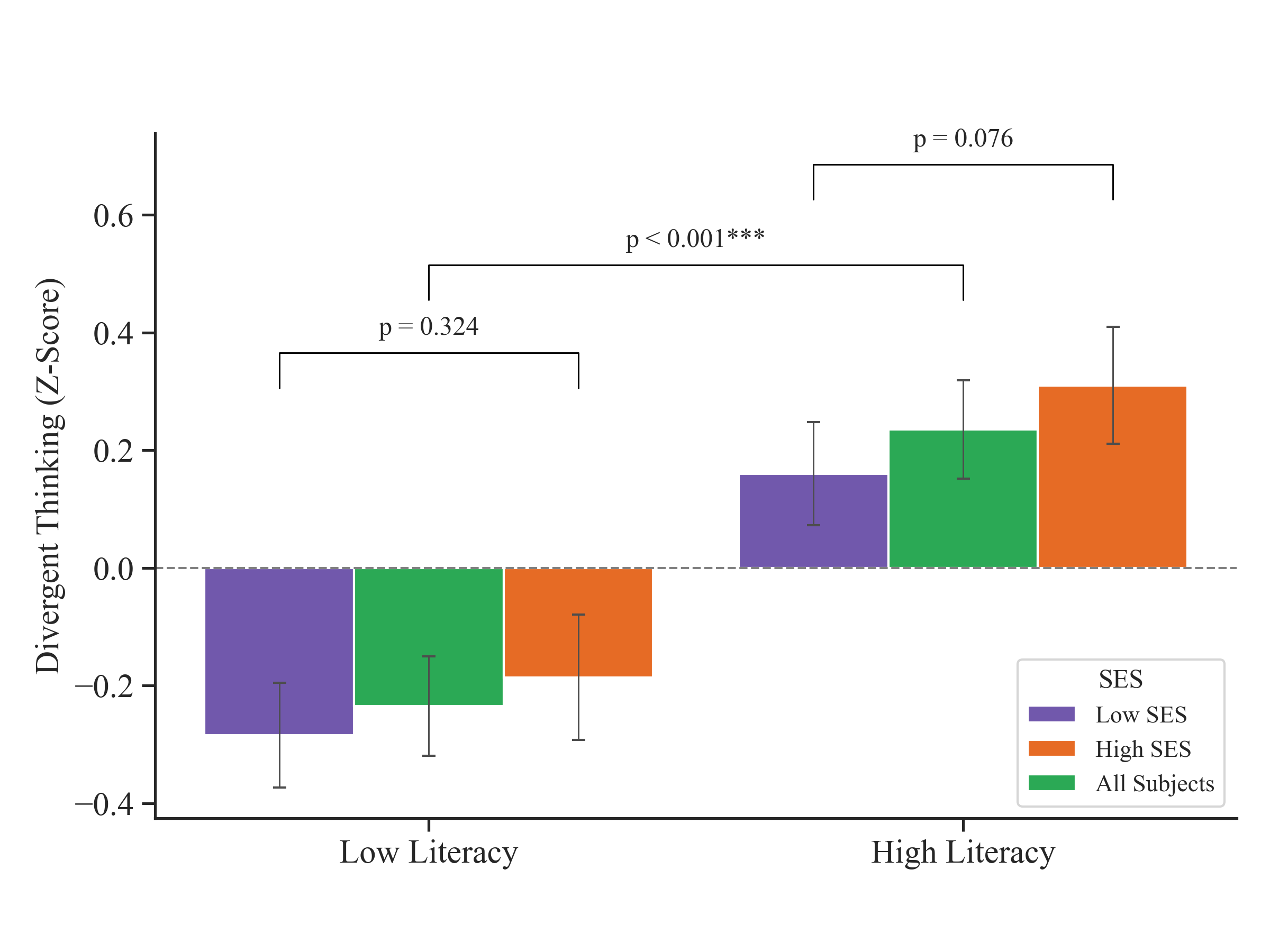
Together, the patterns we document are consistent with the claim that reading ability conflates SES creativity gaps in standard creativity measures. Nonetheless, since reading ability is not randomly assigned – but, rather, correlated with several student characteristics, including household wealth –, it could be that our findings indicate that our reading ability measure is merely a better proxy for SES than the one we rely on (number of full bathrooms).
Study 2 then explores whether experimentally removing reading requirements from the creativity assessments used in Study 1 closes these SES gaps. In May-Jun/2025, the study enrolled 1,100 participants across 140 high schools (grades 10-12) in 27 Brazilian States. The sample was drawn to represent all K–12 schools in the country. Recruited students participated in tablet-based creativity assessments, adapted from those conducted in Study 1.
Removing reading requirements
We independently randomized whether each question prompt was read by the student (control group) or by the enumerator (treatment group). As such, in the control group, our measure of creativity may still reflect students’ reading ability, while in the treatment group, it isolates creativity from reading skills. Across both treatment and control conditions, students responded verbally, and enumerators typed their responses; as a result, the creativity measure is independent of students’ writing skills in both groups.
Experimental findings
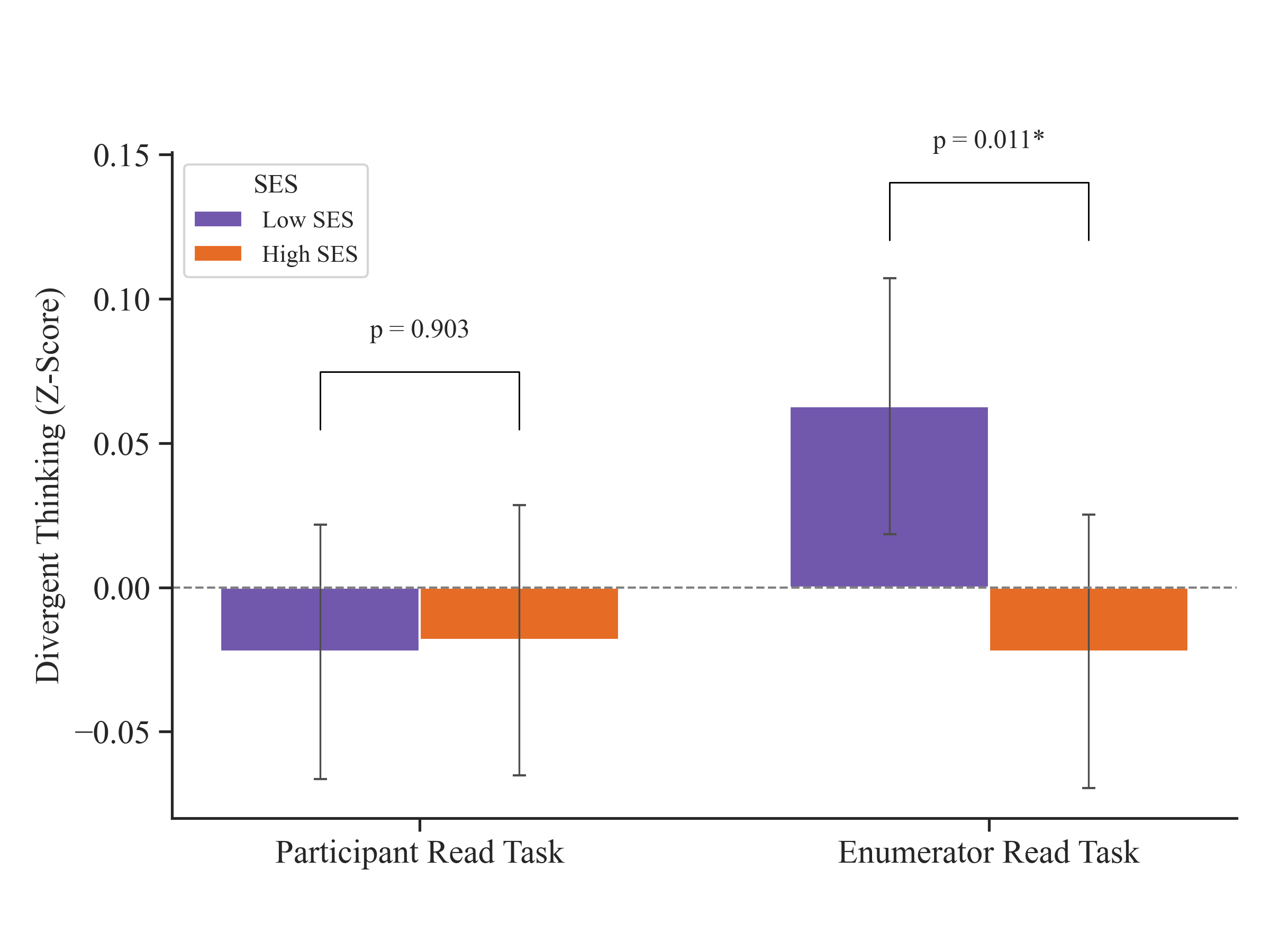
Figure 3 documents that high-SES students outperform low-SES ones in standard creativity measures (the AUT and the DAT) only due to reading requirements. Among participants who had to read the question prompts, we estimate a SES creativity gap similar to the unconditional one documented in Study 1. Conversely, among those for whom enumerators read the prompts on their behalf, the SES gap is less than half and no longer statistically significant. 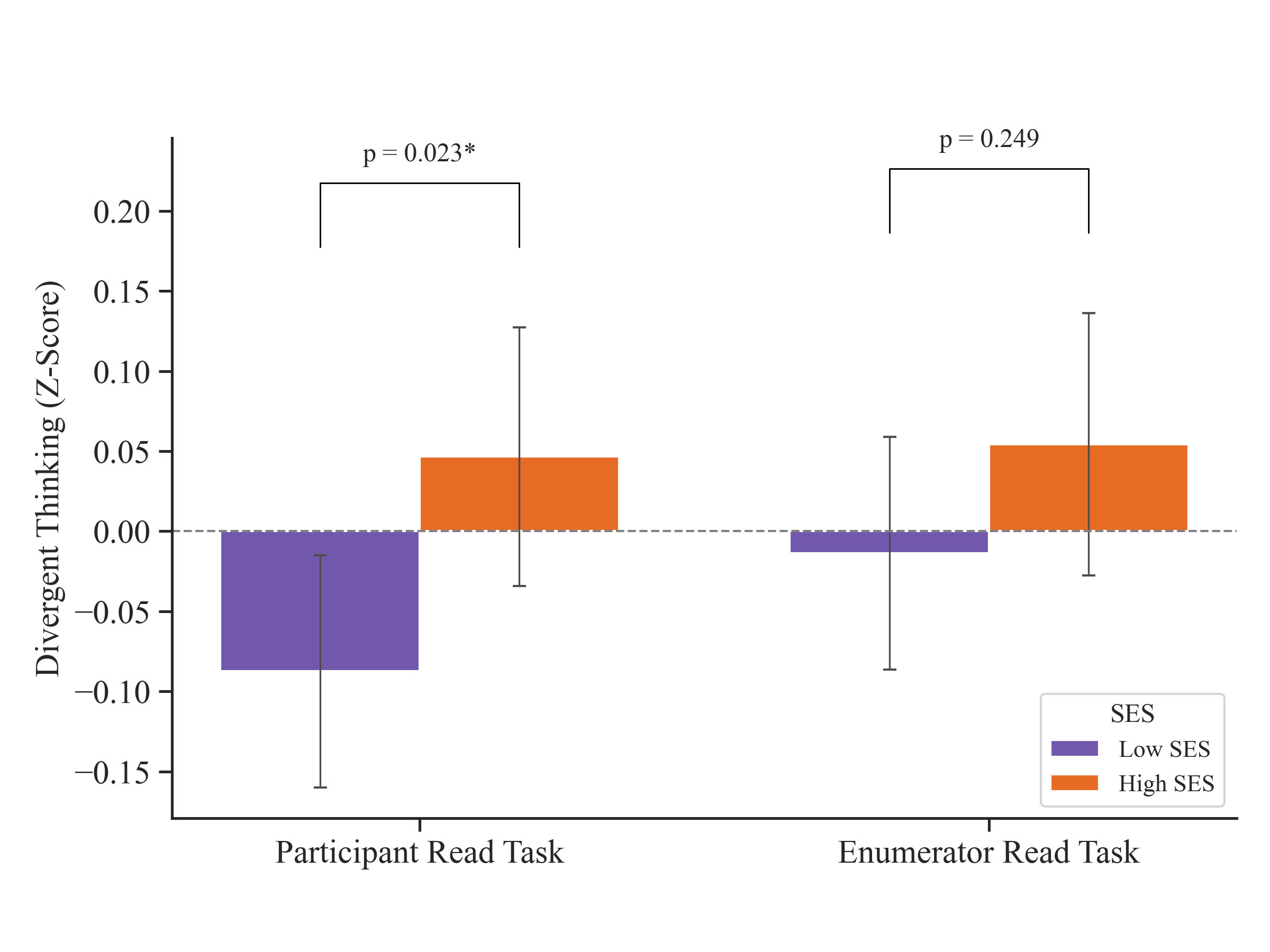
Finally, Study 3 replicates that experimental manipulation in the context of items from the PISA 2022 Creative Thinking assessment. In Aug-Sep/2024, the study enrolled 515 participants across 43 high schools in 23 Brazilian States. The sample was drawn to represent all K–12 schools in the country.
Figure 4 documents that, similar to Study 2, reading requirements mask differences between high- and low-SES students in PISA-like creativity measures (diverse and creative idea generation tasks).Among participants who had to read the question prompts, we estimate virtually no SES creativity gap; in turn, among those for whom enumerators read the prompts on their behalf, a sizeable SES gap emerges in favor of low-SES students.
Implications
Together, our findings provide compelling evidence that reading ability conflates creativity measures in standard assessments – including PISA 2022 –, in particular when it comes to SES gaps. While the OECD report posits that “[S]ocio-economic disparities in creative thinking performance therefore rather reflect a range of economic and cultural factors, experiences and mechanisms known to affect student achievement overall” (p. 113), it does not mention test unfairness as a potential driver of SES differences. Instead, the report concludes that, since the correlation between reading and creativity scores across OECD countries is 0.66 – less than that between reading and other disciplines –, “the creative thinking assessment measures a different subset of skills with respect to those measured in the mathematics, reading and science assessments” (p. 83).
This paper challenges this conclusion; concretely, it suggests that SES differences in reading comprehension can account for the totality of SES differences in average creativity scores across income groups within countries, and across countries of different income levels.
Overall, our findings suggest that assessments of higher-order skills, such as creative thinking, should better account for limitations in foundational skills (often disproportionately concentrated among low-income students). Specifically, assessors might consider administering oral exams or even non-verbal measures of creativity or other higher-order skills in order to accurately capture underlying skills.
More broadly, our findings suggest that reading requirements embedded in conventional assessments might conflate a host of cognitive abilities, from executive functions to mathematical reasoning. Ultimately, unfairness in test design not only (1) constrains the extent to which the assessment accurately reflects levels and differences in the skills or psychological constructs it intends to capture, but also, (2) might end up reinforcing deficit narratives that mischaracterize the potential of disadvantaged students.

Follow the Topic
-
npj Science of Learning
An online open access peer-reviewed journal dedicated to research on all aspects of learning and memory – from the genetic, cellular and molecular basis, to understanding how children and adults learn through experience and formal educational practices.

Related Collections
With Collections, you can get published faster and increase your visibility.
Embodied Learning
Publishing Model: Open Access
Deadline: Jan 10, 2027
Reimagining Teaching and Learning in the Age of Generative AI Agents
Publishing Model: Open Access
Deadline: Oct 13, 2026


Please sign in or register for FREE
If you are a registered user on Research Communities by Springer Nature, please sign in