Lignocellulose‑Mediated Gel Polymer Electrolytes Toward Next‑Generation Energy Storage
Published in Materials
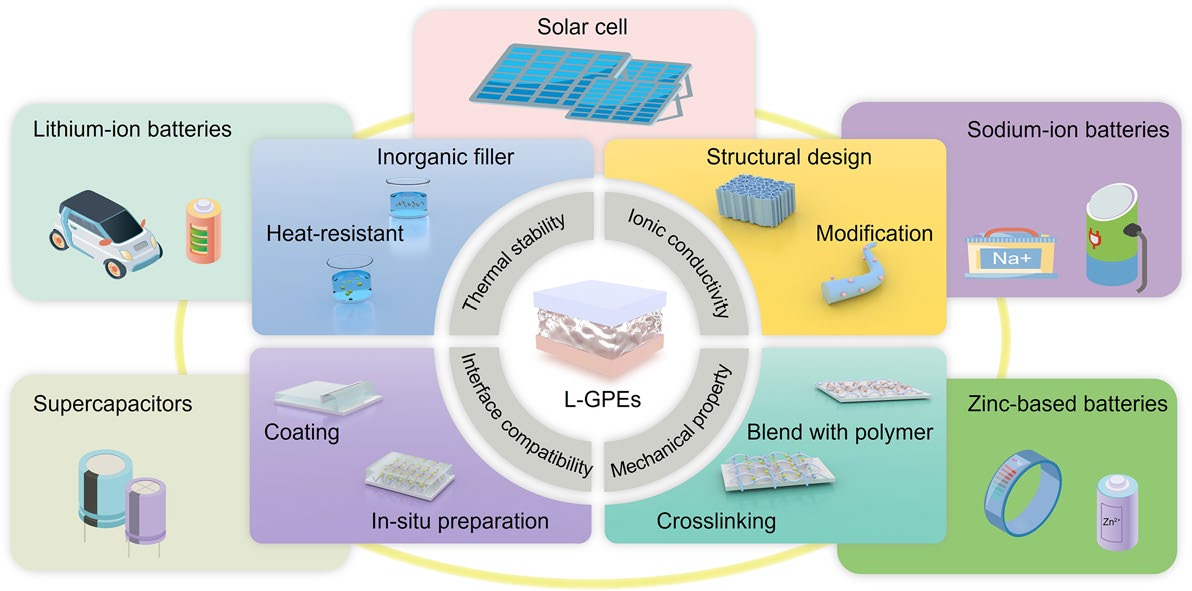

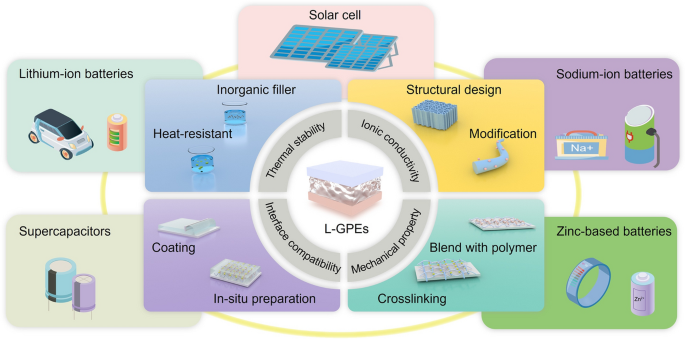

As global energy demands surge and environmental concerns intensify, the quest for safe, high-performance, and sustainable energy storage devices has become urgent. Traditional liquid electrolytes—widely used in lithium-ion batteries, supercapacitors, and zinc-ion batteries—suffer from leakage, flammability, and dendrite growth, limiting device reliability and safety. Now, a team led by Prof. Liyu Zhu, Prof. Ting Xu, Prof. Kun Liu, and Prof. Chuanling Si from Tianjin University of Science and Technology has published a comprehensive review on lignocellulose-mediated gel polymer electrolytes (L-GPEs), offering a bio-based, scalable, and high-performance alternative for next-generation energy storage systems.
Why Lignocellulose-Based Gel Electrolytes Matter
- Sustainability: Lignocellulose—composed of cellulose, hemicellulose, and lignin—is the most abundant renewable biomass on Earth. It offers a carbon-neutral, low-cost, and biodegradable platform for electrolyte design.
- Safety & Stability: L-GPEs eliminate leakage and flammability risks associated with liquid electrolytes. Their 3D crosslinked network suppresses dendrite growth and enhances thermal stability (>320 °C).
- Performance: With tunable porous structures, high ionic conductivity (up to 38.6 mS cm-1), and excellent mechanical strength (>40 MPa), L-GPEs outperform conventional synthetic polymer electrolytes in lithium, sodium, zinc, and supercapacitor systems.
Innovative Design Strategies
- Material Engineering:
- Cellulose provides rigid mechanical support and ion transport channels.
- Hemicellulose enhances electrolyte uptake and ion mobility via hydrophilic branching.
- Lignin improves thermal stability and electrochemical stability through aromatic radical-scavenging and hydrophobic shielding.
- Structural Optimization:
- Nanofiber Networks: Cellulose nanofibers (CNFs) and nanocrystals (CNCs) form low-tortuosity ion pathways.
- Crosslinking & Blending: Chemical crosslinking (e.g., epichlorohydrin) and polymer blending (e.g., PVA, alginate) enhance flexibility and toughness.
- Inorganic Fillers: Boron nitride (BN) and SiO2 nanofibers boost thermal stability and ionic conductivity via Lewis acid-base interactions.
- Interface Engineering:
- Coating: PVDF-HFP/cellulose composite coatings reduce interfacial resistance (194.5 Ω) and suppress lithium dendrites.
- In-Situ Polymerization: Direct gelation on electrodes ensures seamless contact and stable SEI formation.
Applications & Performance Highlights
- Supercapacitors: L-GPEs achieve 97.5% capacitance retention over 2,000 bending cycles and 10,000 charge/discharge cycles.
- Lithium-Ion Batteries: L-GPEs enable 98% capacity retention after 300 cycles at 1C and high Li⁺ transference numbers (0.88–0.902).
- Sodium-Ion Batteries: Vertical-aligned cellulose channels reduce Na⁺ migration resistance, delivering 89.8% capacity retention after 200 cycles.
- Zinc-Ion Batteries: Lignin-modified hydrogels suppress dendrites and extend cycle life by 175% at 2,000 mA g-1.
- Solar Cells: L-GPEs replace volatile liquid electrolytes in dye-sensitized solar cells (DSSCs), maintaining 67.2% efficiency after 6 days.
Challenges & Future Outlook
The review identifies key bottlenecks:
- Scalability: Green pretreatment and cost-effective synthesis routes are needed.
- Interface Chemistry: Balancing covalent crosslinking (mechanical strength) and dynamic bonds (self-healing) remains critical.
- Advanced Characterization: In-situ EIS, cryo-TEM, and multi-scale simulations are essential to decode ion transport and interfacial reactions.
This roadmap underscores the transformative potential of lignocellulose in energy storage. By merging materials science, electrochemistry, and sustainability, L-GPEs are poised to power a safer, greener, and more resilient energy future. Stay tuned for more breakthroughs from the Tianjin team!

Editor of Nano-Micro Letters, which is an Open-Access, peer-reviewed journal reported papers that have at least one dimension ranging from a few sub-nanometers to a few hundreds of micrometers. The journal is published by Springer Nature and indexed by SCI, EI, SCOPUS, Pubmed, etc. The 2025 JCR Impact Factor is 38.5. The 2025 CiteScore is 58.9.
Follow the Topic
-
Nano-Micro Letters
Nano-Micro Letters is a peer-reviewed, international, interdisciplinary and open-access journal that focus on science, experiments, engineering, technologies and applications of nano- or microscale structure and system in physics, chemistry, biology, material science, and pharmacy.






Please sign in or register for FREE
If you are a registered user on Research Communities by Springer Nature, please sign in