LIGO or LIDMO, that is the question
Published in Astronomy
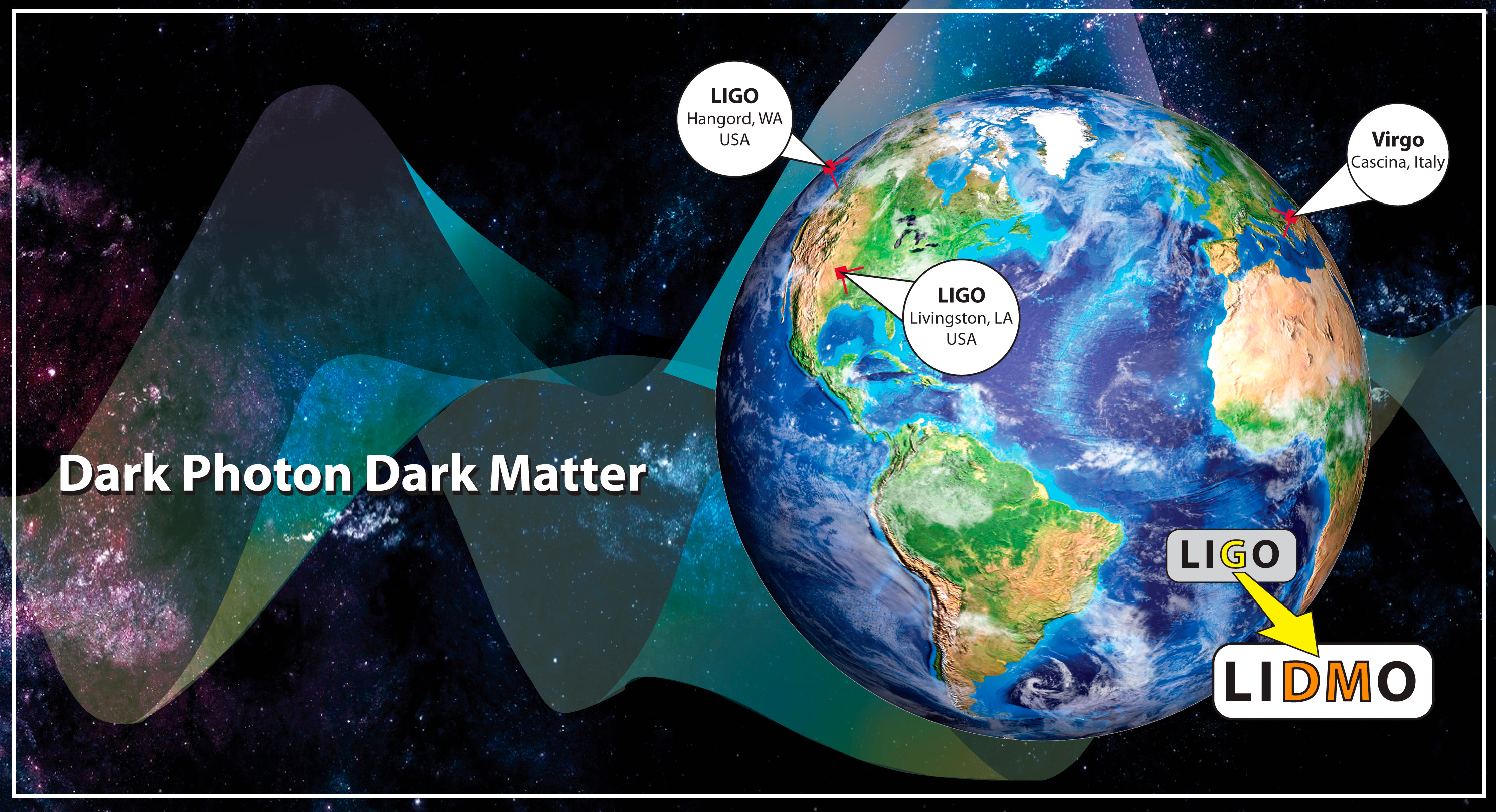



The 2017 Nobel Prize in Physics was awarded for the direct detection of gravitational waves (GW) from binary black hole mergers, underscoring the excitement and vibrancy at the frontiers of physics research. As is well known, gravitational wave detectors probe gravity and astrophysical phenomena. Much less appreciated is their potential to probe - directly - new particle physics beyond the Standard Model.
A wealth of convincing observational evidence confirms the existence of dark matter (DM), which is estimated to compose about 27% of the energy density in our Universe. However, the Standard Model does not have a candidate particle to account for DM. Additionally, all evidence pointing to the existence of DM is related to gravitational effects and associated properties, such as DM mass; their other potential interactions are currently unknown.
In our study, we leveraged the recent advances in GW instrumentation to carry out a novel DM direct detection using the Laser Interferometer Gravitational-Wave Observatory (LIGO). LIGO is a highly advanced Michelson-Morley interferometer (with many extra mirrors and a sophisticated controls system), relying upon precise measurements of a relative change in interferometer arm length. Meanwhile, DM can be formed by an ultra-light ‘dark’ photon, such as the gauge Boson of a U(1)B group. In the ultra-light regime, the dark photon DM (DPDM) can be treated as a classical wave, whose oscillation, like GW, can induce a relative change of the interferometer arm length; thus LIGO can carry out complementary searches for DPDM.
The oscillation frequency of the dark photon field is determined by its energy. In a scenario where the dark photon plays the role of DM, it is non-relativistic and its oscillation frequency approximately depends only on its mass, which is a constant. Thus, the signal induced by DPDM is almost monochromatic, detectable as a sharp peak in the frequency spectrum.
More interestingly, since DM is non-relativistic, the DPDM has a very long coherence length, much longer than the radius of the earth in the frequency regime of interest. This considerable length means that GW detectors at different locations experience very similar dark photon fields. LIGO’s two detectors, one at LIGO Livingston Observatory in Louisiana and the other one at LIGO Hanford Observatory in Washington would experience nearly the same DPDM signal, allowing cross-correlation to be exploited in a search. We use the publicly available data from LIGO's first observing run (O1) to perform the first such DPDM search. We find that, if a dark photon is the gauge boson of U(1)B, LIGO’s O1 data has already provided a sensitivity better than achieved by prior experiments in a certain mass window. Substantially improved search sensitivity is expected during the coming years of continued data taking by LIGO and other GW detectors in a growing global network.

Follow the Topic
-
Communications Physics
An open access journal from Nature Portfolio publishing high-quality research, reviews and commentary in all areas of the physical sciences.

Related Collections
With Collections, you can get published faster and increase your visibility.
Nonlinear dynamics of living systems
Publishing Model: Open Access
Deadline: Nov 09, 2026
High-Energy Light Sources - From Tabletop to Large Facilities
Publishing Model: Open Access
Deadline: Sep 30, 2026