Looking for Violence in Deep History: Building a Bioarchaeological Dataset Across 12,000 Years
Published in Social Sciences, Arts & Humanities, and Economics

A grant from the German Research Foundation (DFG) allowed us to create, at the University of Tübingen, an unusual collaboration among economic historians, archaeologists, and anthropologists interested in understanding human welfare over the very long run. The broader goal of the project was straightforward but ambitious: to combine the analytical tools of applied economics with the high-resolution evidence on past human experiences provided by bioarchaeology. We were particularly interested in whether archaeological and anthropological evidence could help answer questions that are normally discussed using only historical sources or modern statistics.
One of those questions concerns the long-term history of violence. Did interpersonal violence decline over time, as some influential scholars have argued? Or did violence fluctuate in more complex ways across different historical contexts? These debates are notoriously difficult to resolve because systematic homicide statistics only exist for very recent centuries, while written historical records become increasingly fragmentary as we move further back in time. For much of human history, we simply lack the kinds of data that social scientists usually use to investigate violence.
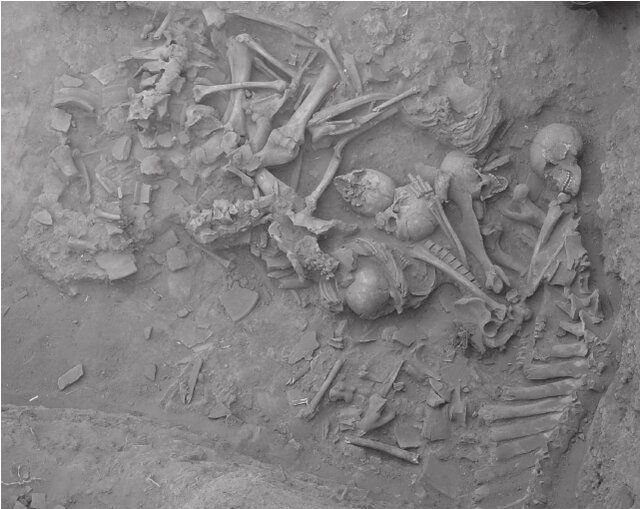
This challenge led us toward bioarchaeology. Human skeletons preserve evidence of past injuries, including cranial trauma and weapon-related wounds that can often be linked to episodes of interpersonal violence. Over the last two decades, advances in forensic techniques and archaeological recording have produced an expanding body of published skeletal evidence. Yet much of this material remained dispersed across specialist publications, excavation reports, and unpublished archives. Bringing together this evidence in a systematic way became the central task of the project.
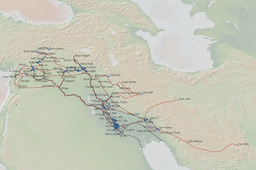
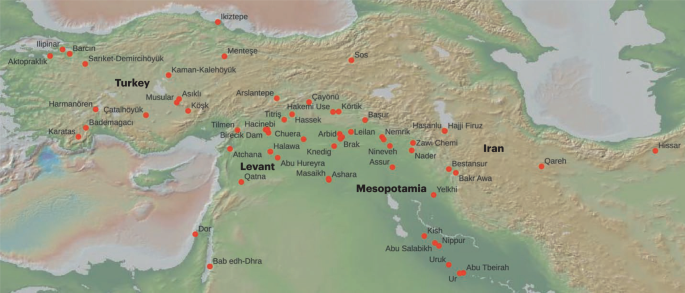
The ancient Middle East emerged as a natural focus. It is one of the world's most important historical laboratories, encompassing the transition from foraging to farming, the rise of the first cities, the emergence of states, and the formation of some of the earliest empires. At the same time, no large-scale attempt had been made to reconstruct long-run violence trends across the region using bioarchaeological evidence. The potential for innovation was therefore substantial.
However, the region also posed significant methodological challenges. Archaeological data are rarely standardized. Different excavations report skeletal trauma in different ways, preservation conditions vary enormously from site to site, and chronological frameworks often differ between national traditions and research projects. Constructing a comparable dataset across thousands of years therefore required far more than simply collecting published numbers.
At this stage, collaboration became essential. We invited Arkadiusz Sołtysiak, one of the leading bioarchaeologists working on the ancient Near East, to join the project. His expertise proved invaluable not only for interpreting skeletal evidence but also for gaining access to field records and unpublished materials accumulated over decades of archaeological research. Throughout the project, data and interpretations moved back and forth between Tübingen and Warsaw, where Professor Sołtysiak generously made available important fieldwork documentation. Many decisions required detailed discussion: how should trauma be classified? Which injuries were likely related to violence rather than accidents? How could different reporting conventions be harmonized without introducing additional biases?
The process involved much more detective work than we initially anticipated. We spent months reviewing excavation reports, reassessing published material, cross-checking site chronologies, and evaluating the quality of individual datasets. Often the challenge was not finding evidence, but determining whether apparently similar observations had actually been recorded according to comparable standards. In many cases, the most time-consuming aspect of the research was not statistical analysis but data construction itself.
The project was conducted during the COVID-19 pandemic, which added another layer of complexity. Access to libraries, archives, and research facilities was often restricted. International travel became difficult or impossible for extended periods. As a result, much of the collaboration took place through online meetings, shared databases, and countless exchanges of documents and comments. Looking back, one of the most rewarding aspects of the study is that it demonstrates what interdisciplinary research teams can achieve even under such difficult circumstances.
The final dataset included evidence from 3,539 individuals spanning approximately 12,000 years, from the Mesolithic and Neolithic periods to the eve of Classical antiquity. The results revealed a striking pattern. Interpersonal violence was relatively limited during the earliest periods, rose sharply during the Chalcolithic era associated with the emergence of early urban societies, declined substantially during the Early and Middle Bronze Ages, and increased again during the major political and environmental disruptions that accompanied the transition from the Late Bronze Age to the Iron Age.
For me personally, the project illustrates the tremendous potential of combining archaeological evidence with methods more commonly associated with economics and the social sciences. Questions about violence, inequality, institutions, and human welfare are often studied separately by different disciplines. Yet the archaeological record contains information capable of connecting these debates across timescales that written records simply cannot reach. By integrating skeletal evidence, historical interpretation, and statistical analysis, we can begin to reconstruct dimensions of human experience that were previously inaccessible.
More broadly, I hope this work encourages greater dialogue between researchers working with different forms of evidence. The study emerged from a simple premise: that understanding long-term human welfare requires combining perspectives that are usually kept apart. The success of the project owes much to that interdisciplinary spirit and to the willingness of scholars from different fields to engage with each other's methods, assumptions, and data. Sometimes the most exciting discoveries come not from a new theory, but from bringing together bodies of evidence that rarely meet.

I am a Ramon y Cajal (tenure-track) researcher at the Department of Economic History, Institutions, Politics and World Economy and the Research Center on Institutions, Politics and Economics (IPERC) of the University of Barcelona (UB). I teach in the MIPE and ADE programs. I am also one of the founders of the ORIGINS project, and an associate editor for the series Cambridge Elements in Law, Economics and Politics.
I investigate the early origins of cooperation, markets, inequality, and states through a long-run and interdisciplinary approach that integrates archaeology, ancient history, and economics. My work combines quantitative methods with novel datasets to uncover the mechanisms driving social, economic, and political development across early and precolonial societies. By extending analysis beyond modern and Western contexts, I aim to build a global framework for understanding the evolution of institutions and long-term development.
I have published in top multidisciplinary outlets, and leading journals in archaeology, and economics.
Follow the Topic
-
Nature Human Behaviour
Drawing from a broad spectrum of social, biological, health, and physical science disciplines, this journal publishes research of outstanding significance into any aspect of individual or collective human behaviour.

Related Collections
With Collections, you can get published faster and increase your visibility.
Basic Psychological Needs and Well-Being
Publishing Model: Hybrid
Deadline: Nov 27, 2026
Computational approaches to Psychiatric Disorders
Publishing Model: Hybrid
Deadline: May 26, 2027