Louisa Allen and Mary Lou Rasmussen on Why Sexuality Education Matters
Published in Social Sciences and Education





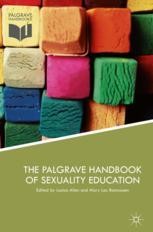

LGBT History month is clearly relevant to the way that we think about sexuality broadly, and to the way that we think about LGBT issues in the past and in the present. The Palgrave Handbook of Sexuality Education, edited by Louisa Allen and Mary Lou Rasmussen, reflects recent debates in relation to sexuality education, which are also pertinent to the way in which LGBT History month is understood and celebrated.
Kate Fisher, Jen Grove, and Rebecca Langlands’ discussion of ‘Sex and History’: Talking Sex with Objects from the Past, might seem the most obvious connection to History Month in our edited collection. For Fisher et al, museums provide a way of engaging young people in ways that can assist teachers and students in having more open conversations about issues like consent and pornography. This chapter is a great starting point for those wanting resources that are relevant to teaching about LGBT history in secondary PSHE. This is particularly pertinent as it turns out that LGBT History month in 2017 is looking specifically at citizenship, Personal, Social and Health Education, and Law. All these subjects lend themselves to the interdisciplinarity afforded by an historical approach.
Several pieces in our collection also speak to the issue of how to address issues related to sexuality, including LGBT sexualities, in ways that are open to religious and cultural diversity. Mary Lou Rasmussen’s chapter Faith, Progressive Sexuality Education, and Queer Secularism, attends to the problem of “queer secularism” – a belief that LGBT issues are predominantly associated with the absence of religion, while the presence of religion might be seen to lead to the exclusion of LGBT issues. Neither of these assumptions is true. LGBT History is also a history of religious and cultural difference. This problem of seeing religion and sexuality as oppositional is one that emerges in many nations that might be understood as secular (or as Joan Scott write “sexular”) – places where sexual freedom might be seen to trump religious freedom, or where the two freedoms might be viewed as mutually exclusive.
In Teaching Sexuality, Teaching Religion, Heather Shipley illustrates young people’s histories of living intersectionally with cultural, religious and sexual difference in Canada. She makes suggestions for how sexuality education curriculum might better reflect this intersectionality. In A Radical Plurality Louisa Allen and Kathleen Quinlivan offer a different way forward in terms of generating understanding of cultural and religious difference in the sexuality education classroom. This approach doesn’t think about culture and religion as bodies of knowledge, but rather as inhabiting a place in the bodies of people, books, histories and feelings in the space of sexuality education and beyond. Akin to LGBT history month, sexuality education has many meanings, and provokes numerous intra-actions that it is not really possible to anticipate at the beginning of the month. But that is part of the pleasure of teaching sexuality education, learning about LGBT History, and, hopefully, of engaging with this Handbook.

Louisa Allen is Professor in the Faculty of Education and Social Work at the University of Auckland, New Zealand. She specialises in research in the areas of sexualities, youth, gender and schooling, and innovative research methodologies that seek to engage hard-to-reach research populations and examines these areas most recently through the lenses of queer and feminist new materialist theoretical frameworks.
 Mary Lou Rasmussen is Professor at the Australian National University. Her research focuses on building transdisciplinary understanding of sexuality and gender across diverse lifeworlds, taking account of issues related to sexual citizenship, cultural and religious difference, and technologies of sexuality, education and health.

Follow the Topic
-
Palgrave Macmillan
Palgrave Macmillan is a world-class publisher of books and journals with more than 175 years’ experience in the Humanities and Social Sciences.

Introducing: Social Science Matters
Social Science Matters is a campaign from the team at Palgrave Macmillan that aims to increase the visibility and impact of the social sciences
Continue reading announcement



Please sign in or register for FREE
If you are a registered user on Research Communities by Springer Nature, please sign in