Metal‑in‑Zeolite Catalysts Poised to Power Clean‑Energy Breakthroughs


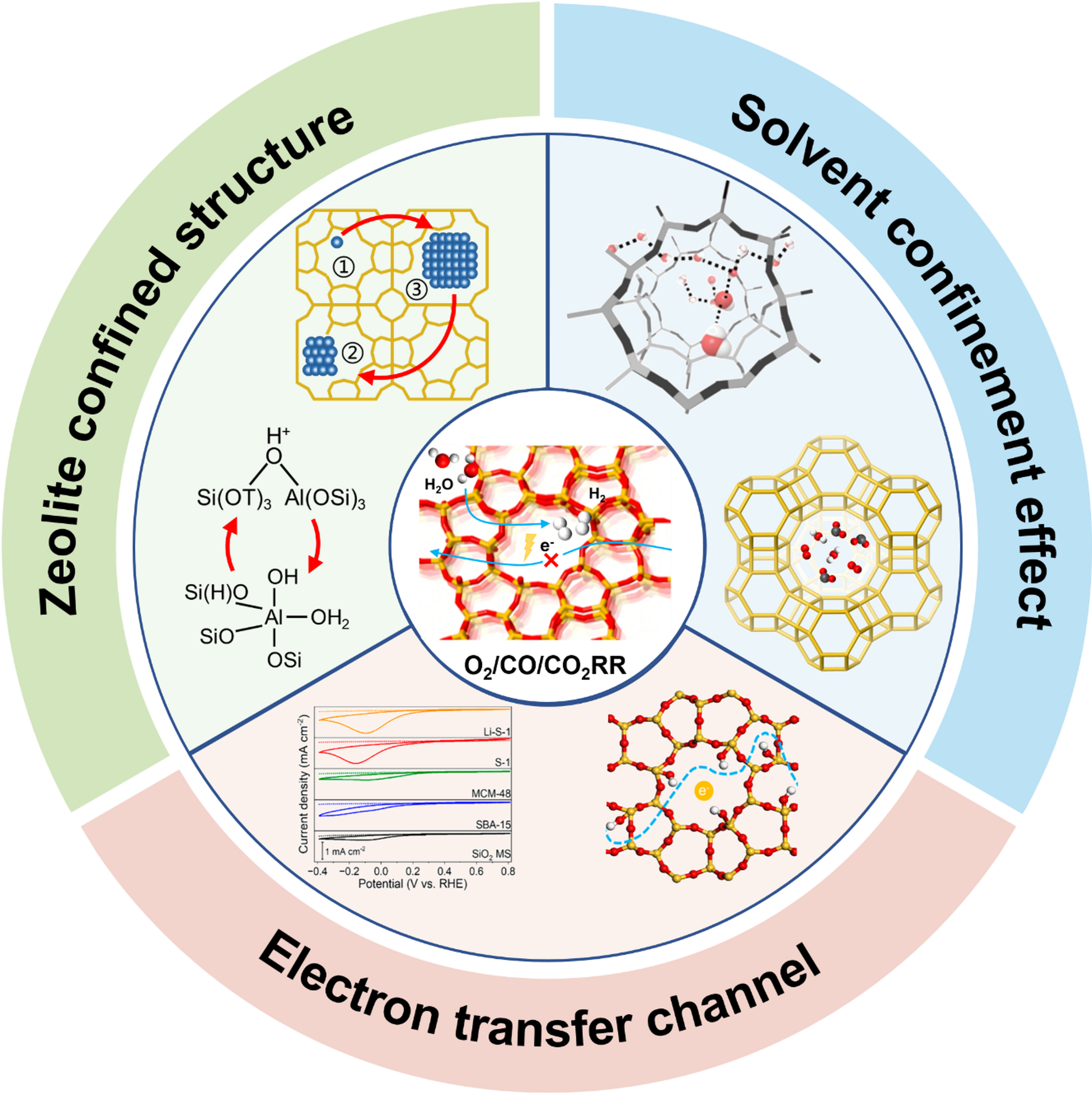

In this review, we present recent advances in metal‑in‑zeolite (MZ) catalysts, a class of materials that leverage the unique confinement effects of zeolite frameworks to stabilize active metal species, regulate reaction pathways, and enable electrocatalytic transformations under mild conditions. By integrating progress in synthesis, structural characterization, and mechanistic understanding, we highlight how MZ catalysts can significantly enhance reactions such as CO₂ reduction, oxygen reduction, and CO conversion, and how these systems are poised to contribute to next‑generation clean‑energy technologies.
Key Insights
- Confinement‑driven stability and selectivity
Zeolite micropores afford atomic‑level control over metal dispersion, oxidation state, and electronic structure, improving activity and product selectivity relative to conventional carbon supports.
- Multiple incorporation pathways: framework
Substituted, ion‑exchanged, and metal‑encapsulated configurations allow tailoring of catalytic centers for targeted electrocatalytic reactions.
- Mechanistic clarity via advanced characterization
In‑situ XAS, Raman, STEM, and solid‑state NMR reveal metal‑site evolution and key intermediates with atomic‑level sensitivity.
- Demonstrated performance
Representative systems include InSn@SnY for CO2‑to‑formic‑acid (98.2% FE) and Co@S‑1 for selective two‑electron ORR to H2O2 (96% FE).
Significance
Our assessment indicates that MZ catalysts provide a robust platform for energy‑efficient, selective, and scalable electrocatalytic processes. Tunable microporous environments and strong metal–framework interactions enable precise control of active sites and reaction environments, supporting future carbon‑neutral chemical transformations and renewable‑energy conversion systems.
Authors & Affiliations
Xiaoyang Han — College of Materials Science and Engineering, Zhengzhou University
Wenfu Yan — College of Chemistry, Jilin University
Jihong Yu — College of Chemistry, Jilin University; International Center of Future Science, Jilin University (now at Beijing Normal University)
Corresponding Authors
Qiang Zhang
Email: qiangz@jlu.edu.cn
Affiliation: College of Chemistry & International Center of Future Science, Jilin
Jia‑Nan Zhang
Email: zjn@zzu.edu.cn
Affiliation: College of Materials Science and Engineering, Zhengzhou
How to Cite This Article
Han, X., Zhang, Q., Yan, W., Zhang, J‑N., & Yu, J. (2026). Challenges and perspectives of metal‑in‑zeolite catalysts for electrocatalysis. Catal, 2, 8. https://doi.org/10.1007/s44422‑026‑00016‑y
Follow the Topic
-
Catal
Catal is an open access journal covering full spectrum of catalysis critical advances. From biocatalysts to heterogeneous catalysts, it integrates fundamental and applied sciences. Catal offers a primary platform for researchers and practitioners in the field.

Related Collections
With Collections, you can get published faster and increase your visibility.
Porous Materials for Sustainable Green Catalysis
The advancement of our collective understanding in the field of porous materials for sustainable green catalysis is crucial as we face urgent environmental challenges and the need for sustainable energy solutions. The integration of porous materials into catalytic processes has opened new avenues for improving efficiency, selectivity and stability while minimizing waste. Significant advances have been made, including the development of zeolites, mesoporous materials, metal-organic frameworks (MOFs) and covalent organic frameworks (COFs), which have demonstrated remarkable catalytic performance in various reactions.
Future research holds immense potential, with speculations ranging from the design of novel porous materials with tailored properties to their application in industrial catalysis, biocatalysis, H2 production and carbon capture technologies. By continuing this research, we can drive progress toward achieving Sustainable Development Goals (SDGs), particularly in clean energy (SDG 7) and climate action (SDG 13), ultimately fostering a sustainable future for our planet.
We invite researchers to contribute to this special Collection by submitting research articles, brief communications, perspectives, reviews, and analyses.
Topics of interest include but are not limited to:
- Synthesis of porous materials
- Catalytic performance evaluation
- Green synthesis methods
- Application in environmental remediation
- CO2 conversion technologies
- Biocatalysis in porous matrices
- Design of multifunctional porous catalysts
- Mechanistic studies of catalysis
Publishing Model: Open Access
Deadline: Dec 31, 2026
National Catalysis Conference 2025
The 22nd National Catalysis Conference, held in December 2025 in Xiamen, China, stands as the largest national academic event in the field of catalysis, bringing together leading scientists from academia and industry to discuss frontier research and emerging technologies across catalytic science.
In collaboration with several internationally recognized researchers from Xiamen University - the main organizer of the conference - Catal will publish a Special Issue featuring selected contributions from the meeting. This joint effort ensures high academic standards and showcases the scientific breadth and excellence presented at the conference.
Potential topics include, but are not limited to:
• Catalytic materials
• Thermocatalysis
• Electrocatalysis
• Biomass and CO₂ conversion
• Industrial catalysis
• Theoretical and computational catalysis
Publishing Model: Open Access
Deadline: Dec 31, 2026