Ultra Low Loading Palladium Catalysts Enable Selective and Scalable Synthesis of E-Alkyl Alkenes

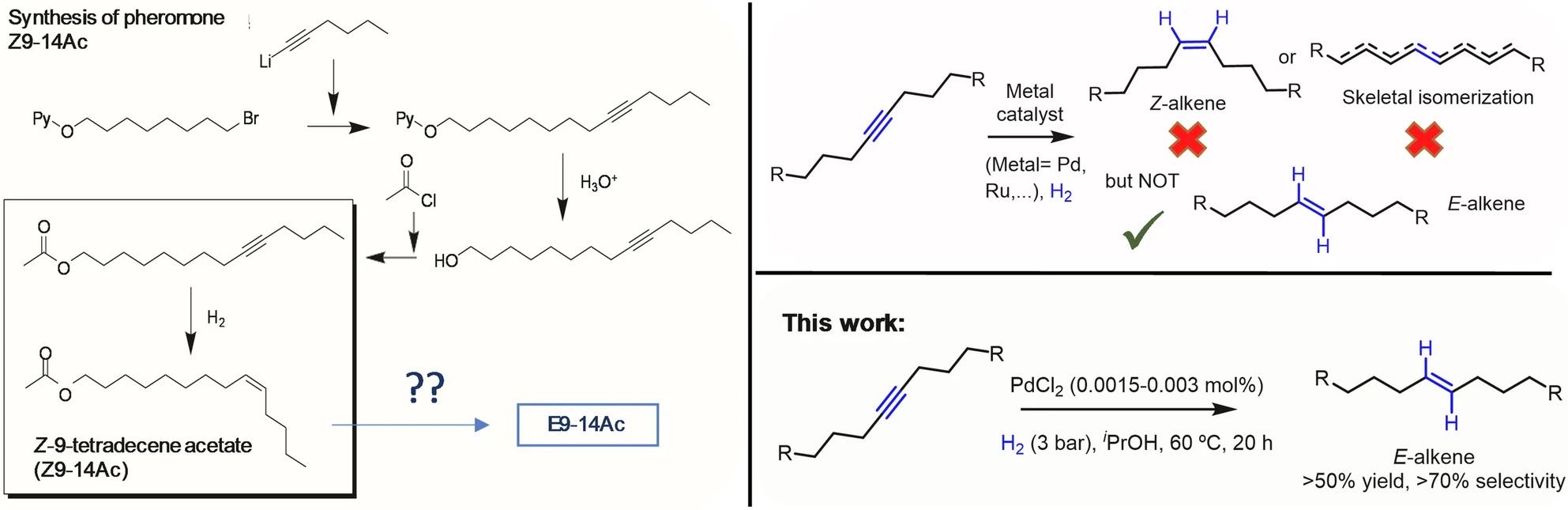
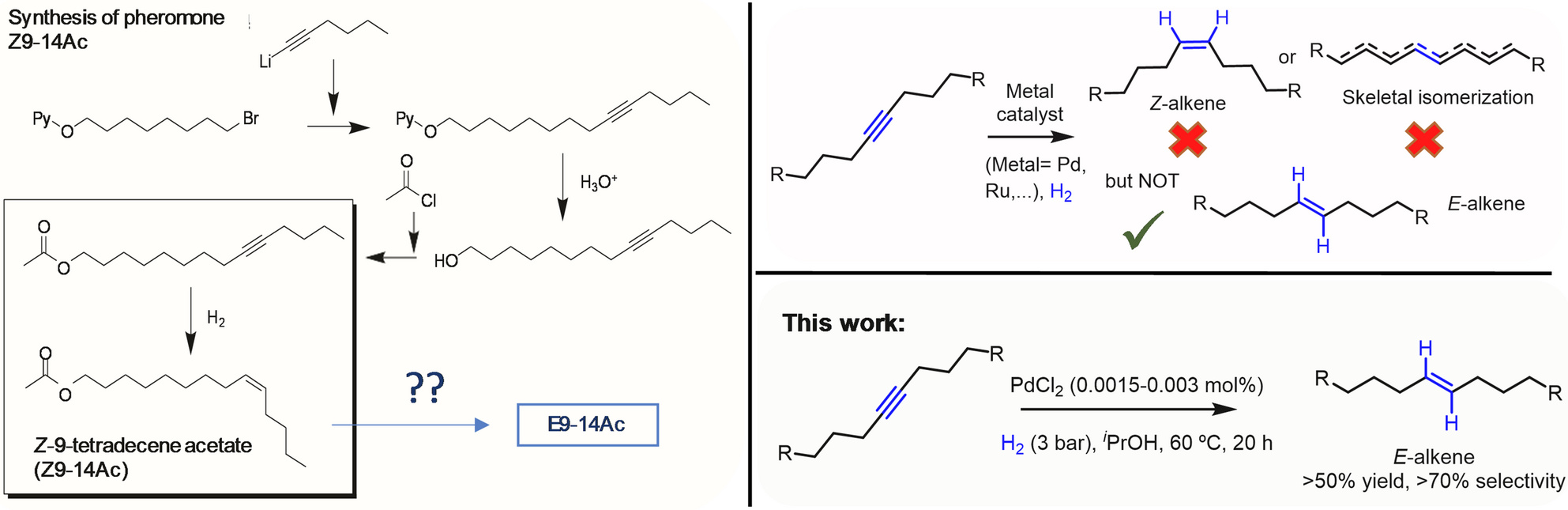

In our recent study, we report a practical and industrially viable catalytic methodology that enables the direct synthesis of E‑alkyl alkenes from internal alkynes using only parts‑per‑million (ppm) levels of palladium (Pd). By employing simple Pd salts such as PdCl₂—in the absence of ligands and at exceptionally low metal loadings—we demonstrate that ultrasmall Pd(0) clusters formed in situ can drive both the Z‑selective semi‑hydrogenation of internal alkynes and the subsequent Z/E isomerization, with minimal side reactions and excellent stereocontrol.
Our findings address a long‑standing synthetic challenge: unlike Z‑alkenes, which can be routinely accessed via classical Lindlar catalysis, the catalytic preparation of E‑alkyl alkenes from alkynes has remained largely inaccessible, forcing industry to rely on cost‑intensive and environmentally burdensome stoichiometric reagents. The methodology presented in our work offers an unprecedented alternative—both economical and scalable—that is immediately applicable to the pheromone industry, where stereochemical purity directly impacts biological activity and commercial viability.
Key Insights
- Ultrasmall Pd(0) clusters are the true catalytic species
Through HAADF‑STEM, XANES, and EXAFS analyses, we confirm that ppm‑level PdCl₂ is reduced under hydrogenation conditions to generate sub‑nanometric Pd(0) clusters and individual atoms, which catalyze both key reaction steps while suppressing unwanted skeletal isomerization and over‑hydrogenation.
- Solvent dictates the E‑selectivity
We find that isopropanol (iPrOH)—unlike ethanol—triggers rapid Z/E isomerization, enabling the formation of E‑alkenes in synthetically meaningful yields. Under optimized conditions, E‑alkene selectivity reaches 53% from the model pheromone precursor, with negligible alkane formation.
- Ligand‑free catalysis at ppm metal loading
PdCl₂ performs effectively at 0.0015–0.006 mol%, drastically lower than traditional heterogeneous systems. These minimal loadings significantly lower costs and enhance sustainability without compromising reactivity.
- Exceptional selectivity for alkyl vs. aromatic alkynes
The catalyst system displays an unusual capability: while internal alkyl alkynes are selectively converted to E‑alkenes, aromatic alkynes show no Z/E isomerization, even though they readily undergo semi‑hydrogenation. This selectivity is rare in Pd‑catalyzed hydrogenation chemistry.
- Scalable to industrial conditions
We validate the method at 1‑kg scale, achieving 94% yield of the Z‑alkene intermediate without unwanted by‑products using standard reactor setups and low H₂ pressures (1.5–4 bar). These results demonstrate the robustness and transferability of the catalytic system.
- Electrochemical compatibility
Beyond thermal catalysis, the Pd system also functions under electrochemical conditions, enabling room‑temperature synthesis of E‑alkenes with 67% selectivity—eliminating the need for external hydrogen gas.
Significance of This Advancement
Our methodology offers a cost‑effective, scalable, and sustainable solution for producing E‑alkenes—an advance with immediate implications for agrochemical pheromone synthesis, where E‑isomers often command significantly higher value but are difficult to produce selectively.
Economic analysis indicates:
- Up to 60% reduction in production cost per kg of E‑alkene or Z‑alkene compared with Lindlar/Na‑NH₃ methods.
- 77.8% reduction in hydrogenation‑related cost when replacing Lindlar catalyst with PdCl₂ at ppm loading.
- Recyclability of the Pd catalyst, further improving sustainability metrics.
Taken together, these results establish a new paradigm for the catalytic synthesis of E‑alkyl alkenes and open opportunities for broader industrial applications beyond pheromones.
Authors & Affiliations
Miquel Molina–García †
- Francesco Orlando †
- Ramón Manzorro
- Juan C. Hernández–Garrido
- Vlad Martin‑Diaconescu
- Judit Oliver‑Meseguer
- Marta Mon*
- Jordi Aragón
- Antonio Leyva–Pérez*
Affiliations:
- Instituto de Tecnología Química (Universitat Politècnica de València–CSIC), Valencia, Spain
- Universidad de Cádiz, Spain
- ALBA Synchrotron Light Facility, Spain
- SEDQ Healthy Crops SL., Barcelona, Spain
Corresponding Authors
-
Marta Mon*
Email: marmoco@itq.upv.es -
Antonio Leyva–Pérez*
Email: anleyva@itq.upv.es
How to Cite This Article
Molina–García, M., Orlando, F., Manzorro, R., Hernández‑Garrido, J. C., Martin‑Diaconescu, V., Oliver‑Meseguer, J., Mon, M., Aragón, J., & Leyva–Pérez, A. (2026).
Synthesis of alkyl trans‑alkenes from alkynes by catalytic semi‑hydrogenation reaction with parts‑per‑million of palladium: application to pheromone synthesis.
Catal, 2, 9. https://doi.org/10.1007/s44422‑025‑00015‑5
Follow the Topic
-
Catal
Catal is an open access journal covering full spectrum of catalysis critical advances. From biocatalysts to heterogeneous catalysts, it integrates fundamental and applied sciences. Catal offers a primary platform for researchers and practitioners in the field.

Related Collections
With Collections, you can get published faster and increase your visibility.
Porous Materials for Sustainable Green Catalysis
The advancement of our collective understanding in the field of porous materials for sustainable green catalysis is crucial as we face urgent environmental challenges and the need for sustainable energy solutions. The integration of porous materials into catalytic processes has opened new avenues for improving efficiency, selectivity and stability while minimizing waste. Significant advances have been made, including the development of zeolites, mesoporous materials, metal-organic frameworks (MOFs) and covalent organic frameworks (COFs), which have demonstrated remarkable catalytic performance in various reactions.
Future research holds immense potential, with speculations ranging from the design of novel porous materials with tailored properties to their application in industrial catalysis, biocatalysis, H2 production and carbon capture technologies. By continuing this research, we can drive progress toward achieving Sustainable Development Goals (SDGs), particularly in clean energy (SDG 7) and climate action (SDG 13), ultimately fostering a sustainable future for our planet.
We invite researchers to contribute to this special Collection by submitting research articles, brief communications, perspectives, reviews, and analyses.
Topics of interest include but are not limited to:
- Synthesis of porous materials
- Catalytic performance evaluation
- Green synthesis methods
- Application in environmental remediation
- CO2 conversion technologies
- Biocatalysis in porous matrices
- Design of multifunctional porous catalysts
- Mechanistic studies of catalysis
Publishing Model: Open Access
Deadline: Dec 31, 2026
National Catalysis Conference 2025
The 22nd National Catalysis Conference, held in December 2025 in Xiamen, China, stands as the largest national academic event in the field of catalysis, bringing together leading scientists from academia and industry to discuss frontier research and emerging technologies across catalytic science.
In collaboration with several internationally recognized researchers from Xiamen University - the main organizer of the conference - Catal will publish a Special Issue featuring selected contributions from the meeting. This joint effort ensures high academic standards and showcases the scientific breadth and excellence presented at the conference.
Potential topics include, but are not limited to:
• Catalytic materials
• Thermocatalysis
• Electrocatalysis
• Biomass and CO₂ conversion
• Industrial catalysis
• Theoretical and computational catalysis
Publishing Model: Open Access
Deadline: Dec 31, 2026